

Translated by Michel Austin
© Michel Austin



|
Translated by Michel Austin © Michel Austin
|
|
This page is also available in French

 Preface
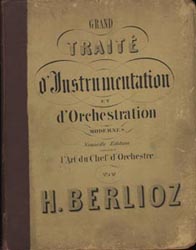
Berlioz’s Treatise on Instrumentation and Modern Orchestration is one of his most important and influential works. It was widely studied in his lifetime and after his death, and remains a landmark in the history of the symphony orchestra. Though there have been numerous improvements in the manufacture and playing of instruments since the composer’s time, especially with wind and brass instruments, the work still retains much of its value. It is a historical document on instrumental practice in the time of Berlioz, and also provides a commentary on Berlioz’s own use of the orchestra. And it shows simultaneously two different but complementary aspects of Berlioz the composer. On the one hand there is Berlioz the practical musician, master of his craft and familiar with all the requirements of music-making, with a deep knowledge and understanding of the technique of every instrument. This he acquired over many years of organising, rehearsing and conducting concerts, and through associating with numerous professional musicians and instrument makers. On the other hand there is Berlioz the creative artist with an inquisitive mind, gifted with an exception musical ear and a no less exceptional imagination. For him the technical study of instruments was not an end in itself but a means of opening up their expressive potential, both as individual instruments in their own right and in combination with others.
The work first appeared in a series of 16 articles published in Paris in the Revue et gazette mausicale between 21 November 1841 and 30 December 1842 (cf. CG no. 759; Critique musicale IV pp. 555-60, 567-79, 581-5, 603-7; V pp. 1-15, 19-21, 51-62, 101-4, 141-52, 159-69, 171-77, 179-84). These articles provided the basic framework of the treatise, but Berlioz felt they were insufficient as they stood, and even while they were in course of publication he decided to revise and enlarge his original text and turn it into a full-scale book. This involved in particular adding a very large number of musical examples to the original text; a publisher was found (Schonenberger) and the work eventually appeared towards the end of 1843 (CG nos. 772, 775, 791). The work played an important part in his first trip to Germany: he offered the dedication of the treatise to the King of Prussia in Berlin, who accepted it. The King became one of Berlioz’s warmest admirers in Germany, and later thanked Berlioz for the dedication in an autograph letter which is extant (see the page on Berlioz and Berlin, and the letters CG nos. 820, 823ter, 873, 877, 891bis, 902). Together with the original publication in Paris, translations appeared in English, Italian (CG no. 802) and German. Berlioz also contacted a publisher in St Petersburg (CG no. 775); though nothing came of this, from the start the work did reach a large audience.
Over a decade later Berlioz revised the work and a second edition appeared in 1855, which was also translated into other European languages and was no less influential (cf. CG no. 2676). A major addition to the work was a new concluding chapter On the Art of Conducting, which formed a natural sequel to the preceding chapter on the orchestra; it drew on Berlioz’s long experience of organising and conducting concerts in France and abroad. The full text of this chapter is reproduced in the original French on a separate page of this site.
The present page has been compiled using an 1876 reissue by the publisher Henri Lemoine in Paris of the original second edition of the work. A new edition of the original Treatise was published in 2003 as volume 24 of the New Berlioz Edition. The Treatise is also available in an up-to-date English translation with detailed commentary: Hugh Macdonald, Berlioz’s Orchestration Treatise. A Translation and Commentary, Cambridge University Press, 2002, xxxix + 388 pages.
In his first chapter Berlioz defines his aims as follows:
The purpose of the present work is […] first to indicate the range of some essential parts of the mechanism of the instruments, then to proceed to the study, hitherto much neglected, of the nature of the timbre, the peculiar character and expressive potential of each of them, and finally to that of the best methods known of combining them in an appropriate manner.
Ideally, the Treatise should be reproduced in full as written by the composer. But this, though not impossible, would be a difficult and time-consuming task, not so much because of the length of the text, but above all because of the many hundreds of musical examples that form an integral part of the work, some quite short but others running to many pages in full score. Many of the passages are taken from the works of other composers, especially Gluck, Beethoven, and Weber among earlier composers, and Meyerbeer among contemporaries, or from Berlioz’s own music. Notating and integrating these into the text is a difficult task. Many of the purely orchestral examples cited by Berlioz are actually available elsewhere on this site, in the two sections entitled Berlioz: Predecessors and Contemporaries and Berlioz Music Scores, in Scorch-Sibelius format and in pdf files. References have been given in the relevant sections of the text to these files when they are available.
The excerpts from the Treatise reproduced in this page represent only a selection from a much longer text. The following points should be noted:
The Treatise was Berlioz’s major work on musical instruments and their use, but his interest in the subject was demonstrated in other writings as well. See for example the numerous comments he made on the instrumental practices current in Germany and central Europe during his trips of 1842-3 and 1845-6, which he wrote down in the Letters he published after his trip, in particular the 7th letter of the first trip and the 5th and 6th of the second. Comparison may also be made with the Report written by Berlioz on the musical instruments exhibited in 1851 at the Great Exhibition in London, and available on this site both in the original French and in an English translation. See also the reports he published on the instruments exhibited at the 1855 Universal Exhibition in Paris (Journal des Débats, 9 January, 12 January and 15 January 1856).
Copyright notice: The texts, photos, images and musical scores on all pages of this site are covered by UK Law and International Law. All rights of publication or reproduction of this material in any form, including Web page use, are reserved. Their use without our explicit permission is illegal.

Contents of this page:
IntroductionAt no time in the history of music has so much been said as at present about Instrumentation. The reason for this probably lies in the development of this branch of art, and perhaps also in the proliferation of critical opinions, varied doctrines, pronouncements whether reasonable or unreasonable, spoken or written, which is elicited by even the slightest works of the most insignificant composers.
Great importance seems to be attached nowadays to this art of instrumentation, which was unknown at the start of the previous century; sixty years ago, many who were regarded as true friends of music tried to hinder its development. Attempts are being made at this moment to block the progress of music on other fronts. This has always been the case, and there is therefore no cause for surprise. At first some would only accept as music sequences of consonant harmonies, interspersed with a few dissonant suspensions. When Monteverdi tried to add to them the dominant seventh chord without preparation, he was assailed with criticism and invective of every kind. But once the dominant seventh was accepted after all, together with suspended dissonances, those who called themselves erudite came to look down on any composition harmonised in a way that was simple, gentle, clear, sonorous and natural. To please these people it was absolutely essential to saturate compositions with major or minor seconds, sevenths, ninths, fifths and fourths, used without reason or purpose, unless it is assumed that the point of this harmonic style is to offend the ear as often as possible. These musicians had developed a taste for dissonant chords, rather like certain animals have a taste for salt, prickly plants and thorny shrubs. This was reaction taken to exaggeration.
Behind all these fine combinations melody was non-existent. When it did make its appearance, there was an outcry: art was being degraded and ruined, they protested, hallowed rules were being consigned to oblivion, etc. etc. Clearly all was lost. Melody did all the same take hold, but the reaction over melody was not long in coming. There were fanatics of melody, for whom every piece of music with more than three parts was unbearable. There were those who insisted that most of the time the melody should only be accompanied by a bass, and that the listener should have the satisfaction of supplying himself the notes missing from the chords. Some went further and wanted to dispense altogether with any accompaniment, pretending that harmony was a barbarous invention.
Then came the turn of modulations. At the time when the practice was to modulate only to related keys, the first to venture to a distant key was greeted with abuse, as he could have expected. Whatever the effect of this new modulation, it was severely censured by the masters. It was no good for the innovator to say: « Listen to it carefully: see how gently it is introduced and how appropriate it is; it fits in neatly with what follows and what precedes; how exquisite it sounds! — THAT IS NOT THE POINT, he was told, this modulation is forbidden, it must therefore be avoided! ». On the contrary, that is the point, in everything and everywhere. Unrelated modulations soon appeared in great works, and led to effects that were as felicitous as they were unexpected. Almost at once a new kind of pedantry arose: there were some who felt it beneath their dignity to modulate to the dominant, and in the merest Rondo they would wander cheerfully from the key of C natural to that of F sharp major.
Time has gradually put everything back in its place.
A distinction is now drawn between use and abuse, reactionary vanity and pig-headed obstinacy, and there is general agreement nowadays on the subject of harmony, melody and modulations: what results in a good effect is good, and what results in a bad one is bad. The authority of a hundred old men, be they all aged 120, should not persuade us to find ugly what is beautiful, nor beautiful what is ugly.
As for instrumentation, expression and rhythm, that is another matter. Their turn to be noticed, rejected, accepted, repressed, liberated and exaggerated only came later. Hence it has not as yet been possible for them to reach the point of the other branches of the art of music. Let us just say that instrumentation is at the head of the march and has reached the stage of exaggeration.
It takes a long time to discover the Mediterraneans of music, and longer still to learn to navigate them.
 Table of contents
Top of the page
Chapter 1Any sounding body that is used by a composer is a musical instrument. Hence the following classification of the means currently available to him:
| STRINGED INSTRUMENTS. | Strings set in vibration by a bow | The Violin, Viola, Viola d’amore, Cello and Double-bass. |
| Plucked strings | The Harp, Guitar and Mandolin. | |
| With keyboard | The Piano. | |
| WIND INSTRUMENTS. | With reeds | The Oboe, Cor anglais, Bassoon, Tenoroon, Contrabassoon, Clarinet, Basset Horn, Bass Clarinet, Saxophone. |
| Without reeds | Flutes, large and small. | |
| With keyboard | The Organ, Melodium-Organ, Concertino. | |
| Brass instruments with a mouthpiece | The Horn, Trumpet, Cornet, Bugle, Trombone, Ophicleide, Bombardon, Bass Tuba. | |
| Wood instruments with a mouthpiece | The Russian Bassoon and Serpent | |
| The voices of men, women, children and castrati | ||
| PERCUSSION INSTRUMENTS. | With a fixed and definite pitch | The Timpani, Antique Cymbals, Chime, Glockenspiel, Keyboard Harmonica, Bells. |
| With an indefinite pitch and which only produce sounds with various characteristics | The Drum, Bass Drum, Tambourine, Cymbals, Triangle, Tam-tam, "Jingling Johnny". |
The art of instrumentation consists in using these various sound elements and applying them, either to colour the melody, harmony and rhythm, or to produce effects that are sui generis (whether motivated by an expressive intention or not), independently of the part played by the three other musical forces.
From a poetical point of view, this art is as little susceptible of being taught as that of inventing beautiful melodies, fine successions of chords or rhythmic forms that have originality and power. One can learn what is suitable for the various instruments, what can or cannot be played on them, what is easy or difficult, and what sounds well or not. One can also say that one particular instrument is more suitable than another to produce certain effects or to express certain feelings. As for grouping them together, whether in small or large ensembles, and the art of combining and blending them so that the sound of some is modified by others, or in order to draw from the ensemble a special sound that none of them could produce in isolation or when combined with instruments of the same family — for that the only viable approach is to draw attention to the results obtained by the masters and indicate the methods they used. These results will probably be modified in a thousand other ways, good or bad, by composers who adopt them.
The purpose of the present work is therefore first to indicate the range of some essential parts of the mechanism of the instruments, then to proceed to the study, hitherto much neglected, of the nature of the timbre, the peculiar character and expressive potential of each of them, and finally to that of the best methods known of combining them in an appropriate manner. But to try to go beyond this would be to trespass on the territory of inspiration, where only genius is capable of making discoveries, because genius alone is able to range over it.
Table of contents
Top of the page
Stringed instruments The violin
[…] The tremolo, played on one or two strings by massed violins produces several excellent effects; it expresses anxiety, agitation, or terror when played piano, mezzo forte or fortissimo on one or two of the G, D, or A strings and when pitched no higher than the middle B flat. It has a stormy and violent character when played fortissimo on the middle range of the A and E strings. But it becomes ethereal and seraphic when used in several parts and is played pianissimo on the higher notes of the E string. One may mention here that the usual practice in the orchestra is to divide the violins into two groups, first and second, but there is no reason why they should not each be subdivided further into two or three parts, depending on what the composer is trying to achieve. […]
The tremolo on the lower and middle range of the third and fourth strings is much more distinctive in fortissimo if the bow presses the strings near the bridge. In large orchestras and when the players are willing to take the trouble to play correctly, it results in a sound which is rather like that of a fast and powerful waterfall. The style of playing must be indicated by the words: near the bridge. […]
Harmonics [...] have a peculiar quality of mysterious softness, and the extreme height of some of them gives to the violin a vast upper range. […] The composer may write them in two, three or even four parts, depending on the number of violin parts. The effect produced by such sustained chords is very remarkable, if the subject of the piece calls for it and it integrates well with the rest of the orchestral writing. I used them for the first time in three parts, in the scherzo of a symphony [Romeo and Juliet, Queen Mab scherzo, bar 361 and following], above a fourth, non-harmonic, violin part which consists of a continuous trill on the lower note. The extreme delicacy of the harmonics is enhanced in this passage by the use of mutes; with the sound thus reduced the notes come from the highest regions of the musical scale, which could hardly be reached by the use of normal violin sounds. […]
Mutes are small devices made of wood which are placed on the bridge of stringed instruments to reduce their sonority, and which give them at the same time a sad, mysterious and gentle character; this can be used to good effect in every kind of music. Mutes are normally used in slow pieces, but they are no less effective for quick and light figuration when the subject of the music calls for it, or for accompaniments in an urgent rhythm. […]
Pizzicato (plucked strings) is also widely used with bowed instruments. The resulting sounds produce accompaniments which singers appreciate, as they do not cover their voices. They can also be used to excellent effect in symphonic music, even in vigorous passages, whether played by all the string sections together, or by only one or two parts.
Here is a delightful example of the use of pizzicato in the second violins, violas and basses, while the first violins play arco. In this passage the contrasting sounds blend in truly wonderful fashion with the melodic sighs of the clarinet and enhance their expressiveness (Example: Beethoven, 4th symphony, 2nd movement, bars 26-34) [...]
When pizzicato is used in a passage played forte it is in general necessary that it should be written neither too high nor too low, since the highest notes are thin and dry in sound, and the lower ones are too dull. […] Plucked chords, with two, three or four notes, are also useful in fortissimo passages; the single finger that violin players use crosses the strings so quickly that they seem to be struck all at once and vibrate almost simultaneously. For accompaniments pizzicato figures played piano are always graceful in effect; they relax the listener and when used with discretion give variety to the orchestral texture. It is likely that in future far more original and arresting effects will be produced with pizzicato than is the case nowadays. Since violinists do not regard pizzicato as an integral part of the art of violin playing they have hardly studied it. Up till now they have only used the thumb and the index finger for plucking, and the result is that they are unable to play passages or arpeggios involving more than semiquavers in common time and at a very moderate tempo. But if they were to put their bow aside and used the thumb and three fingers, with the right hand supported by the little finger resting on the body of the violin, as is done when playing the guitar, they would soon be able to play with ease and at speed passages such as the following, which at the moment are impossible. (Examples). The double or triple repetition of the upper notes in the last two examples is made very easy by using in succession the index finger and the third finger on the same string.
Tied grace notes are also feasible in pizzicato playing. The following passage from the Scherzo of Beethoven’s (fifth) Symphony in C minor, which has such grace notes, is always executed very well. (Example: 5th Symphony, 3rd movement, bars 302-316). […]
One common practice to give great power to a passage for the violins is to have the first violins doubled by the seconds playing an octave below; but if the passage is not written too high it is much better to have all the violins playing in unison. The effect then becomes incomparably more powerful and beautiful. The electrifying impact of the end of the first movement of Beethoven’s [Fifth] Symphony in C minor is due to a unison of violins. In such a case when the violins are playing in unison the composer may want to increase their power even further, and has them doubled by the violas playing an octave below them. But this doubling in the lower part is too weak and out of proportion to the upper part, and the result is a superfluous buzzing sound, which tends to obscure rather than enhance the vibration of the higher notes on the violins. If the viola part cannot be written in a distinctive way it is better to use it to add volume to the sound of the cellos by having both parts written in unison and not an octave apart (as far as the lower range of the instrument permits). This is what Beethoven has done in the following passage (Example: Symphony no.5, 1st movement, bars 398-423) [...]
Stringed instruments are the essential foundation of any orchestra. They possess the greatest expressive power and an unquestionable variety of timbres. The violins in particular can express a vast range of nuances that seem at first sight incompatible. A violin section has power, lightness and grace, it can express sombre or joyful feelings, reverie and passion. It is just a matter of knowing how to let them speak. There is incidentally no need, as there is for wind instruments, to calculate the duration of a held note, or to provide them with pauses from time to time. The composer can be sure that they will not run out of breath. Violins are faithful, intelligent, active and tireless servants.
Slow and gentle melodies, which too often are given to wind instruments, are never better expressed than by a mass of violins. Nothing can compare with the penetrating gentleness of the E string of some twenty violins in the hands of experienced players. It is the orchestra’s real feminine voice, at once passionate and chaste, heart-rending and gentle; it can weep, cry and lament, or it can sing, pray and dream, or it can break out in joyful strains, like no other instrument. An imperceptible movement of the arm, an unsuspected emotion on the part of the player, might produce no noticeable effect when played by a single violin. But when multiplied by many instruments playing in unison, it results in magnificent nuances and irresistible surges of emotion that penetrate to the depth of the heart.
[The part played by violins in Berlioz’s orchestral writing is of course extremely extensive and varied: virtually Berlioz’s entire output could be cited. A few random examples: Symphonie fantastique, 1st, 2nd and 3rd movements; Romeo and Juliet, 2nd movement, bar 1 and following; overture Le Corsaire, bar 1 and following; for pizzicato, which Berlioz uses more than all his predecessors, Romeo and Juliet, 2nd movement, bar 81 and following, bar 187 and following; a special effect, col legno, in the Symphonie fantastique, 5th movement, bar 444 and following]
Table of contents
Top of the page
The viola[…] Among all orchestral instruments, the viola’s excellent qualities have suffered the longest neglect. The viola is as agile as the violin; its lower strings have a peculiarly penetrating quality; its higher notes are distinctive and have a sad and passionate intensity; in general its tone has a quality of deep sadness which distinguishes it from all other stringed instruments. And yet for a long time it has been left idle, or used mostly for the lowly and pointless function of doubling the bass part an octave higher. There are several reasons for the unjust bondage of this noble instrument. To begin with the majority of last century’s masters did not know what to do with it, as they rarely wrote four real string parts. When they were unable to think straightaway of a few notes to fill in the chords they quickly fell back on the inevitable indication col basso, and did so in such a careless way that the result was sometimes an octave doubling of the bass line which was incompatible either with the harmony, or with the melody, or with both at once. Then it was not possible at the time to write for violas distinctive parts which required from the players a normal degree of proficiency. Viola players were always recruited from among rejected violin players. When a musician was not capable of performing adequately a violin part, he turned to the viola. As a result viola players were incapable of playing either the violin or the viola. I must admit that in our time this prejudice against the viola part has not been completely eliminated, and that even in the best orchestras there are still players who have not mastered the art of viola playing any better than that of the violin. But the drawbacks of tolerating this state of affairs are becoming increasingly obvious, and gradually the viola, like other instruments, will cease to be entrusted to any but competent hands. Its tone quality is so distinctive that it is not necessary in an orchestra to have exactly the same number of violas as of second violins. The expressive qualities of its tone stand out so clearly that in those very rare cases when composers of the past have given it a prominent role the instrument has never failed to live up to expectation. […]
[…] Méhul was captivated by the affinity between the sound of violas and the dreamy character of Ossianic poetry, and wanted to make constant use of them in his opera Uthal, to the complete exclusion of the violins. The result, according to contemporary critics, was unbearably monotonous and damaged the work’s success. It was on this occasion that Grétry exclaimed: ‘I would give a louis to hear the sound of an E string!’ In truth, the viola’s tone quality, which is so valuable when properly used and expertly contrasted with the tone of violins and other instruments, must inevitably become quickly wearisome: it is too lacking in variety and too tinged with sadness for it to be otherwise. Nowadays violas are often divided into first and second. In those orchestras, like that of the Opéra, where their numbers are about sufficient, there is no harm in doing this; but in others where there are hardly four or five violas, such a division can only be detrimental to an instrumental group which is already so weak in itself and which other groups always tend to overwhelm. It should be said that the majority of violas used in contemporary French orchestras do not have the right dimensions; they have neither the size nor consequently the tonal power of real violas, and are more or less violins fitted with viola strings. Musical directors should ban completely the use of these hybrid instruments, whose weak sound drains one of the most interesting parts of the orchestra of much of its colour and energy, especially in the lower notes.
When the cellos are playing a melody, it can sometimes be very effective to double them in unison with violas. The tone of the cellos then acquires a very rounded and pure quality without ceasing to predominate. One example is the theme from the slow movement of Beethoven’s (5th) Symphony in C minor. (Example: Symphony no. 5, second movement, bars 1-11)
[Examples in Berlioz: Symphonie fantastique, 3rd movement, bar 69 and following; Harold in Italy, passim; Romeo and Juliet, 4th movement, bar 369 and following; Roman Carnival overture, bar 37 and following; Royal Hunt and Storm from Les Troyens, bar 51 and following]
Table of contents
Top of the page
The cello[…] In orchestral writing the cellos are generally given the same part as the double-basses, which they then double an octave higher or in unison. But in very numerous cases it is better to separate them: this could be to give them to sing a melody or a melodic passage in their higher strings, or to write them below the double-basses to take advantage of the special sound of an open string or produce a special harmonic effect, or even to give them a part very similar to that of the double-basses, but with figuration faster than what the double-basses could manage correctly. […]
[…] The cello, in a section of eight or ten players, is essentially a melodic instrument, and the tone quality of its two higher strings (A and D) is one of the most expressive in the orchestra. Nothing has such voluptuous sadness as a mass of cellos playing in unison on the A string, and nothing is better suited to expressing tender and languorous melodies.
The cello excels also in melodies of a religious character; the composer must then select the string on which the passage should be played. The two lower strings, the C and G strings, have a smooth and deep sound which is admirably suited in such cases, but their low register means that they can only be given a bass line that is more or less melodic, while the true singing parts must be reserved for the higher strings. In the overture to Oberon Weber with rare felicity makes the cellos sing in their upper register, while two clarinets in A playing in unison sound their lower notes underneath. The effect is novel and arresting. [Example]
[Examples in Berlioz: Waverley overture, bar 30 and following; Symphonie fantastique, 3rd movement, bar 69 and following; Benvenuto Cellini overture, bar 67 and following; Romeo and Juliet, 3rd movement, bar 23 and following, 49 and following, 82 and following]
Table of contents
Top of the page
The double-bass[…] It is a common fault nowadays to write for this heaviest of instruments passages that are so fast that even cellos have difficulty in playing them. This has serious disadvantages. Double-bass players who are lazy or who really cannot cope with such difficult parts immediately give up and concentrate on simplifying the passage. But as they are not all of one mind on the harmonic importance of the various notes found in the passage, one player’s simplified version does not match that of another player, and the result is disorder and a dreadful confusion. This buzzing chaos, full of strange noises and hideous grunts, is completed or compounded by the other players, who are either more dedicated or more confident of their ability, and who labour in a fruitless attempt to perform the passage entirely as written.
Composers must therefore be very careful to ask from the double-basses only what is possible and where there is no doubt that the passage can be correctly played. This means that the old system of double-bass players who simplify their parts, a system widely adopted in the old instrumental school and exposed to the dangers we have indicated, is nowadays completely rejected. Provided the composer has not written anything that is unsuitable for the instrument, the player must perform the music as written, neither adding nor deleting anything. When the fault is the composer’s, he and his audience must bear the consequences, and the player does not have to answer for anything. [...]
Beethoven has also made use of these barely articulated notes (sc. of the double-basses), but in the opposite manner from the preceding example [Gluck, Orphée Act II], by stressing the first rather than the last note of each group. Such is the case with the passage from the storm of the Pastoral Symphony, which conveys so well the suggestion of a violent wind charged with rain and of the dull rumbling of a squall. It should be noted that in this example and in many other passages Beethoven has given to the basses low notes which they cannot play, and this suggests that the orchestra for which he wrote included double basses which could reach down to C an octave below the low C of the cellos, which are no longer found today. (Example: Pastoral Symphony, 4th movement, bars 45-70) [...]
[Examples in Berlioz: Symphonie fantastique, 1st movement, bars 12 and 14; Lélio, La harpe éolienne; Funeral March for the last scene of Hamlet, bar 39 and following, bar 87 and following]
Table of contents
Top of the page
The harp[…] The effect produced by harps – except in music that is intended to be heard at close quarters in a salon – is all the better when they are more numerous.
The notes, chords and arpeggios that they project across the orchestra and the chorus have exceptional splendour. There is nothing that is more appropriate for the idea of poetic festivals or religious celebrations than the sounds of a large number of harps when deployed in an imaginative way. When used in isolation or in groups of two, three, or four, it is strikingly the timbre of horns, trombones, and brass instruments in general that marries best with them. The lower strings (except for those at the lowest end of the range, which are loose and dull in tone) have a veiled, mysterious, and beautiful quality, but have hardly ever been used for anything but bass accompaniments in the left hand. This is a mistake. Admittedly harp players are not anxious to play whole pieces in these lower octaves; they are rather far from their bodies, force them to lean forward and stretch their arms, and thus to maintain a rather uncomfortable posture for some length of time. But this was probably of little consequence as far as composers were concerned. The true reason is that it had not occurred to them to make use of this special timbre. […]
The strings of the top octave have a delicate and crystalline sound of voluptuous freshness; this makes them ideal for expressing graceful, fairylike ideas, and for whispering the gentlest secrets of smiling melodies. But the player must never attack them with force, as they then produce a dry and hard sound, rather like the sound made when breaking a glass, and this is unpleasant and irritating.
Harp harmonics, especially with several harps in unison, are even more magical. Virtuoso players often use them in cadenzas and in their fantasias, variations and concertos. But there is nothing like the sound of these mysterious notes when combined with chords from flutes and clarinets playing in the middle register; surprisingly it was only three years ago that for the first time a demonstration was made of the affinity of these timbres and of the poetic beauty of combining them together […]
[Numerous examples in Berlioz: among others may be cited the Symphonie fantastique, 2nd movement; Lélio, La harpe éolienne; the first three movements of Harold in Italy; Romeo and Juliet, 2nd and 4th movements; Weber, Invitation to the Dance in Berlioz’s orchestration; the Ballet des Sylphes from the Damnation of Faust; the Te Deum, 8th movement; the trio for 2 flutes and harp from L’Enfance du Christ; the Trojan March]
Table of contents
Top of the page
The guitarThe guitar is an instrument suitable for accompanying the voice and for taking part in some instrumental compositions with restrained dynamics. It is also suitable for performing on its own pieces that are more or less complicated and have several voices, and these have real charm when performed by genuine virtuoso players. […]
It is almost impossible to write well for the guitar without playing the instrument oneself. And yet the majority of composers who use it are far from being familiar with it; hence they write for it pieces that are excessively difficult, lack sonority and are ineffective. […]
I repeat, without playing this instrument it is not possible to write for the guitar pieces with several voices, full of runs and in which all the resources of the instrument are deployed. To get an idea of what virtuosi are capable of achieving in this genre it is necessary to study the compositions of celebrated guitar players such as Zanni de Ferranti, Huerta, Sor, etc.
Since the introduction of the piano in every household with a basic interest in music, the use of the guitar has become rather rare, everywhere except in Spain and in Italy. Some virtuosi have studied and continue to study it as a solo instrument, and are able to draw from it effects that are as enchanting as they are original. Composers do not use it in churches, in opera houses or in concert halls. The probable cause of this is its weak sonority, which does not allow it to be used together with other instruments nor with several voices of normal volume. Yet its melancholy and dreamy character could be displayed more often; it has real charm, and it is not impossible to let that come through. Contrary to the majority of other instruments, the guitar loses if used as an ensemble. The sound of twelve guitars playing in unison is almost ridiculous.
[Berlioz himself played the guitar which he learned early together with the flute and the recorder (Memoirs chapter 4 [also in English translation]). In his student days he was sufficiently proficient to give lessons in the instrument (Memoirs chapters 11 and 28). During his stay in Italy in 1831-2, for want of an orchestra he travelled around with his guitar (Memoirs chapters 36, 37). He used the guitar in several of his works that had Italian associations: Benvenuto Cellini, in the first version of the Strophes in Roméo et Juliette (later replaced by a harp), and in Béatrice et Bénédict. In the original version of the serenade of Mephistopheles in the Huit Scènes de Faust the guitar provided the accompaniment; in the Damnation de Faust this was changed to the whole string section playing pizzicato]
Table of contents
Top of the page
The mandolinNowadays the instrument has become all but obsolete, and this is a pity; its timbre may be thin and nasal, but there is something pungent and original about it which might very often be put to good use. […]
It is an instrument that is melodic rather than harmonic; its strings are made to vibrate with a plectrum made of feather or bark which the performer holds in his left hand, and they are able to sound chords of four notes [example], which are produced by passing the plectrum quickly over the four double strings. But the effect of these groups of notes played simultaneously is rather mean, and the mandolin only shows its true character and effectiveness in melodic accompaniments such as the one Mozart wrote in the second act of Don Giovanni [example].
The mandolin has nowadays been so neglected than in opera houses where Don Giovanni is being staged, there is always a problem in the performance of this part of the serenade. Although a guitarist or even an ordinary violonist can after a few days’ study become familiar with the technique of the mandolin, there is in general so little respect for the intentions of the great masters, as soon as the slightest attempt is made to upset old habits, that everywhere, even at the Opéra (the last place on earth where such a liberty should be taken), the mandolin part in Don Giovanni is allowed to be executed by violins playing pizzicato or by guitars. The timbre of these instruments does not have the incisive delicacy of the one they replace, and Mozart knew exactly what he was doing when he chose the mandolin to accompany the love song of his hero.
[Berlioz does not use the mandolin in any of his scores]
Table of contents
Top of the page
Wind instruments The piccolo[...] Nowadays the piccolo is strangely misused, as is the case with all instruments which vibrate in a shimmering, piercing or explosive manner. The sounds of the second octave can be very suitable for pieces of a joyful character, and the whole dynamic range can be used. The upper notes (played fortissimo) are excellent for violent and shattering effects, as for example in a storm or in a piece of a ferocious or infernal character. The use of the piccolo is thus particularly appropriate in the 4th movement of Beethoven’s Pastoral symphony, sometimes exposed on its own above the tremolo of the violas and basses, imitating the whistling of a storm which has yet to break out in its full force, and sometimes on higher notes together with the mass of the orchestra. (Example: bars 93-108). Gluck, in the storm from Iphigénie en Tauride, makes the higher notes of two piccolos in unison grind even more ferociously, by writing them in a sequence of sixths, a fourth above the first violins. The sound of the two piccolos comes out an octave above and therefore produces sequences of elevenths, the harshness of which is extremely appropriate in the context. (Example: bars 69-76). In the chorus of the Scythians in the same opera, the two piccolos double the violins’ turns an octave above; these notes, mingled with the baying of the savage crowd and the relentless rhythmic din of the cymbals and small drum, have a terrifying impact. (Example). The diabolical laughter of the two piccolos playing in thirds in the drinking song in Der Freischütz is well known. It is one of the happiest inventions in Weber’s orchestral writing. (Example).
Spontini, in the magnificent bacchanal of the Danaïdes (which has since become an orgiastic chorus of Nurmahal), was the first to have the idea of combining a brief shriek of piccolos with a cymbal crash. No one before had suspected the peculiar affinity between two so very different instruments when used in this way. The effect has a stabbing, lacerating quality, like a dagger blow. It is very characteristic, even when only those two instruments are used, but the impact can be increased by a sharp stroke on the timpani together with a brief chord on the remaining instruments. (Example).
These and other examples I might mention seem to me altogether admirable. Beethoven, Gluck, Weber and Spontini have thus used the piccolo in a manner which is at once imaginative, original and sound. But when I hear this instrument used to double three octaves above the melody of a baritone, to utter its shrill cry in the midst of religious harmonies, to add power and incisiveness to the upper part of the orchestra, from the beginning to the end of the act in an opera, and all just for the sake of noise, I cannot help finding this style of instrumental writing flat, stupid, and in general worthy only of the melodic style to which it is applied.
The piccolo can be effective in quiet passages, and it is a misconception to believe that it can only play very loud. [...]
[Examples in Berlioz: Francs Juges overture, bars 36, 45 and following, 612 and following; Weber, Invitation to the Dance, in Berlioz’s orchestration; The Menuet des Follets from the Damnation of Faust; Royal Hunt and Storm from Les Troyens, passim and especially bar 219 and following]
Table of contents
Top of the page
The flute[...] The sonority of this instrument is gentle in the middle range, fairly penetrating in the upper range, and very distinctive in the lower notes. The timbre of the middle and upper ranges does not have a strongly defined expressive character. It can be used for melodies and accents of different kinds, though it cannot match the artless gaiety of the oboe or the noble tenderness of the clarinet. It appears therefore that the flute is an instrument largely devoid of expression, and can be introduced in any context to play anything, because of its facility in executing groups of fast notes and in sustaining high sounds that are useful in the orchestra to supplement high harmonies. In general this is true. But a careful study will reveal that it possesses an expressiveness of its own, and is well suited to rendering some feelings which no other instrument can match. Should one wish, for example, to give to a sad melody a note of grief that was at the same time humble and resigned, the weak sounds of the middle range of the flute, especially in the keys of C minor and D minor, will certainly provide the appropriate tone colour. Gluck is the only master who seems to me to have understood how to make excellent use of these pale tones. Listening to the pantomime aria in D minor which he inserted in the scene in the Elysian Fields in his Orphée, one can see at once that the flute was the only suitable instrument to play it. The oboe would have sounded too childlike and its voice would not have seemed pure enough. The clarinet would perhaps have been more suitable, but some of its sounds would have been too forceful, and none of the softest notes could have been scaled down to the weak, faded and veiled sound of the F natural in the middle range and of the first B flat above the stave. These give to the flute all its sad character in the key of D minor where they occur frequently. And lastly neither the violin, nor the viola, nor the cello, whether used solo or as a section, were suitable to express this sublime lament of a suffering shade overcome with despair; the instrument required was precisely that chosen by the composer. Gluck’s melody is so designed that the flute lends itself to all the troubled emotions of this eternal grief, which still bears the marks of earthly passions. At first it is a barely perceptible voice that seems afraid of being heard. Then it sings a gentle lament, and rises to express reproach, deep grief, and the cry of a heart torn by incurable wounds. It then sinks back gradually to the lament and murmured grief of a resigned soul… What a poet!… (Example)
The use made by most composers of the lower notes of the flute is limited or unsatisfactory. And yet Weber, in numerous passages in Der Freischütz, and before him Gluck, in the religious march in Alceste, have shown all that they can contribute to harmonies of a solemn and dreamy kind. As I have already said, these low notes blend well with the lower register of the cor anglais and of the clarinets; they provide the soft nuance in a dark colouring. (Example) […]
Modern composers generally write their flute parts too uniformly high; they always seem worried that they will not stand out above the rest of the orchestra. The result is that they dominate instead of blending with the whole, and the instrumental writing becomes shrill and harsh instead of being sonorous and harmonious. […]
[Although the flute plays a major role in Berlioz’s orchestra, flute solos of any length are comparatively rare compared with other wind instruments (for one example cf. Harold in Italy, 3rd movement, bars 167-90). His preference is to give wind melodies to two or more instruments. The trio for 2 flutes and harp from L’Enfance du Christ is of course a special case]
Table of contents
Top of the page
The oboe[…] Quick runs, whether chromatic or diatonic, can be played fairly easily on the oboe, but the effect they produce is merely clumsy and almost ridiculous; the same is true of arpeggios.
The need for runs of this kind is extremely rare, and we confess we have not yet come across it. What virtuoso players attempt in this style of playing, in their fantasias and variations, is hardly likely to demonstrate the opposite. The oboe is principally a melodic instrument; it has a rustic character, full of tenderness, I would say even of shyness.
Nevertheless it is always written in tutti passages without any regard for its tonal character, because it is then submerged in the ensemble and the distinctive quality of its timbre can no longer be identified. Let us say immediately that the same is true of the majority of wind instruments. The only exception that should be made is for those instruments that are excessively powerful or have a timbre that stands out because of its individuality. Unless one wishes to trample common sense and all artistic principles it is quite impossible to use such instruments merely to provide the harmony. This applies to trombones, ophicleides, double-bassoons, and in many cases to trumpets and cornets. The sounds of the oboe are suitable for expressing simplicity, artless grace, gentle happiness, or the grief of a weak soul. It renders these admirably in cantabile passages.
It can also convey a degree of agitation, but one must be careful not to intensify this to cries of passion, to vehement outbursts of anger, threats or heroism: its thin, bitter-sweet tones then become feeble and altogether grotesque. Some great masters, Mozart among them, have not avoided this pitfall. One may find in their scores passages with a passionate intent and martial tone that are oddly at variance with the sound of the oboes that play them. The result is not only that the effect misfires, but that there is a jarring discrepancy between the stage and the orchestra, and between the melody and its instrumentation. The most direct, beautiful and noble march theme loses its nobility, directness and beauty if heard on the oboes. It may preserve some of its character if given to the flutes, and will hardly lose anything if played by the clarinets. Should it be absolutely necessary to use the oboes in a piece of this kind to give more body to the harmony and increase the power of the wind section, then at least the parts should be written in such a way that their timbre, unsuited to this style of music, should be completely covered by the other instruments and should blend with the ensemble so as to be unobtrusive. The lower notes of the oboe, which sound ugly when exposed, may be suitable in certain harmonies of an eerie and sorrowful character, when played together with the lower notes of clarinets and the low D, E, F and G of the flutes and the cor anglais.
Gluck and Beethoven have shown a wonderful understanding of the uses of this valuable instrument, and it is to the oboe that they both owe the deep feelings aroused by some of the most beautiful passages in their music. (Examples from Gluck) […]
Beethoven has made greater use of the joyful tones of the oboe. Examples of this are the solo in the scherzo of the Pastoral symphony [example: bars 88-123], that in the scherzo of the Choral symphony, or in the first movement of the symphony in B flat, etc. But he has been equally successful in giving the instrument passages of a sad or desolate character. This can be seen in the solo in the minor in the recapitulation of the 1st movement of the symphony in A [example: bars 300-310], in the andante from the episode in the last movement of the Eroica symphony [example: bars 348-372], and especially in the aria from Fidelio where Florestan, dying of hunger, imagines in his delirious agony that he is surrounded by his family in tears, and mingles his cries of anguish with the broken lamentation of the oboe.
[Examples in Berlioz: Symphonie fantastique, 1st movement, bar 360 and following; 3rd movement, bar 3 and following; overture to King Lear, bar 38 and following, bar 151 and following; overture to Benvenuto Cellini, bar 228 and following; Romeo and Juliet, 2nd movement, bar 81 and following; overture Le Corsaire, bar 247 and following]
Table of contents
Top of the page
The cor anglais[…] Quick runs for the cor anglais sound even worse than they do for the oboe. Its tone is less penetrating, more veiled and deeper than that of the oboe, and is therefore not suitable for expressing the gaiety of rustic tunes. It is not capable either of voicing passionate laments, and tones of acute grief are more or less beyond its reach. It is a melancholy, dreamy and rather noble voice, with a somewhat subdued and distant tone. This makes it superior to any other instrument when the intention is to move by reviving images and feelings from the past, and when the composer wishes to touch the hidden chords of tender memories. M. Halévy made a most felicitous use of two cors anglais in the ritornello of Eleazar’s aria in act IV of La Juive. (Example)
In the Adagio of one of my symphonies [the Symphonie fantastique], the cor anglais, after repeating an octave lower the phrases of the oboe, like the voice of a young man answering a girl in a pastoral dialogue, then repeats fragments from it at the end of the piece, to the muted accompaniment of four timpani, while the rest of the orchestra remains silent. The feelings of absence, oblivion, and painful loneliness which arise in the minds of some listeners when they hear this forsaken melody would not have a quarter of their force if sung by any instrument other than the cor anglais. (Example).
When blended with the lower notes of clarinets and bassoons over a tremolando of the double basses, the lower notes of the cor anglais produce a novel and special sound, eminently suitable for giving a menacing colour to musical ideas where fear and anguish predominate. This effect was unknown to Mozart, Weber, and Beethoven. There is a magnificent example in the duet in Act IV of Les Huguenots, and I believe M. Meyerbeer is the first to have introduced this sound into the opera house. (Example). […]
[Examples in Berlioz: Symphonie fantastique, 3rd movement, beginning and bar 175 and following (cited by Berlioz); Rob Roy overture, especially bar 260 and following, 275 and following; Harold in Italy, 3rd movement, bar 34 and following; Roman Carnival overture, bar 21 and following; L’Enfance du Christ, passim; it should be noted that in Romeo and Juliet there are no prominent solos for the cor anglais, which is always used together with one or more of the other wind instruments; see for example the special colouring produced by a unison of the cor anglais, the bassoons and a horn in the 6th movement, bar 48 and following]
Table of contents
Top of the page
The clarinet[…] The small clarinet in E flat has piercing sounds which can easily be made to sound vile, starting from the A above the stave. It has therefore been used in a modern symphony to parody, degrade and vilify a melody; the dramatic purpose of the work required this strange transformation [this refers to the last movement of the Symphonie fantastique] […]
As a general rule players should only use the instruments specified by the composer. Since each of these instruments has its own special character it is at least likely that the composer chose one rather another because he preferred this particular timbre, and not through any caprice. To insist, as some virtuoso players do, in transposing and playing everything on the B flat clarinet, is therefore with rare exceptions a betrayal on the part of the player. This betrayal will be even more obvious and reprehensible if it involves, for example, the A clarinet [which alone could play a low C sharp]. [...]
We mentioned that the clarinet has four registers; each of these has its distinctive timbre. The upper register has a somewhat piercing character which should only be used in an orchestral fortissimo or in extrovert runs in a brilliant solo passage (some of the high notes can nevertheless be sustained piano when the tone production has been carefully prepared). The tones of the middle range and of the chalumeau are suitable for melodies, arpeggios and runs. Those of the lower register are particularly suited, especially with held notes, for those coldly threatening effects, and for the dark tones of still rage which Weber ingeniously invented. […]
The sounds of the middle range have a proud quality tempered by noble tenderness, and are thus ideal for expressing feelings and ideas of the most poetic kind. Only light-hearted gaiety, or even carefree joy, seem not to suit them. The clarinet is not well adapted for music of an idyllic kind, it is an epic instrument, like the horns, trumpets and trombones. It is the voice of heroic love. Whereas massed brass instruments in great military symphonies evoke the idea of a warlike band in shining armour, marching on to glory or to death, the numerous unisons of clarinets playing with them seem to represent the loved women, proud-eyed and deeply passionate, who, stirred by the sound of arms sing as they fight, and crown the victors or perish with the vanquished. I have never been able to hear from a distance military music without being deeply moved by the feminine timbre of clarinets and being filled with images of that kind, as after the reading of ancient epic poems. This beautiful instrumental soprano voice, so sonorous and rich in penetrating inflexions when used in large numbers, gains when played solo in delicacy, elusive nuances, and mysterious sympathy what it loses in power and brightness. Nothing is so virginal and pure as the colour given to certain melodies by the timbre of the middle range of a clarinet in the hands of a talented player.
No other wind instrument is able like the clarinet to voice a note quietly, make it to swell, decrease, and fade away. Hence its priceless ability to produce a distant sound, the echo of an echo, a sound like twilight. I cannot think of a more admirable example of the use of some of these nuances than the dreamy phrase on the clarinet, accompanied by a tremolo of the strings, in the middle of the Allegro of the Freischütz overture!!! Here is the lonely virgin, the blond betrothed of the huntsman, who raises her eyes to heaven and mingles her gentle lament with the sounds of the deep forests shaken by the storm. O Weber! (Example)
I may also quote from my monodrama (Lélio) a similar though not identical effect produced by a melody on the clarinet. The fragmented melody is similarly accompanied by a tremolo on some of the strings, while the double-basses pluck intermittently a deep note and provide a heavy pulsation under the harmony, and the harp plays fragments of barely sketched arpeggios. In this case, to give the clarinet a sound as vague and remote as possible, I had the instrument wrapped in a leather bag to serve as a mute. This sad murmur and the faint sound of this solo, reproducing a melody already heard in an earlier piece, have always struck audiences deeply. This shadow-like music induces deep sadness and moves to tears, in a way the most sorrowful strains could not; it provokes feelings of spleen as much as the shimmering harmonies of the Aeolian harp (Example).
[…] Neither Sacchini, nor Gluck, nor any of the great masters of that period made use of the lower notes of the instrument. I cannot guess why. Mozart seems to have been the first to use them for accompaniments of a sombre character such as that of the trio of masks in Don Giovanni. It was left to Weber to discover the terrifying quality of these low notes when used to sustain sinister harmonies. It is better in such cases to write them in two parts than to make the clarinets play in unison or in octaves. The more numerous the harmonic notes, the more striking the effect. […]
[Examples in Berlioz: Francs Juges overture, bar 496 and following; Symphonie fantastique, 2nd movement, bar 302 and following; 3rd movement bar 119 and following; 4th movement, bar 164 and following; 5th movement, bar 40 and following (small clarinet en E flat); Lélio, La harpe éolienne; Romeo and Juliet, 6th movement bar 74 and following; Symphonie funèbre et triomphale, 1st and 3rd movements]
Table of contents
Top of the page
The bass clarinet[…] The lowest notes are the best, but in view of the slowness of the vibrations they should not be made to follow in too quick succession. M. Meyerbeer has entrusted to the bass clarinet an eloquent monologue in the trio of Act V of Les Huguenots (Example). Depending on the way the part is written and the skill of the performer, this instrument’s lower notes can assume the raw timbre of the low notes of the standard clarinet, or the calm, solemn and magisterial tone of some of the organ’s registers. It can therefore be used to good effect in many circumstances. Besides, if four or five instruments are used in unison, it provides a smooth sound which is excellent for the bass line of bands of wind instruments.
[Examples in Berlioz: overture to Benvenuto Cellini, bar 66 and following; Symphonie funèbre et triomphale, passim]
Table of contents
Top of the page
The bassoon[…] The bassoon is in many ways extremely useful in the orchestra. Its sonority is not very powerful, and its timbre, totally devoid of brightness or nobility, has a propensity towards the grotesque, which must always be kept in mind when it is given a prominent part. Its lower notes provide excellent basses for the whole woodwind section. Bassoons are normally written in two parts. But as large orchestras always have four bassoons, the composer may with advantage write four real parts, or better still, three parts with the lowest doubled an octave below, to give more strength to the bass line. The upper notes have a somewhat painful and suffering character, I might call it almost pitiful; these can sometimes be used in a slow melody, or in an accompanying passage, with the most striking results. Thus the strange little cackles that are heard in the scherzo of Beethoven’s symphony in C minor, towards the end of the decrescendo, are produced exclusively by the rather strained sound of the high A flat and G of the bassoons playing in unison. (Example: 5th Symphony, 3rd movement, bars 281-302).
On the other hand when M. Meyerbeer, in the scene of the Resurrection of the Nuns [in Robert le Diable], wanted to produce a pale, cold and deathly sound he obtained it by using the flaccid notes of the instrument’s middle range. (Example).
Quick legato runs can be used to good effect; they only sound well when written in the instrument’s preferred keys, such as D, G, C, F, B flat, E flat, A, and their relative minor keys. The following runs produce an excellent effect in the scene of the bathing women in Act II of Les Huguenots. (Example).
[Examples in Berlioz: Francs Juges overture, bar 494 and following; Symphonie fantastique, 4th movement, bar 25 and following, 49 and following; Roman Carnival overture, bar 304 and following; Le Corsaire overture, bar 174 and following]
Table of contents
Top of the page
The double-bassoon[…] There is no need to add that the double-bassoon, a very ponderous instrument, is only suitable for grand harmonic effects and for bass lines in a moderate tempo. Beethoven used it in the finale of his C minor symphony and in that of the Choral Symphony. It is extremely valuable in large orchestras of wind instruments; but few players decide to take up the instrument. Sometimes the ophicleide is used to replace it, but its tone does not have the same depth as its range is the same as that of the standard bassoon and not an octave lower; in any case its timbre is of a quite different character from that of the double-bassoon. I therefore believe that in the majority of cases it is better to do without this instrument than to replace it in this way.
[Examples in Berlioz: Francs Juges overture; Symphonie funèbre et triomphale, passim]
Table of contents
Top of the page
Keyboard instruments
The piano[…] Given the high level of perfection to which the skilled piano-makers of our time have brought the instrument, the piano can be considered from two different angles: as an orchestral instrument, or as a small but complete orchestra in its own right. On only one occasion has a composer thought it appropriate to use the piano in the orchestra just like any other instrument, that is to make it contribute to the ensemble its own individual resources, for which there is no available substitute. And yet some passages in Beethoven’s concertos should have drawn the attention of composers in this direction. They have probably all admired the wonderful effect produced in the great E flat concerto (sc. the Emperor) by the slow broken chords played by both hands in the upper register of the instrument while flute, clarinet and bassoon play the melody and the strings accompany with off-beat chords. In such a context the sound of the piano has a delightful charm, full of calm and freshness, and is the very image of grace. (Example: 5th piano concerto, 2nd movement, bars 64-82).
The use made of the piano in the single example I have just mentioned is quite different. In a chorus of airy spirits, the composer has used two pianos for four hands. The lower pair of hands executes a fast rising arpeggio in triplets, which is answered in the second half of the bar by another, descending arpeggio in three parts played by a piccolo, a flute and a clarinet, above which there is a shimmering double trill in octaves from the upper pair of hands on the piano. No other available instrument could produce this kind of harmonious flutter which the piano has no difficulty in rendering, and which the sylph-like character of the piece requires. (Example: Berlioz, Fantasia on Shakespeare’s Tempest). [...]
Table of contents
Top of the page
The organ[…] Like the piano, though better than it, the organ seems to be able to assume a double face in the hierarchy of instruments, as an additional orchestral instrument, or as instrument that is by itself a complete and independent orchestra. It may be possible to combine the organ with the different elements that build up the orchestra, and this has been done several times. But it is a strange way of belittling this majestic instrument to reduce it to this secondary role. It must also be realised that its level, even and uniform sonority never blends completely with the diverse and distinctive sounds of the orchestra, and that there seems to be a hidden antipathy between these two musical powers. The organ and the orchestra are both Kings, or rather one is Emperor and the other Pope; they have different missions, their interests are too vast and too divergent to be confused. Hence on almost all occasions when the attempt has been made to bring these two incompatible forces together, either the organ largely overshadowed the orchestra, or the orchestra, increased to inflated proportions, almost completely obliterated its opponent.
Only the very soft stops seem to be suitable for the accompaniment of voices. In general the organ is meant for total domination, it is a jealous and intolerant instrument. It seems to me that there is only one set of circumstances where it could blend with a chorus and an orchestra without detriment, but only on condition that it remained itself in majestic isolation. Suppose a mass of voices placed in the choir of a church, far away from the organ, and interrupting its chant to let the organ repeat it, in whole or in part; suppose even that the chorus, in a ceremony of a sad character, was accompanied by a lament alternating between the orchestra and the organ from the two extremities of the church, with the organ following the orchestra like a mysterious echo of its lament. This manner of instrumentation could lead to grand and sublime effects. Yet even in this case the organ would not really blend with the other instruments, but would answer and question them. There would only be between these two rival powers an alliance all the more sincere as neither would shed any of its dignity. Every time I have heard the organ playing together with the orchestra it seemed to me to produce a dreadful effect; it interfered with the orchestra instead of strengthening it. As for determining how the organ should be used on its own when considered as a self-contained orchestra, this is not the place to do this. We have not set ourselves the task of writing a collection of textbooks for different instruments, but rather to study how they can contribute to musical purposes when combined with each other. […]
[Examples in Berlioz: Te Deum, 4th and 8th movement]
Table of contents
Top of the page
Brass instruments The horn[...] There are two kinds of sounds on the horn which are very different in character, open sounds which are almost always the natural resonance of the harmonic divisions of the instrument’s tube, and which are produced solely by the lips and the breath of the player; and stopped sounds which can only be produced by closing to a greater or lesser extent the bell – the lower opening of the instrument – with the hand. […] The older masters have generally restricted themselves to the use of open sounds, and it has to be admitted that they have employed them in a rather clumsy way. Even Beethoven is very sparing in his used of stopped notes when he is not writing a solo part for the horns. There are only few examples in his orchestral writing, and when he makes use of this it is almost always for a special effect. This is the case with the stopped notes and the artificial sound of the three horns in E flat in the scherzo of the Eroica, and with the low F sharp of the second horn in D in the scherzo of the Symphony in A. (Examples: 3rd Symphony, 3rd movement, bars 166 to 260; 7th Symphony, 3rd movement, bars 181 to 208).
This method is probably far superior to the opposite one which most contemporary French and Italian composers have now adopted. The latter consists in writing for the horns exactly as for bassoons and clarinets, without taking into account the vast difference between stopped notes and open notes, and also between different stopped notes, or the difficulty for the performer to play a particular note after another that does not lead to it naturally, or the doubtful intonation, poor sonority and harsh and strange sound produced when two thirds or three quarters of the bell are stopped. All this shows ignorance of the fact that a deep knowledge of the instrument’s character, taste and good sense, might argue against the use of the sounds which these apprentice composers throw around with gay abandon in the orchestra. The poverty of the writing of older composers is obviously preferable to this ignorant and hateful wastage. When stopped sounds are not used for a specific effect then at least those which have a poor sonority and are too different from the other sounds of the horn should be avoided.
[...] In certain scenes of silent horror stopped notes in several parts can produce a considerable effect. I believe Méhul is the only composer who sensed this in his opera Phrosine et Mélidore. (Example).
[…] The horn is a noble and melancholy instrument. But the expression of its tone and its sonority are such that it can be used in any kind of piece. It blends easily with the rest of the harmony, and even the least skilful composer can at will give it a prominent role or make it play a part that is useful though inconspicuous. It is Weber in my opinion who more than any other master has succeeded in making the most original, poetic and complete use of the instrument. In his three masterpieces, Oberon, Euryanthe and Der Freischütz, he has given the horn a new and magnificent voice, which only Méhul and Beethoven seem to have understood before him; Meyerbeer more than anyone else has maintained its purity. Among orchestral instruments Gluck’s writing for the horn shows him at his least successful. It is enough to examine any of his works to lay bare his limited skill in this respect […].
I have said that the horn is a noble and melancholy instrument, and this is true despite those joyful hunting fanfares that are often mentioned. But the joyful character of such tunes actually owes more to the melody than to the timbre of the horns. Hunting fanfares only sound joyful when they are played on hunting horns, a rather unmusical instrument, whose strident and brash sound does not in any way resemble the chaste and reserved voice of the horns. Yet by forcing the flow of air in the horn’s tube it is possible to make it sound like a hunting horn; this is what is known as making the tone sound brassy.
This can sometimes produce excellent effects, even with stopped notes. When the aim is to force open sounds, composers usually require that the players turn the bells upward, to make the sound as forceful as possible. In this case they indicate the position of the instrument with the words with upturned bells. There is a magnificent example of the use of this device in the final explosion of the duet "Gardez vous de la jalousie!" in Méhul’s Euphrosine et Coradin. One day Grétry, still reeling from the impact of the horns’ dreadful shriek, answered to someone who was asking his opinion of this electrifying duo: "It is enough to blow off the theatre’s roof with the skulls of the audience!"
[Examples in Berlioz: Romeo and Juliet, 4th movement, bar 476 and following; Royal Hunt and Storm from Les Troyens, bar 45 and following, 322 and following, 338 and following; on the use of stopped notes see for example Symphonie fantastique, 4th movement, beginning, 5th movement, bar 9 and following, 370, 372; Les Troyens Act II scene 1, bar 75 and following]
Table of contents
Top of the page
The trumpet[...] Despite the generally adopted routine, delightful effects can be obtained from trumpets playing piano; Gluck was one of the first to demonstrate this in the long held note of the two trumpets playing in unison on the dominant, in the andante of the introduction to Iphigénie en Tauride (Example: bars 9-12, 14-16, 25-28); after him Beethoven (especially in the slow movement of the 7th Symphony in A), and Weber, have made very effective use of this. (Example: Beethoven, 7th Symphony, 2nd movement, bars 174-183). [...]
[…] The trumpet’s timbre is noble and brilliant. It is equally suitable for martial ideas, for cries of fury and vengeance, and for songs of triumph. It can express all manner of vigorous feelings, proud and grand, and the majority of tragic accents. It can even figure in a joyful piece, so long as it has a fiery or stately character.
Despite its proud and genuinely distinguished timbre, there are few instruments that have been so debased as the trumpet. Until Beethoven and Weber, all composers, Mozart not excepted, have insisted either in confining it to the demeaning role of filling up, or in making it sound two or three rhythmic patterns, always the same, which are flat, ridiculous, and frequently jar with the character of the pieces where they occur. This odious commonplace has now been abandoned at last. All composers with a sense of style give to the melodies, accompaniment figures and fanfares played by trumpets the breadth, variety and independence which the instrument’s characteristics make possible. It has taken nearly a century to reach that point. […]
[Example in Berlioz: Symphonie funèbre et triomphale, 3rd movement, beginning]
Table of contents
Top of the page
The cornet[...] The cornet is very popular in France at the moment, particularly in that musical world where loftiness and purity of style are not thought of as truly essential qualities. As a result it has become the solo instrument that is indispensable for quadrilles, galops, variations and other second-rate compositions. Since we are now used to hear it playing in dance orchestras melodies that are more or less devoid of originality and distinction, and since its timbre has neither the nobility of the horn nor the pride of the trumpet, it is rather difficult to introduce the cornet to the elevated melodic style. Yet it could play a valuable role there, but rarely and only on condition that it is given melodies in a broad tempo that have unquestionable dignity. Thus the ritornello in the trio from Robert le Diable [by Meyerbeer], "mon fils, mon fils, ma tendresse assidue", is well suited to the cornet. (Example).
Joyful melodies must always fear from this instrument some loss of whatever nobility they may have, and if they have none, an enhancement of their triviality. A phrase that would appear tolerable, when performed by violins or the woodwind, becomes flat and intolerably vulgar when emphasised by the incisive, brash and impudent sound of the cornet. This danger disappears if the phrase can suitably be played at the same time by one or more trombones, whose mighty voice will then cover up and ennoble that of the cornet. When used harmonically, it blends very well with the mass of brass instruments. It serves then to complete trumpet chords, and to contribute to the orchestra groups of notes, whether diatonic or chromatic, which because of their speed would be unsuitable for trombones or horns. The normal practice is to write two parts for cornets, often in two different keys.
[Berlioz makes constant use of the cornet as a regular part of the brass section: it is found for example in all four symphonies and in the overtures from Benvenuto Cellini onwards. But is rare for Berlioz to give solo passages to the cornet which give prominence to the instrument for its own tonal characteristics. The cornet part which Berlioz added to the second movement of the Symphonie fantastique, though distinctive and not a mere doubling of the other parts, is not intended as a solo]
Table of contents
Top of the page
The trombone[…] Starting from a point that is more or less low, all the trombones have a similar range, which as we have seen comprises two octaves and a sixth. But that is not all. In addition to this vast range, they have at the lower end of the scale, and starting from the lowest sound of the natural resonance of the tube, four notes: on the tenor trombone they are huge and magnificent, but on the alto trombone they have a poor sound, while they are formidable on the bass trombone when it is possible to make them sound. They are called pedal notes, probably because of their resemblance to the lowest notes of the organ, which are given the same name. It is rather difficult to write them correctly, and there are even many trombone players who are unwaware of their existence. […]
The trombone is, in my view, the real leader among the class of wind instruments I have described as epic. It possesses to the highest degree nobility and grandeur. It commands all the accents, grave or powerful, of high musical poetry, from imposing and calm religious tones to the frenzied clamour of an orgy. The composer may at will make it sing a chorus of priests, threaten, utter a subdued lament, whisper a funeral dirge, raise a hymn of glory, break out in dreadful cries, or sound its formidable call for the awakening of the dead or the death of the living.
And yet a way was found, some thirty years ago, of demeaning it by reducing it to a slavish duplication of the double-bass part, which is useless and grotesque. Fortunately this system has now been almost entirely abandoned. Yet one may see in a host of otherwise fine scores the basses almost constantly doubled in unison with a single trombone. I know of nothing less harmonious and more vulgar that this style of instrumentation. The sound of the trombone is so distinctive that it must never be heard except to produce a special effect. Its task is therefore not to reinforce the double-basses, with which its timbre does not blend in any way. It must also be admitted that in an orchestra a single trombone on its own almost always seems more or less out of place. The instrument requires harmony, or at least the unison of the other members of its family for its various qualities to manifest themselves completely. Beethoven sometimes used it in pairs, as with trumpets, but the established practice of writing it for three parts seems to me preferable. […]
In a single forte trombones in three part harmony, especially in their middle range, convey an expression of heroic pomp, of majesty and pride, which only a prosaic and vulgar melody could diminish or nullify. In such cases they assume the character of trumpets, but magnified to an enormous extent. They do not merely threaten, they proclaim, they sing instead of roaring. But it should be noted in such cases that the sound of the bass trombone always tends to predominate over the other two, especially if the first is an alto trombone. (Example)
In mezzo forte in the middle range, in unison or in harmony in a slow tempo, the trombones take on a religious character. In the chorus of the priests of Isis in the Magic Flute Mozart has provided wonderful examples of how to give them the voice and manner of high priests. (Example)
The pianissimo of trombones applied to harmonies in a minor key is sombre and lugubrious, I might say almost hideous. Particularly in cases where the chords are brief and separated by silences, it is like hearing strange monsters uttering in the dark groans of barely suppressed rage. No one in my view has made a more dramatic use of this special sound of the trombones than Spontini in the incomparable funeral march of La Vestale: "Périsse la vestale impie!" and Beethoven in the immortal duet of the second act of Fidelio sung by Leonora and the jailer as they dig the tomb of the prisoner who is about to die. (Examples)
The practice of some masters nowadays of treating the three trombones and ophicleide as a quartet, with the latter taking the real bass part, may not be above reproach. The timbre of the trombones, so incisive and domineering, is far from similar to that of the ophicleide. I believe it is much better to have the ophicleide simply double the lower part, or at least the composer should provide a correct bass line by writing for the three trombones as though they were meant to be heard on their own.
Gluck, Beethoven, Mozart, Weber, Spontini, and a few others have fully understood the importance of the role of the trombones. They have utilised with perfect understanding the diverse characteristics of this noble instrument to depict human passions and to reproduce the sounds of nature. They have therefore preserved its power, dignity and poetry. But when the trombone is compelled, as by the majority of contemporary composers, to howl in a credo brutal phrases more appropriate for a drinking house than a holy place; to ring out in tones suitable for Alexander’s entry into Babylon when no more is involved than a dancer’s twirl; to play tonic and dominant chords as accompaniment to a ditty where a guitar would be enough; to mingle its Olympian voice with the trivial melody of a vaudeville duet or to the frivolous noise of a dance theme; to prepare in the tutti of a concerto the triumphant entry of an oboe or a flute – this is cheapening and degrading a magnificent personality; this is turning a hero into a slave and a buffoon; this is depriving the orchestra of its colour; this is rendering impotent and useless any attempt at utilising instrumental forces in a cumulative and calculated manner; this is ruining the past, present and future of art; this is a wilful act of vandalism, or it demonstrates a complete lack of feeling for expression which verges on stupidity.
[Numerous examples: see for instance the Francs Juges overture, bar 20 and following, bar 100 and following; Symphonie fantastique, 4th movement, (pedal notes) bars 62 and following, 70 and following, 78 and following, 89 and following, 97 and following, 105 and following, 114 and following; 5th movement, bar 147 and following; Romeo and Juliet, 1st movement, bar 45 and following, 79 and following; 6th movement, bar 160 and following; Symphonie funèbre et triomphale, passim, et especially the solo in the 2nd movement; the Hungarian March from the Damnation of Faust, bar 94 and following]
Table of contents
Top of the page
The ophicleide[…] The timbre of the ophicleide’s lower notes is rough, but it can do wonders in some cases when placed below a mass of brass instruments. The highest notes have a raw quality which have perhaps not been sufficiently exploited. The middle range, particularly when the player is not very skilled, is all too reminiscent of the sound of the serpent and the cornet. I think it is best for them not to be left exposed. There is nothing more vulgar, I would even say more monstrous and less designed to blend with the rest of the orchestra than those more or less fast passages written as solos for the middle range of the ophicleide in some modern operas. It is rather like a bull escaped from its stable and frolicking in a salon.
[Examples in Berlioz: the Francs Juges overture, bar 20 and following; Symphonie fantastique, 4th movement, 5th movement, bar 127 and following]
Table of contents
Top of the page
The bass tuba[…] The bass tuba is nowadays very widespread in the north of Germany, especially in Berlin; it has an immense advantage over all other low wind instruments. Its timbre is incomparably nobler than that of ophicleides, bombardons and serpents, and has something of the vibration of the timbre of a trombone. It is less agile than the ophicleide, but its tone is powerful and its range in the lower part is the most extensive available in the whole orchestra. […]
Table of contents
Top of the page
VoicesVoices naturally divide into two large categories: masculine voices which are lower in pitch, and feminine voices which are higher. The latter includes not only the voices of women, but also those of children of both sexes and the voices of castrati. Both of them are further subdivided into two distinct groups, which according to prevailing theory are considered to have the same range, the only difference between them being how high or low they are. According to the usage established in all Italian and German schools, the lowest male voice (the bass) extends from F below the staves (bass clef) up to D or E flat above, and the highest male voice (the tenor) is a fifth above the bass voice, and extends therefore from C below the staves (tenor clef) to reach A or B flat above. Then the voices of women and children would, in the same order, take their place precisely an octave above the two male voices, and divide into the two names of contralto and soprano, the former corresponding to the bass voice and the latter to the tenor voice. In this way the contralto, like the bass, would extend from the low F to the high E flat (nearly two octaves), and the soprano, like the tenor, from the low C to the high B flat [examples].
This regular arrangement of the four most characteristic human voices may well seem very attractive, but unfortunately it must be admitted that in some respects it is insufficient and dangerous, because if it is accepted without qualification it results in depriving oneself of a large number of valuable voices when writing for choruses. The fact is that nature does not proceed in the same way in every climate, and though it may be true that it produces numerous contralto voices, it cannot be denied that in France these are extremely rare. Tenors who reach easily the high A or B flat are common in France and Italy, but more rare in Germany, where on the contrary they have more sonority in their lower notes than anywhere else.
In my view it is therefore really unwise to write choruses in four genuine parts of equal importance, following the traditional division of voices into soprani, contralti, tenors and basses. It is at least certain that in Paris, in a chorus set out in this way, the part of contralto, compared to the other parts, especially in a large number of voices, will be so weak that the majority of effects assigned to it by the composer will be more or less reduced to nothing. It is no less certain that in Germany, and even in Italy and France, if one writes the tenor part according to the range commonly assigned to it, that is a fifth above the bass voice, a significant number of voices will stop short at the passages where the composer has made them go up to the high A of B flat, or will only produce sounds that are out of tune, strained and of poor quality.
The opposite observation applies to the bass voices; several of them lose a great deal of their quality already on the low C and B natural; there is no point in writing Gs and Fs for these. Since nature produces everywhere sopranos, tenors and basses, I believe it is infinitely more prudent and rational, and also more musical, if one wishes to make use of all the voices, to write choruses either in six parts: first and second sopranos, first and second tenors, baritones and basses (or first and second basses), or in three parts, but being only careful to divide the voices every time they reach the extremities of their respective range, by giving to the first basses a note higher by a third, a fifth or an octave, than the note of the second bass which is too low, or to the second tenor and the second soprano intermediary notes when the first tenor and the first soprano rise too high.
It is less essential to separate the first sopranos from the second, when the passage goes down very low, than in the opposite case. It is true that high voices lose their strength and the specific quality of their timbre as soon as they are obliged to sing notes which are suitable only for the contralto or the second soprano; but at least they are not then exposed to producing sounds of poor quality, like the seconds when they are forced to go too high. The same applies to the two other voices. The second soprano, second tenor and first bass are generally placed a third or fourth below and above the main voice whose name they bear, and have a range that is almost equal to his, though this is more true for the second soprano than for the second tenor and the first bass. If indeed you assign to the second soprano a range of an octave and a sixth, from the B natural below the staves up to the G above [example], all the notes will sound well and without effort. The same will not be true of the second tenor, if he is given a similar range: his low Ds, Cs and B naturals, will hardly have any sonority. Unless there is a definite intention and a special effect is required, it is all the better to avoid these low notes for them as nothing is easier than to give them to the first basses or baritones. If they are supposed to be a third above the second basses, and one writes for them from the low A to the high G, the low A will be ponderous and dull, and the high G excessively strained, to say no more; this latter note is really only suitable for the first and second tenors.
It follows that the voices with the most restricted range are the second tenors, who do not rise as high as the first while not going much lower, and the first basses who do not go as low as the second while hardly going any higher. In a chorus written in six parts, as I am suggesting, the true contralto voices (for in any large chorus they are always to be found in greater or lesser numbers) must necessarily sing the second soprano part; that is why I believe that when they go above the high F it is good to subdivide the part further, to avoid forcing the contralti to shout notes that are too high for them.
Choruses of women in three parts are delightfully effective in religious and tender music; they are laid out in the order of the three voices I have mentioned, that is first soprano, second soprano and contralto or third soprano. […]
On the other hand choruses composed only of men’s voices are very powerful, all the more so with deeper voices and fewer divisions. The division of basses in first and second (to avoid the notes that are too high) is less necessary in passages that have a rough and fierce character, for which unusual forced sounds, such as the high F and F sharp, are more suitable because of their special quality than the more natural sounds of tenors on the same notes. […]
In the light of these remarks it will be readily understood that the composer must select the appropriate register of the voices to suit the character of the piece in which they are used. He must use only the tones of the middle range in an Andante with gentle and sustained sounds; they are the only ones to possess the appropriate timbre, they can be placed calmly and accurately, and be sustained pianissimo without the slightest effort. That is what Mozart has done in his heavenly prayer Ave verum corpus [example] […].
We have not yet talked of the very high notes, those that are called head tones or falsetto. With tenors they have a fine quality, and greatly increase their range, as a number of singers can reach with head tones up to E flat and F above the staves. These notes might be used frequently and to good effect in choruses if choristers were more advanced in the art of singing. With basses and baritones head tones are only bearable in a very light musical style, such as that of our French comic operas. […] The point at which chest tones end and head tones begin cannot be determined very precisely. Besides, competent tenors are capable of singing forte some high notes such as A, B natural or even C equally in head tones and in chest tones; yet for the majority I believe it is necessary to fix the high B flat as the limit of the chest tones of the first tenor. […]
The voices of children are very effective in large choruses. The sopranos of young boys even have an incisive and crystalline quality which is missing in that of women sopranos. But in a composition that is gentle, smooth and calm, the voices of women will always seem to me preferable, as they are fuller and less piercing. As for castrati, to judge from those I heard in Rome [in 1831-2], I do not think there should be any great regrets at their virtual disappearance nowadays. […]
As can be seen, this study of voices has so far applied only to the use of choral masses. The art of writng for individual voices is in practice subject to countless circumstances that can hardly be defined, but which must be taken into account and which vary with the particular characteristics of each singer. One might set out how to write for Rubini, for Duprez or for Haitzinger, who are three tenors; but it would not be possible to lay down how to compose a tenor role which would be equally favourable or perfectly adequate for all three.
Of all the voices the solo tenor is the most difficult to write for, because of its three registers, which comprise chest tones, mixed tones and head tones, the range and ease of which are not identical for all singers, as I have mentioned. […]
The voice of first soprano is slightly less difficult to handle than the first tenor; its head tones are hardly distinct from the rest of the voice. Yet it is necessary to know the singer for whom one is writing, because of the unevenness of the voice of some sopranos […]. The voices of mezzo-soprano (second soprano) and of contralto are in general more homogeneous and even, and consequently are easier to use. […]
The most convenient voice is evidently that of the bass, because of its simplicity. Since head tones are banished from its repertoire, the possibility of a change in timbre is not something one has to worry about […]. Every singer who claims to possess a genuine bass voice must be able to sing any music that is competently written, from the low G up to the E flat above the staves. A few voices can go much lower, such as that of Levasseur, who can sing the low E flat and even the D; others, such as that of Alizard, can without losing any of the purity of their timbre, rise up to F sharp or even G, but these are exceptions. […]
Table of contents
Top of the page
Percussion instruments The timpaniAmong all percussion instruments the timpani seem to me the most valuable, or at least those which are most commonly used, and from which modern composers have been able to draw the greatest number of picturesque or dramatic effects. The old masters only used them to strike the tonic or dominant on a more or less commonplace rhythm in pieces of a brilliant character or with martial pretensions. They therefore associated them almost always with the trumpets.
The majority of orchestras nowadays still only have one pair of timpani, the largest of which is reserved for the lower note. […]
For many years composers have complained of the awkward obligation, caused by the lack of a third timpani sound, to avoid using the instrument in chords which did not include either the tonic or the dominant; no one ever asked whether a single timpanist might not play on three timpani. Eventually the timpanist at the Paris Opéra demonstrated one day that this was easy, and this daring innovation was tried. Since then composers who write for the Opéra can make use of three timpani notes. It took seventy years to reach that point!… It would obviously be better to have two pairs of timpani and two players; this is the practice that has been followed in the orchestration of several modern symphonies [an allusion to Berlioz’s own works]. But progress moves more slowly in theatres, and it will take another twenty five years to bring this about.
One may use as many timpanists as there are timpani in the orchestra, in order to produce rolls and rhythms with two, three, or four parts, depending on the numbers available. […]
Apart from the special skill required from the timpanist in the handling of sticks, he needs to be a first rate musician who is gifted with an exceptionally sensitive ear: that is why good timpanists are so rare.
There are three kinds of sticks; their use changes so much the nature of the timpani’s sound that it is more than mere negligence for composers to fail to indicate in their scores the sticks they want the players to use.
Sticks with a wooden head produce a harsh, dry and hard sound, suitable only for striking a violent blow, or for accompanying a noisy orchestral outburst.
Sticks with a wooden head covered with leather are less harsh; their sound is less brilliant though still very dry. In many orchestras these are the only sticks used and this is a great pity.
Sticks with sponge heads are the best; they are the most musical and are less noisy, and should be used most of the time. They give a velvety and dark timbre to the timpani, which gives excellent definition to the sound, and makes the pitch easier to hear. They are suitable for a whole range of soft or loud nuances for which the other sticks would produce a very poor effect or would at least be inadequate.
Whenever mysterious and softly threatening sounds are required, even in a forte passage, sticks with sponge heads should be used. It may be added that the elasticity of the sponge increases the stick’s bounce; the player only needs to touch the timpani’s surface lightly to obtain in a pianissimo delicate, gentle and very tight rolls. In his symphonies in B flat and C minor Beethoven made wonderful use of the timpani pianissimo; these superb passages lose a great deal if played with sticks without sponge heads, even though the composer did not specify anything to that effect in his scores. (Examples: 4th Symphony, 2nd movement, bars 96-104; 5th Symphony, 3rd movement, bars 313-373)
[Examples in Berlioz: Francs Juges overture, bar 310 and following; Waverley overture, bar 55 and following; Symphonie fantastique, 3rd movement, bar 177 and following; 4th movement, bar 1 and following; King Lear overture, bar 67 and following]
Table of contents
Top of the page
BellsBells have been introduced into orchestral writing to produce effects that are dramatic rather than musical. The timbre of low-pitched bells is appropriate only for scenes of a solemn or tense character. High-pitched bells, on the other hand, give rise to more peaceful impressions; there is something rustic and artless about them which make them particularly suitable for religious scenes from country life. That is why Rossini made use of a little bell in G to accompany a graceful chorus from the second Act of William Tell, the refrain of which is "voici la nuit". Meyerbeer on his side needed to use a deep bell in F to give the signal for the massacre of the Huguenots, in the fourth Act of the opera of that name. In addition he was careful to make that F the augmented fifth of the B natural played by the bassoons below. Assisted by the low notes of two clarinets in A and B flat this gives the passage the sinister timbre which evokes the feelings of terror and fear which permeate this immortal scene. (Example)
[Example in Berlioz: the last movement of the Symphonie fantastique, bar 102 and following]
Table of contents
Top of the page
The bass drumAmong percussion instruments of indeterminate pitch it is without doubt the bass drum that has caused the greatest havoc and introduced most nonsense and vulgarity in modern music. None of the great masters of the previous century thought it appropriate to introduce it in the orchestra. Spontini was the first to use it in his triumphal march in La Vestale and a little later in a few pieces in Fernand Cortez, where it was well motivated. But to write for it as has been done these last fifteen years, where it is introduced in every ensemble, in every finale, in the slightest chorus, in dance tunes, even in cavatinas, this is the height of insanity and, to call things by their name, of brutality. All the more so as composers usually do not have the excuse of an original rhythm which they might want to enhance and bring out over subsidiary rhythms. Instead, the strong beat of every bar is struck, the orchestra is crushed, the voices obliterated; nothing is left, neither melody, nor harmony, nor line; even the tonality barely emerges. Composers then naively believe that they have orchestrated their music in an energetic way and written something beautiful! No need to add that in this system the bass drum is almost never used without the accompaniment of cymbals, as though these two instruments were by their nature inseparable. In some orchestras both instruments are even played by one and the same musician: one of the cymbals is fixed to the bass drum, so the player can strike it with the other cymbal in his left hand, while the right hand wields the bass drum’s stick. This cost-cutting method is intolerable: the cymbals lose their sonority in this way and can only make a noise similar to the dropping of a bag full of metal junk and broken glass. This is trivial, and devoid of pomp and splendour. It is just good enough to set monkeys dancing and to accompany the tricks of conjurers, jugglers and swallowers of swords and snakes on public squares and at the dirtiest of cross-roads.
And yet the bass drum can be admirably effective when used intelligently. It might join in an ensemble piece, in a very large orchestra, but only to enhance gradually the power of a strong rhythm which has already been established, and which is gradually reinforced by successive entries of the most sonorous instruments. The impact of the bass drum is then wonderfully telling; the orchestra’s pendulum acquires enormous power; and noise tamed in this way is transformed into music. Pianissimo notes from the bass drum, when combined with cymbals in an andante and struck at long intervals, have a majestic and solemn quality. On the other hand the bass drum played pianissimo on its own is sinister and threatening (provided the instrument is of large dimensions and well built); it then resembles a distant cannon shot.
In my Requiem I have used the bass drum forte without cymbals and played with two sticks. The player strikes each side of the instrument and can thus play a succession of fairly rapid notes. When combined with timpani rolls in several parts, as in the work I have just mentioned, and with an orchestration that emphasises the note of terror, they suggest the strange and awesome sounds that accompany the great cataclysms of nature. (Example)
On another occasion, to obtain a deep roll in a symphony which would be much lower in pitch than the lowest notes of the timpani, I did this by using two players on a single bass drum that was stood upright like a drum.
[Examples in Berlioz: the Francs Juges overture, bar 299 and following; Symphonie fantastique, 5th movement; the Hungarian March from the Damnation of Faust, bar 84 and following; the Royal Hunt and Storm from Les Troyens, bar 207 and following, 239 and following]
Table of contents
Top of the page
The cymbalsCymbals are often used in conjunction with the bass drum, but as I have just said about the latter instrument, they can be used separately to excellent effect in many circumstances. Their quivering and thin sound, which cuts through the rest of the orchestra, can be eminently suitable whether for feelings of extreme ferocity, combined with the shrill shrieks of piccolos and strokes on the timpani or the side drum, or for the feverish excitement of a bacchanal where joy turns to frenzy. […]
A vigorous marcato rhythm in a vast choral piece or a frenzied dance gains a great deal by being played not by a single pair of cymbals but by four, six, ten or even more, depending on the size of the venue and the numbers of the other instruments and voices. The composer must always be careful to indicate the duration he wishes to give to cymbal strokes that are followed by a rest. When he wants the sound to reverberate, he should write long sustained notes with the indication: let the sound vibrate; in the opposite case he should write a quaver or a semiquaver with the words: dampen the sound. The player does this by bringing the cymbals close to his chest immediately after striking them. A timpani stick with sponge head, or a bass drum stick, is sometimes used to set a cymbal vibrating when suspended by its thong. This produces a rather prolonged metallic shimmer, sinister in quality though without the formidable power of a stroke on the tam-tam.
[Berlioz makes frequent use of the cymbals, but always with discretion and a great variety of nuances. The Roman Carnival overture is a good illustration. In the Symphonie fantastique the cymbals are used only at the very end of the 4th and 5th movements (the last chord). The Menuet des Follets from the Damnation of Faust may be mentioned as an example of the varied use of the instrument in the course of the same piece]
Table of contents
Top of the page
The antique cymbalsThey are very small, and their pitch is higher in proportion to their greater thickness and smaller width. I have seen some at the Pompei museum in Naples which were hardly larger than a piaster [this is mentioned in a letter of Berlioz dated October 1831; see CG no. 244]. The sound of those was so high and so weak that it could hardly be heard without all the other instruments being completely silent. In antiquity those cymbals probably served to emphasise the rhythm of certain dances, like our modern castanets.
In the scherzo of my Romeo and Juliet symphony I have made use of two pairs of the size of the largest of the Pompei examples, that is somewhat smaller than the hand, and tuned at an interval of a fifth. Le lowest produces a B flat [example] and the highest an F [example].
To make them vibrate properly the performers, instead of striking the two cymbals fully against each other, must instead strike them on one of their sides. Bell makers are all capable of manufacturing these little cymbals by casting them first in brass or copper and then turning them on a lathe to obtain the required pitch. They must have a thickness of at least 8mm. It is another delicate instrument of the same kind as the keyboard harmonica, but its sound is stronger and can easily be heard above a large orchestra playing all piano or mezzo-forte.
Table of contents
Top of the page
The gongThe tamtam, or gong, is only used in compositions of a dirge-like character and for dramatic scenes of the utmost horror. When mingled in a forte with strident chords of brass instruments (trumpets and trombones) its vibrations have an awe-inspiring quality. No less terrifying in their lugubrious resonance are the exposed strokes of the gong, as M. Meyerbeer has demonstrated in the magnificent scene of the resurrection of the nuns in Robert le Diable. (Example)
Table of contents
Top of the page
The side drumSide drums are rarely appropriate except in large ensembles of wind instruments. Their effect is enhanced and ennobled in proportion to the numbers used; a single side drum, particularly when used in an ordinary orchestra, has always seemed to me trivial and vulgar. It should however be mentioned that M. Meyerbeer has been able to draw a distinctive and formidable sound by combining the side drum with the timpani for the celebrated crescendo roll in the scene of the blessing of the daggers in Les Huguenots. But when eight, ten, twelve or more drums play rhythmic accompaniments or crescendo rolls in a military march, they can provide magnificent and powerful support for wind instruments. Ordinary rhythms, devoid of melody, harmony or tonality, or of anything that constitutes real music, but intended solely to provide a beat for soldiers on the march, become exciting when performed by a mass of forty or fifty drums on their own. This may be the moment to point out the peculiar and very real delight for the ear of a multiplicity of unisons or of the simultaneous reproduction by a very large number of similar instruments of the sound they make. […]
Side drums, like the timpani, can be used covered; but instead of covering the skin with a piece of cloth, players often merely loosen the snares, or insert a leather strap between them and the lower skin to check the vibrations. The drums then take on a flat and dull sound, rather similar to what is produced when the top skin is covered. This makes them suitable for compositions of a funereal or awe-inspiring character.
[Examples in Berlioz: Symphonie funèbre et triomphale, passim; Te Deum, 3rd and 8th movements; the Hungarian March from the Damnation of Faust; the Funeral March for the last scene of Hamlet]
Table of contents
Top of the page
The tambourineThis instrument, a favourite of Italian peasants who use it for every festive occasion, is very effective when used in large numbers for stressing, like cymbals and with them, the rhythm in scenes of orgiastic dances. It is only written as a separate instrument in orchestral music when, in accordance with the subject of the piece, it is related to the customs of people who use it regularly: wandering Gypsies, Basques, Italians in Rome, the Abruzzi and Calabria. It produces three very different kinds of sounds: when it is simply struck with the hand, its sound is not particularly effective, and unless a large number of instruments is used, the tambourine when used in this way does not stand out unless it is left almost completely unaccompanied by the other instruments. If you strike the skin of the instrument by rubbing it with the tip of the fingers, it results in a roll where the sound of the little bells that are fitted to its edge predominates […] but this roll has to be very short, since the finger which rubs the skin of the instrument soon reaches the edge and this ends its action. […]
On the other hand if you rub the skin with the flesh of the thumb without lifting it, the instrument produces a wild rasp which is rather ugly and grotesque, though it is not altogether impossible to put it to good use in certain masquerade scenes.
[Berlioz uses the tambourine in the last movement of the Harold in Italy symphony (the Orgy of Brigands), and in the Roman Carnival overture]
Table of contents
Top of the page
The triangleAs with the bass drum, cymbals, timpani, trombones, and all instruments that have a thunderous, explosive or reverberating sound, the triangle is nowadays deplorably misused. It is even more difficult than with those instruments to give it an appropriate role in the orchestra, as its metallic sound when played forte is only suitable for pieces that are extremely brilliant, and when played piano for pieces that have a certain bizarre wildness. Weber has used it to good effect in his choruses of Bohemians in Preciosa, and Gluck better still in the section in the major of the terrifying ballet of the Scythians in Act I of Iphigénie en Tauride (Example).
[Examples in Berlioz: Harold in Italy, 1st movement, bar 73 and following; overture to Benvenuto Cellini; the Roman Carnival overture; the Menuet des Follets from the Damnation of Faust]
Table of contents
Top of the page
The “pavillon chinois” or “Jingling Johnny”The “pavillon chinois” or “Jingling Johnny” is equipped with numerous little bells, which serve to give brilliance to extrovert pieces and solemn marches in military music. It cannot be shaken to produce its sound except at well spaced intervals, that is about twice in a bar in a moderate tempo
[Example in Berlioz: Symphonie funèbre et triomphale, 3rd movement]
We will not say anything here about various more or less imperfect and little known instruments, such as the aeolodicon, the anemochord, the accordion, the poikilorgan, the ancient sistrum etc. and will refer interested readers to the excellent General Treatise on Instrumentation by M. Kastner. Our aim in this work is merely to study those instruments that are used in modern music and to try to discover the rules for creating harmonious understanding and striking contrasts between them, by taking into account above all their expressive potential and the individual character of each.
Table of contents
Top of the page
New instrumentsThe author of this work is presumably not obliged to mention the multitude of experiments of every kind carried out every day by the manufacturers of musical instruments, their so-called inventions that are more or less unsuccessful, nor to make known the useless individuals they wish to introduce to the population of musical instruments. But he must mention and bring to the attention of composers the fine discoveries that some ingenious artists have made, particularly when the excellence of the result of their discoveries has been generally acknowledged, and when their introduction in the musical practice of part of Europe is already a reality. These manufacturers are actually few in number, and MM. Adolphe Sax and Alexandre stand at their head.
M. Sax, whose work we will deal with first, has made improvements to a number of older instruments, as I have indicated in different parts of this work. He has in addition filled a number of gaps which existed in the family of brass instruments. Yet his principal merit is the creation of a new family, which has only been completed in the last few years, that of instruments with a single reed and the mouthpiece of a clarinet, and made of brass.
SaxophonesThese are the saxophones. These new voices that have been provided to the orchestra possess rare and valuable qualities. Gentle and penetrating in their upper register, full and smooth in their lower one, their middle register has a quality that is deeply expressive. It is in short a timbre all of its own, vaguely reminiscent of the tone of the cello, of the clarinet and of the cor anglais, with a partly brassy tint which gives to it a distinctive character.
The body of the instrument is a parabolic cone made of brass, equipped with a system of keys. They are agile, suitable for runs of a certain speed almost as much as for graceful melodies and harmonic effects of a religious and dreamy kind, but particularly in music that is slow and gentle.
The timbre of the high notes of the low saxophones has something strained and painful; on the other hand that of their low notes has a grandiose calm that is so to speak pontifical. All, and especially the baritone and bass, have the ability to swell and extinguish the sound; in the lower part of the scale this results in effects unheard-of to this day, which are entirely special to them and have some affinity with those of the expressive organ. The timbre of the high saxophone is much more penetrating than that of the clarinets in B flat and C, without having the piercing and often sour brilliance of the little clarinet in E flat.
The same could be said of the soprano. In future able composers will be able to put the saxophones to wonderful use when associating them with the family of clarinets, or introducing them in other combinations which it would be rash to try to predict.
This instrument is very easy to play, as the fingering derives from that of the flute and of the oboe. Clarinet players, already familiar with its mouthpiece, can master the instrument’s technique very quickly. […]
[Apart from an arrangement of one of his songs, now lost (Holoman 44C), Berlioz never used the saxophone in any of his compositions]
Table of contents
Top of the page
Saxhorns[…] The tone of the saxhorns is rounded, pure, full, even, resonant, and completely consistent throughout the whole range. The different keys of the saxhorn, like those of the cornet, start in descending order from the typical instrument, the little soprano saxhorn in C, which is an octave above the cornet in C. The practice has developed in France of writing all these instruments, as well as the saxotrombas and the saxtubas, both the lowest and the highest, on the G clef, as is done with horns. The only difference is that whereas for the horn in C basso the real sound must be imagined to be an octave below the written note in the G clef, for some very low saxhorns the sound must be imagined to be two octaves below. […]
The notes of the bottom range have a rather poor timbre and the instrument must not be used below the low A. But there is nothing more brilliant, better defined and more devoid of shrillness despite their brilliance than all the notes of the upper octave. This timbre is also so clear and penetrating that one can pick out a single soprano saxhorn through a considerable mass of other wind instruments. The soprano saxhorn in B flat is more frequently used than that in C; and though it is a tone lower than the C saxhorn it is already difficult or at least very strenuous for the player to sound the last two notes; these valuable notes must therefore be used very sparingly and must be introduced in a skilful way. […]
[Example in Berlioz: Te Deum, 8th movement; the original version of the Royal Hunt and Storm from Les Troyens was written for saxhorns, which nowadays are often replaced by horns, trumpets, and cornets; the same applies to the great finale (the Trojan March) of Act I of Les Troyens]
Table of contents
Top of the page
Alexandre’s melodium-organ[…] The simplest melodium with a single register, whose range we have just indicated, has two different timbres, that of the Cor anglais for the left half of the keyboard and that of the Flute for the right. Depending on the manufacturer’s design, the others can produce through various combinations registers for the Bassoon, the Clarion, the Flute, the Clarinet, the Fife, and the Oboe, all of them so named because of the analogy between these instruments and the timbre of the melodium. There is also the Full organ, the Forte, and Expression. These registers give the melodium a range of seven octaves, although its keyboard only has five. […]
The melodium does not have the mixture stops of the organ, the effect of which is traditionally admired by many people, but which in reality are an open door to the most dreadful confusion. It only has stops for simple or double octaves and for shifting the keyboard right or left. These cause each key to sound both the fundamental note and the octave or double octave of the note, or the double octave without the octave, or even the octave above and the octave below simultaneously.
Many ignorant players, devoted to noise, make a deplorable use of these octave stops. The result is barbaric, though admittedly not to the same degree as with the mixture stops of the organ which give to each note simultaneously the notes of the major chord, in other words the major third and perfect fifth. Barbaric it is nonetheless, since quite apart from the harmonic congestion produced, it necessarily introduces into the harmony the most dreadful chaos through the unavoidable inversion of chords. […]
The ignorance of the middle ages, groping for the laws of harmony, must probably be credited with the introduction into organs of these monstrosities which routine has preserved and bequeathed to us. It is to be hoped that they will gradually disappear.
Since the tone production of the melodium is rather slow, as is the case with the pipe organ, it is more suited for the legato style than any other, and very appropriate for religious music, for gentle and tender melodies in a slow tempo.
Pieces that have a sprightly character, that are vehement or petulant, display in my view when performed on the melodium the bad taste of the player, or the ignorance of the composer, or the ignorance and bad taste of both at once.
It has been M. Alexandre’s aim to give to the sounds of the melodium a dreamy and religious character, and to make them capable of reproducing all the inflexions of the human voice and of the majority of instruments, and he has succeeded in his aim.
The melodium is an instrument that is suitable at once for churches, theatres, salons, and concert halls. It requires little space and is portable. For composers and music lovers it is therefore an assistant of unquestionable usefulness. Since MM. Meyerbeer, Halévy, and Verdi have used the organ in their operas, many theatres in the provinces in France and even in Germany have had difficulty in performing these works, as they do not have an organ. This lack has resulted in numerous more or less clumsy mutilations and arrangements of the original scores. Theatre directors nowadays have no excuse to tolerate misdeeds of this kind, since for a modest outlay they can acquire, if not a pipe organ, at least a melodium-organ which is almost adequate as a substitute.
The same is true of small churches where music has so far not been able to penetrate. A melodium played by a sensitive musician can and should introduce there harmony and civilisation, and bring about in time the disappearance of those grotesque howls which are still the concomitant of religious services.
[Examples in Berlioz: the three pieces for Alexandre’s melodium-organ]
Table of contents
Top of the page
The OrchestraThe orchestra may be thought of as a large instrument that is capable of producing simultaneously or in succession a multitude of sounds of different kinds. Its power can be limited or considerable depending on whether it draws on the totality or only part of the performing resources available to modern music, and depending on whether those resources are well chosen or not and set out in acoustic conditions that are more or less favourable.
The performers of all kinds which together make up the orchestra would then seem to be the strings, tubes, boxes, flat surfaces, of wood or metal, that are like machines endowed with intelligence but actuated by a vast keyboard played by the conductor under the direction of the composer.
I believe I have already stated that it seemed to me impossible to explain how beautiful orchestral effects are invented, and that this faculty, which practice and reasoned observation probably help to develop, is, like the faculty of creating melody, expression, and even harmony, one of the precious gifts that the poet-musician, like an inspired creator, must have received from nature.
On the other hand one can certainly demonstrate easily and with virtual exactness the art of making orchestras that are suitable for rendering faithfully compositions of every form and dimension.
A distinction must be drawn between theatre orchestras and concert orchestras. From some points of view the former are, generally speaking, inferior to the latter.
The place occupied by musicians, the way they are arranged on a horizontal or inclined platform, in an enclosure that is shut on three sides or at the centre of a hall, with sound-reflectors made of hard material suitable for reflecting sound, or of soft material which absorbs it and cuts the vibrations short, placed nearer or further away from the musicians, all of these have considerable importance. Sound reflectors are indispensable; they are found arranged in different ways in any enclosed building. The nearer they are to the point of origin of the sounds the more effective they become.
That is the reason why open air music does not exist. The most formidable orchestra placed in the centre of a vast garden open on all sides, such as that of the Tuileries, will have no effect. Even if placed against the walls of the palace, the reflection will not be sufficient, as the sounds get immediately dissipated in every other direction. An orchestra with a thousand wind instruments, and a chorus of two thousand voices, if placed in an open plain will not have one twentieth of the musical effectiveness of an ordinary orchestra of eighty musicians and a chorus of a hundred voices carefully arranged in the hall of the Conservatoire. The brilliant effect produced by military bands in some streets of large cities supports this statement while appearing to contradict it. In this case the music is not actually in the open air; the walls of the tall houses to the right and the left of the streets, the rows of trees, the façades of the large palaces and neighbouring monuments, all serve as reflectors. The sound reverberates and circulates actively in the narrow space between them before escaping through the spaces left open. But if the military band continues to march and perform as it moves on, and leaves a large and reverberant street of this kind to emerge into a plain devoid of trees and buildings, the sounds immediately evaporate, the orchestra vanishes, and there is no music.
The best layout for performers, in a hall which is suitably proportioned in relation to the numbers involved, is to raise them one above the other by a series of tiers set out so in such a way that each row can project the sounds it makes to the audience without any intervening obstacle.
Any well-organised concert orchestra must be set out in this way. If the tiers have been erected in a theatre, the stage must be perfectly sealed at the end, to the right, the left and above by a wooden enclosure.
But if the tiers are erected in a special hall or at one end of a church, and if, as often is the case, the end of this building is constructed of thick materials and causes the sound of the instruments close to it to reverberate with excessive force and harshness, then the effectiveness of the reflectors and the resulting reverberation can easily be reduced. This is done by suspending a number of hangings and concentrating at this point materials that are suitable for intercepting the sound waves.
Concerning the design of our theatres and opera houses and the requirements of dramatic performances, this layout in the shape of an amphitheatre is not possible for orchestras that are meant for the performance of operas. On the contrary, by being relegated to the central and lowest point of the hall, in front of the footlights and on a horizontal plane, the players are deprived of most of the advantages that derive from the layout I have described for concert orchestras. The result is that many effects are lost with opera orchestras and numerous delicate nuances go for nothing, even when the playing is of the highest standard. So great is the difference that composers must inevitably take this into account and should not write their dramatic scores in exactly the same way as symphonies, masses and oratorios that are intended for concert halls or for churches.
Formerly opera orchestras were always made up of string instruments in numerical proportion to the mass of the other instruments; but for some years now things have changed. The orchestra in an opéra-comique used to have only two flutes, two oboes, two clarinets, two horns and two bassoons, only rarely two trumpets and almost never four horns, three trombones, two trumpets, a bass drum and cymbals. These you now find, but the number of string instruments has not been increased, so the tonal balance is destroyed, the violins can scarcely be heard, and the overall result is dreadful. In a grand opera, where in addition to the wind instruments I have mentioned you hear two cornets, one ophicleid, and also percussion instruments and sometimes six or eight harps, the orchestra cannot make do with twelve first violins, eleven seconds, eight violas, ten cellos and eight double-basses. The minimum needed would be fifteen first violins, fourteen seconds, ten violas and twelve cellos, but they should not all be used together in pieces where the accompaniment needs to be very soft.
The proportions of an opéra-comique orchestra would be sufficient for a concert orchestra that is meant to perform symphonies of Haydn or Mozart.
A larger number of string instruments would even be too loud in many cases for the delicate effects which these two masters have normally entrusted to flutes, oboes and bassoons only.
On the other hand, for Beethoven’s symphonies, Weber’s overtures, and modern compositions written in a grand and passionate style, it is absolutely essential to have the body of violins, violas and basses which I mentioned earlier for grand opera.
But the finest concert orchestra, for a hall scarcely larger than that of the Conservatoire, the most complete, the richest in nuances and variety of tone colour, the most majestic, powerful and at the same time the most mellow, would be an orchestra composed as follows:
| 21 First Violins, 20 Seconds, 18 Violas, 8 First Cellos, 7 Seconds, 11 Double-basses, |
4 Harps, 2 Piccoli, 2 Flutes, 2 Oboes, 1 Cor Anglais, 2 Clarinets, |
1 Basset Horn or one Bass Clarinet, 4 Bassoons, 4 Valve Horns, 2 Valve Trumpets, 2 Cornets with Pistons or with Valves, 3 Trombones (1 Alto, 2 Tenor; or 3 Tenor), |
1 Bass Trombone, 1 Ophicleid in B flat (or one tuba), 2 Pairs of Timpani with four players, 1 Bass Drum, 1 Pair of Cymbals |
If the intention was to perform a composition involving a chorus, such an orchestra would require:
| 46 Sopranos (First and Second) | 40 Tenors (First and Second) | 40 Basses (First and Second) |
By doubling or tripling in the same proportions and order this body of performers the result would probably be a superb festival orchestra. But it is a mistake to suppose that all orchestras must be constructed according to this scheme, which is based on the predominance of string instruments. Excellent results can be achieved with the opposite system. In the latter case the string instruments would be too weak to dominate the mass of clarinets and brass instruments, and would serve to provide a harmonious bridge with the strident sounds of the orchestra of wind instruments. In some cases they would soften their brilliance, in others they would give warmth to the impetus of the music, by means of the tremolo which can lend a musical quality even to drum rolls by blending with them.
Common sense suggests that unless the composer is obliged to make do with whatever size of orchestra is available, he must put together his body of performers according to the style and character of the work he is writing and the type of principal effects the subject may require. For example to reproduce in a musical way the great images of the mass for the dead in a Requiem, I have used four small orchestras of brass instruments (trumpets, trombones, cornets and ophicleides) placed some distance from each other at the four corners of the large orchestra. The latter consists of an imposing mass of string instruments, all the other wind instruments doubled or tripled, and ten musicians playing eight pairs of timpani tuned to different notes. It is quite certain that the special effects obtained by this new type of orchestra could not possibly be achieved with any other forces.
This is the place to draw attention to the importance of the different points of origin of the sounds. Some parts of an orchestra are meant by the composer to question and answer each other, and this intention only becomes clear and beautiful if the groups which engage in dialogue are placed at a sufficient distance from each other. In his score the composer must therefore indicate the layout that he thinks is appropriate.
In the case of drums, bass drums, cymbals and timpani, for example, if they are used all at once to play certain rhythms in the commonplace manner, they can remain grouped together. But if they are playing a rhythmic dialogue, one part of which is performed by the bass drums and cymbals, and the other by timpani and drums, it is probably the case that the effect will become immeasurably better, more interesting and more beautiful if the two groups of percussion instruments are placed at the two ends of the orchestra, and therefore at a fairly great distance from each other. This means that the constant uniformity in the placing of masses of instruments is one of the greatest obstacles to the production of monumental works that are really novel. It is imposed on composers more by habit, routine, laziness and lack of thought than for reasons of economy, though these are unfortunately all too compelling, particularly in France. Here music is far from our national habits, the government does everything for theatres, but nothing for real music. Wealthy magnates who are prepared to give 50,000 francs or more for a painting from a great master, because this represents a safe investment, would not spend even fifty francs to make it possible to hold once a year some musical celebration worthy of a country such as ours, which would display to good effect the considerable musical resources it does actually possess but which in practice cannot be put to good use.
And yet it would be interesting to try once to make simultaneous use of all the musical resources that can be assembled in Paris, in a work specially written for the occasion. Assuming a composer had such resources at his disposal, in a vast hall organised for this purpose by an architect versed in acoustics and music, he would need to determine precisely before starting work the disposition and layout of this huge orchestra, and then keep them always in mind while composing. It can be assumed that it is highly important in using such a vast mass of players to take into account the distance or the proximity of the different groups that make it up. This is an essential precondition for achieving the best possible results and calculating with sureness the intended effects. In musical festivals up till now all that has been heard are standard orchestras and choruses but with their parts quadrupled or quintupled, depending on the smaller or larger number of performers. But this would involve something very different, and the composer who wanted to show off the prodigious and innumerable resources of such an instrument would certainly have to perform a novel task.
Given time, care and the necessary expenditure, this is how it could be done in Paris. The layout of the groups is optional and subject to the composer’s intentions; percussion instruments, which have a compelling effect on the rhythm, and which always drag when at a distance from the conductor, should, as I have mentioned, always be placed sufficiently near to him to be able to respond instantaneously and exactly to the slightest variations in the tempo and the beat.
| 120 Violins divided in two, three, or four parts; 40 Violas divided optionally into first and seconds, at least ten of which would at times play the viola d’amore; 45 Cellos, divided into first and seconds; 18 Double-Basses with 3 strings tuned in fifths (G, D, A); 4 Octo-Basses; 15 Double-Basses with 4 strings tuned in fourths (E, A, D, G); 6 Flutes; 4 Flutes in E flat, incorrectly known as Flutes in F; 2 Piccolos; 2 Piccolos in D flat, incorrectly known as piccolos in E flat; 6 Oboes; 6 Cors Anglais; 5 Saxophones; 4 Tenoroons; 12 Bassoons; 4 Clarinets in E flat; 8 Clarinets (in C, B flat or A); 3 Bass Clarinets (in B flat); 16 Horns (6 of them with valves); 8 Trumpets; 6 Cornets; 4 Alto Trombones; 6 Tenor Trombones; 2 Bass Trombones; 1 Ophicleid in C; 2 Ophicleids in B flat; 2 Tubas. ----------------- 351 |
30 Harps; 30 Pianos; 1 very deep Organ, with at least sixteen foot stops; 8 Pairs of Timpani (10 players); 6 Drums; 3 Bass Drums; 4 Pairs of Cymbals; 6 Triangles; 6 Sets of Bells; 12 Pairs of Antique Cymbals (tuned to different pitches); 2 Large and very deep Bells; 2 Gongs; 4 ‘Jingling Johnnies’; ------------------ 467 Instrumental players 40 Sopranos (children, first and second); 100 Sopranos (women, first and second); 100 Tenors (first and second;) 120 Basses (first and second;) ------------------ 360 Choristers |
It can be seen that in this ensemble of 867 performers choristers do not predominate. Even then it would be very difficult to bring together in Paris 360 voices of any quality; at the moment the study of singing there is neither very widespread nor very advanced.
Obviously it would be necessary to adopt a style of extraordinary breadth every time the entire mass of players and singers is used, while delicate effects, light and fast movements, should be reserved for small orchestras which the composer could easily assemble and make to dialogue with each other in this crowd of musicians.
In addition to the dazzling colours which this multitude of different sounds could generate at any moment, there would be harmonic effects previously unheard that could be produced:
— By dividing in eight or ten parts the 120 violins supported by the 40 violas in the high register, for music of an angelic and light character, played pianissimo.
— By dividing the cellos and double-basses in the low register at a slow tempo, for music of a melancholy or religious character, played mezzo forte.
— By grouping in a small orchestra the lower notes of the clarinet family, for music of a sombre kind, played forte or mezzo forte.
— By grouping in a small orchestra the lower notes of oboes, cor anglais and tenoroons, mixed with the lower notes of flutes, for music of a religious and sad kind, played piano.
— By grouping in a small orchestra the lower notes of ophicleids, tubas and horns, mixed with the pedal notes of the tenor trombones, the lowest notes of the bass trombones, and the sixteen foot stops of the organ, for music of a deep, religious and quiet character, played piano.
— By grouping in a small orchestra the highest notes of E flat clarinets, flutes and piccolos, for music of a strident kind, played forte.
— By grouping in a small orchestra the horns, trumpets, cornets, trombones and ophicleids, for music of a festive and brilliant character, played forte.
— By grouping in a large orchestra the 30 harps and the mass of string instruments playing pizzicato, which would thus form together another gigantic harp with nine hundred and thirty four strings, for music of a graceful, brilliant and voluptuous kind, played at every dynamic level.
— By grouping the 30 pianos and the 6 sets of bells, the 12 pairs of antique cymbals, the 6 triangles (which like the antique cymbals could be tuned to different pitches) and the four ‘Jingling Johnnies’ into a metallic percussion orchestra, for music of a joyful and brilliant kind, played mezzo forte.
— By grouping the 8 pairs of timpani, the 6 drums and the 3 bass drums into a small percussion orchestra of an almost exclusively rhythmic character, for music of a threatening kind, played at every dynamic level.
— By combining the 2 gongs, the 2 bells, and the 3 large cymbals with some chords of the trombones, for music of a lugubrious and sinister kind, played mezzo forte.
How could one enumerate all the harmonic characteristics that each of these different groups might assume when combined with groups that blend or contrast with it!
One might set up:
— A great duet between the orchestra of wind instruments and the orchestra of strings.
— A duet between one of these orchestras and the chorus. Between the chorus and harps and pianos alone.
— A great trio between the chorus in unison and octaves, the wind instruments in unison and octaves, and the violins, violas and cellos also in unison and octaves.
— The same trio accompanied by a rhythmic pattern played by all percussion instruments, the double-basses, harps and pianos.
— A chorus, single, double or triple, without accompaniment.
— A melody by the violins, violas and cellos playing in unison, or by the wind instruments playing in unison, or by brass instruments playing in unison, accompanied by a vocal orchestra.
— A melody sung by the sopranos, tenors, or basses, or by all voices in octaves, accompanied by an instrumental orchestra.
— A small melodic chorus, accompanied by the full chorus and a few instruments.
— A deep and solemn melody, played by all the lower strings, and accompanied high up by the divided violins, the harps and pianos.
— A deep and solemn melody, played by all the lower wind instruments and the organ, and accompanied high up by the flutes, oboes, clarinets, and divided violins.
Etc, etc, etc…….
There can be no doubt about the system of rehearsals needed for this gigantic orchestra: it is the system that should be adopted every time a large scale work is to be performed, a work with a complex plan and which whether in parts or as a whole presents difficulties in performance – the system of sectional rehearsals. The conductor should proceed as follows in his analytical work.
I assume he is thoroughly familiar, down to the smallest details, with the score he is going to perform. He must first appoint two assistant conductors who when beating time in the general rehearsals must constantly keep their eye on him so as to communicate the tempo to the masses that are too far away from the centre. He will then select coaches for each one of the vocal and instrumental groups.
He will have a preliminary rehearsal to instruct them on how to direct the sectional rehearsals that are entrusted to them.
The first coach will rehearse on their own the first sopranos, then the second, then the first and second together.
The second coach will rehearse in the same way the first and second tenors.
Similarly for the third with the basses. After this three choruses will be formed composed each of one third of all the singers; and finally the entire chorus will rehearse together.
To accompany these vocal rehearsals use will be made either of an organ, or of a piano assisted with a few stringed instruments, violins and basses.
The assistant conductors and orchestral coaches will rehearse on their own, following the same method:
1. The first and second violins separately, then all the violins together.
2. The violas, cellos, and double-basses separately, then all together.
3. The whole mass of stringed instruments.
4. The harps on their own.
5. The pianos on their own.
6. The harps and pianos together.
7. The woodwind instruments on their own.
8. The brass instruments on their own.
9. All the wind instruments together.
10. The percussion instruments on their own; particular attention will be given to getting the timpani players to tune their instruments properly.
11. The percussion instruments together with the wind instruments.
12. Finally the entire orchestral and vocal mass brought together under the conductor’s direction.
This method should result first in an excellent quality of performance which could not be obtained under the old system of collective rehearsals; it would not require more than four rehearsals at the most from each player. Care should be taken in this case to provide numerous tuning forks in the orchestra; this is the only way to preserve exactly the correct pitch of a crowd of instruments that are so different in character and temperament.
There is a common prejudice that large orchestras are noisy. But if they are properly composed, well drilled and well conducted, and if they are playing real music, they should be called powerful; in truth, the difference between these two words could not be greater. A small and flimsy vaudeville orchestra can be noisy, where a great mass of musicians properly deployed will be extremely gentle and, even in its most vehement outbursts, will produce the most beautiful sounds. Three trombones poorly used will seem noisy and unbearable, while a moment later, in the same hall, twelve trombones will astonish the public through their noble and powerful harmony.
But there is a further point. Unisons only acquire quality when they are multiplied beyond a certain number. For example the effect produced by four first-rate violinists playing the same part together will be rather ungainly, even dreadful, where fifteen average violinists will be excellent. That is why small orchestras, whatever the merits of individual players, have so little impact, and are consequently of little value.
But in the thousand combinations that are possible with the monumental orchestra we have just described there would reside a harmonic richness, a variety of sounds, a succession of contrasts, which cannot be compared with anything that has been achieved in art to this day. In particular it would have an incalculable melodic, expressive and rhythmic power, a penetrating force like no other, a prodigious sensitivity in all nuances whether in ensemble or in detail. When at rest it would be majestic like a slumbering ocean. When in a state of agitation it would recall tropical storms. It would erupt like a volcano. It would convey the laments, whispers and mysterious sounds of virgin forests, the shouts, prayers, songs of triumph or lamentation of a people with an expansive soul, an ardent heart, and fiery passions. Its silence would strike awe through its solemnity, and the most recalcitrant temperaments would shudder at the sight of its surging crescendo, like the roar of an immense and sublime conflagration!…
THE END
Table of contents
Top of the page
Related pages on this site:
Le Chef d’orchestre – théorie de son art (full text in the original French)
Berlioz Music Scores: Texts and Documents
Berlioz Music Scores
Berlioz: Predecessors and Contemporaries
The Hector Berlioz Website was created by Michel Austin and Monir Tayeb on 18 July 1997;
This page was created on 2 November 2001; numerous subsequent additions. Revised and enlarged on 1 September 2022.
© Michel Austin. All rights of reproduction reserved for the texts and translations on this page.
 Back to Home Page