


Unless otherwise stated all pictures on Berlioz Photos pages have been scanned from engravings, paintings, postcards and other publications in our collection. All rights of reproduction reserved.
This page includes portraits or photographs of the following: Luigi Cherubini, François-Antoine Habeneck, Esprit Auber, Narcisse Girard, Édouard Bénazet, Anne Charton-Demeur, Rosine Stoltz, Henriette Sontag, Jenny Lind, François-Joseph Fétis.

 Luigi Cherubini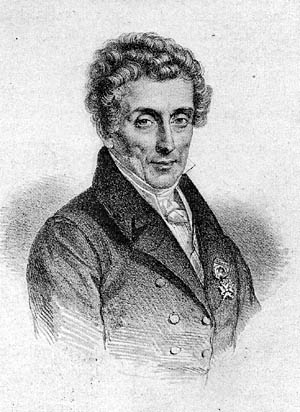
Though born in Italy much of Cherubini’s career was based in France. He settled in Paris in 1788 and subsequently became director of the Paris Conservatoire in 1822 which he remained until his death twenty years later, and was a very influential figure on the French musical scene. As a frequent visitor to the library of the Conservatoire and then one of the students there Berlioz necessarily had extensive dealings with him. A cursory reading of the composer’s Memoirs might give the impression that Berlioz thought of Cherubini as a diehard conservative, intrinsically hostile to the innovative spirit that animated Berlioz, anxious at times to obstruct the progress of his career, and in addition a figure of fun through his strong Italian accent (see chapters 9, 18, 31, 44, 46, 47). But whatever his disagreements with Cherubini at a personal level, Berlioz also respected and admired him as a composer. When Cherubini died in 1842 Berlioz wrote an obituary which may come as a surprise to those who only know Cherubini through the Memoirs (Journal des Débats, 20 March 1842). While mentioning at the end of his article the asperities of Cherubini’s character, Berlioz relates his career at length and is highly appreciative of the Italian composer’s music and achievements: ‘The life of this great composer can be proposed as a model to young artists from almost every point of view’.

François-Antoine Habeneck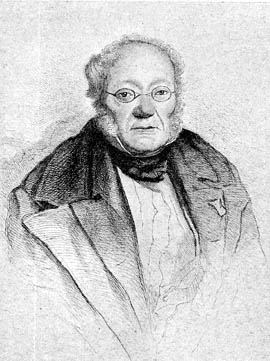
François Habeneck’s chief title to fame is his foundation of the Société des concerts du Conservatoire in 1828 through which he was able to introduce the symphonies of Beethoven to the French public. This was an achievement for which Berlioz gave him full credit, whatever his subsequent disagreements with his senior (Memoirs, chapter 20). Habeneck remained chief conductor of the Conservatoire for the next two decades until his death in 1849; he held this post concurrently with that of chief conductor at the Opéra. As conductor of the two most important musical institutions in the capital, Habeneck was a figure of considerable influence in the musical life of France in the 1830s and 1840s, and was expected to conduct at important public musical events.
Because of Habeneck’s dominant place on the musical scene and his own inexperience in conducting Berlioz had frequently to deal with the older man during the early part of his career. Relations at first were good. Habeneck conducted for the first time a concert which included music by Berlioz at the Conservatoire in 1829 (1 November). He then gave the first performance of the Symphonie fantastique the following year (5 December 1830; Memoirs chapter 31), and Berlioz had no criticisms to make of his conducting then; when he made revisions to the work during his trip to Italy in 1831 he was prepared to entrust the revised score to Habeneck for future performances of the symphony (Memoirs chapter 34). When he returned from Italy it was Habeneck again who gave the first performances of the revised symphony, together with its new sequel Le Retour à la vie (9 and 30 December 1832); the following year he also conducted the new Rob Roy overture (14 April 1833).
At this point relations began to turn sour and were thereafter characterised by ambivalence and distrust; this is reflected in Berlioz’s account in the Memoirs of their dealings on a variety of occasions. Later in 1833 Habeneck refused to conduct another concert of music by Berlioz, who had to turn to Girard instead (22 December 1833; Memoirs chapter 45). Berlioz on his side had already started to have doubts about Habeneck’s conducting; in particular, he had been incensed by the changes Habeneck was prepared to make to Beethoven’s orchestral writing (Memoirs, chapter 16). For Berlioz this was an act of artistic vandalism which he was not prepared to forgive (cf. Journal des Débats 1 July 1851, two years after Habeneck’s death). The rivalry became both personal and artistic. In the later 1830s Berlioz, wishing to emancipate himself from dependence on other conductors, started to develop his conducting skills, and came to be regarded by Habeneck as a threat to his own position. Nevertheless Berlioz had to rely again on Habeneck for the first performance of the Requiem at the Invalides in 1837 as it was a public occasion (5 December); the event is often remembered for the celebrated incident of the pinch of snuff (Memoirs, chapter 46, and the page on the Invalides), though this obscures the fact that Habeneck evidently had some regard for the work itself, since he performed the Lacrymosa at a large public concert in Lille the following year (25 and 26 June 1838). In that year and early in 1839 Berlioz had to rely again on Habeneck for the performances of Benvenuto Cellini at the Opéra (he was not allowed by convention to conduct himself), but according to Berlioz Habeneck did so with bad grace and was out of sympathy with the music (Memoirs, chapter 48). Berlioz and Habeneck came together once more in 1842 for a large-scale concert organised at the Opéra by Berlioz, in which the two men eventually had to share the conducting (7 November 1842), though again Berlioz suggests that Habeneck and his supporters did their best to place obstacles in Berlioz’s way (Memoirs, chapter 51); Berlioz nevertheless regarded the concert as a great success.
Though in private Berlioz had many doubts about Habeneck, outwardly he continued to maintain good relations with him; his eighth letter on his trip to Germany of 1842-43, first published in the Journal des Débats of 21 October 1843, was addressed to Habeneck. It was later incoporated in the Memoirs, but Berlioz made clear that by that time he did not consider Habeneck to be a true ‘friend’ (Memoirs, chapter 51).
Esprit Auber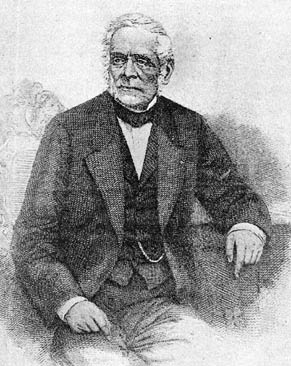
Auber, a prolific and highly successful composer of comic operas, was elected as member of the music section of the Institut in 1829, and subsequently succeeded Cherubini as director of the Conservatoire in 1843. In all three capacities he played a significant if at times unwelcome part in Berlioz’s career; outwardly the relations between the two men were polite, but in their attitudes to music they stood at diametrically opposed ends.
As one of the seven members of the music section of the Institut Auber had a vote in key decisions, notably in the annual competition for the Prix de Rome prize for composition. Berlioz, who had been trying to win the prize since 1826, eventually won the second prize in 1828 and so, according to precedent, was expected to win the first prize the following year. He believed that Auber, who had just been elected to the Institut, was sympathetic to him (CG nos. 125, 132, 133), and Auber had indeed attended the first concert Berlioz gave on 26 May 1828 and been very complimentary (CG no. 91). But Berlioz made the mistake of giving free rein to his imagination in his cantata, and this so disconcerted the academicians that they decided not to award any prize that year. Auber advised him afterwards to compose pedestrian music if he wanted to succeed as a composer (CG no. 134)… The following year Berlioz was careful to write a ‘safe’ cantata; the vote in his favour was unanimous (CG no. 172), and this indicates that Auber must have supported him.
The other important vote that the members of the Institut had was on the election of new members. From 1839 onwards Berlioz tried repeatedly to be elected whenever there was a vacancy, but Auber was for a long time hostile (cf. CG no. 768, 19 March 1842). In 1854 Berlioz wrote to his friend James Davison asking him to influence Auber in his favour, but Davison would not oblige (CG no. 1780, 8 August). In 1856 circumstances were now more propitious; Auber seemed at first to be sitting on the fence (CG no. 2132), but in the end sided with all his colleagues bar one (Carafa), and Berlioz was elected (CG no. 2144). He and Auber were henceforward colleagues, though this did not mean that Auber would necessarily support him when needed (cf. CG no. 2475, 2 February 1860). But it was appropriate that at the funeral of Berlioz on 11 March 1869 Auber and other members of the Institut should have participated in the ceremony.
As director of the Conservatoire Auber did nothing to advance the career of Berlioz and may well have obstructed him on several occasions, though if so his direct influence is easier to suspect than to demonstrate. From the end of 1843 Berlioz was in effect excluded from using the Conservatoire for his concerts; for this he blamed the ‘coterie of the Conservatoire’ and the conductor Girard, and not Auber its director specifically (Memoirs chapter 59). In fact he hardly says anything about Auber in his Memoirs, beyond a dismissive reference to his directorship of the Conservatoire (Memoirs, end of chapter 9) and a scathing remark about the noisy orchestration of ‘Auber, Halévy, Adam and many others’ (Post-Scriptum).
Among the many operas of Auber Berlioz did express genuine admiration for his La Muette de Portici of 1828 which he proclaimed the composer’s masterpiece (Journal des Débats, 26 January 1863 and frequently elsewhere), and he included the Prayer from that work in the large concert he gave on 1 August 1844 at the Festival of Industry. Otherwise music by Auber hardly ever figures in his concerts (an exception on 25 March 1851). But as a music critic Berlioz could not avoid writing about Auber’s numerous operas, which kept appearing year and year and made their author a wealthy man. Berlioz acknowledged the easy-going talent and success of Auber, and many of his reviews are on the surface complimentary. See for example among many others Débats 9 February 1842 (contrast CG no. 765 for Berlioz’s real feelings), 30 March 1844, 29 April 1845, 9 December 1850, 25 December 1852, 8 June 1855, 30 September 1857, 13 February 1861. Occasionally he was more openly critical (Débats 3 April 1839, 12 March 1841). But for any reader familiar with Berlioz’s own artistic ideals it was not necessary to read between the lines to divine what he really thought. Here as an example is an excerpt from one review (Débats 10 December 1937, concerning le Domino noir):
Auber’s music was generally well received. As ever it was thought to be lively, light and witty. It is true that some people with austere tastes criticise him for his rather narrow forms, his short melodies and his tendency to vaudeville. These shortcomings would perhaps be less noticeable if seen from the angle of a musician who is searching above all for a style that is most likely to sway the present audience of the Opéra-Comique, without leaving the musical circle in which art is circumscribed by the practices and resources of that theatre and thus unable to escape from them. To be successful above everything else seems to have been the aim of M. Auber, and this he has fully achieved.
Narcisse Girard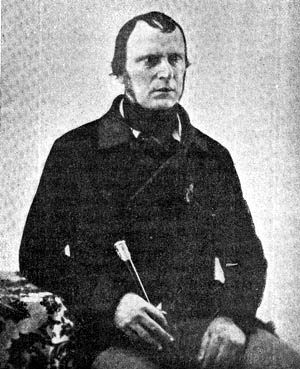
Narcisse Girard was younger than François Habeneck, the doyen of conductors on the Paris musical scene of the 1830s and 1840s. Unlike Habeneck he was a composer as well as a conductor, though most of his career was spent in Paris conducting various orchestras, especially that of the Conservatoire and of the Opéra-Comique. Possibly because of the smaller age difference Berlioz found it easier to develop a good rapport with him in the early stages of his career than with the more senior Habeneck. The relations between himself and Girard are outlined in the section on Berlioz as a conductor on another page of this site, and Berlioz’s own Memoirs mention the main stages in their contacts.
Girard first appears in 1830 where he is already presented as a close acquaintance of Berlioz; newly appointed conductor of the Théâtre Italien he asked Berlioz for an overture for a concert there in November, and Berlioz responded with the overture to Shakespeare’s The Tempest which was eventually performed, not at the Théâtre Italien under Girard, but at the Opéra on 7 November (CG no. 173 [23 August]; Memoirs chapter 27). Girard reappears in 1833 when Berlioz, in search of a conductor to take the place of Habeneck who was no longer willing to assist him, turned to Girard who had already helped him early in the year; Girard obligingly stepped in for a concert at the Conservatoire on 22 December 1833 in which he acquitted himself well (Memoirs chapter 45). Thereafter he conducted for Berlioz in several concerts in 1834 and 1835, mostly at the Conservatoire, but then ceased abruptly. The reason was that Girard had botched the first performance of Harold en Italie on 23 November 1834, which prompted Berlioz to take up conducting himself; he could no longer rely on others to conduct his music adequately (Memoirs chapter 45; cf. CG no. 454). The result was a rift between the two former friends, and Girard became jealous of Berlioz’s success as a conductor; after 1843 Berlioz was in practice excluded altogether from the Conservatoire. Years later (15 April 1849) Girard did conduct again music by Berlioz there, though this was the last time; according to the Memoirs (chapter 59) he did not handle it well, though a letter of Berlioz gives a more positive view (CG no. 1258).
Further evidence on Girard is provided by Berlioz’s numerous feuilletons in the Journal des Débats; Girard is frequently mentioned there, though Berlioz’s public comments evidently should not always be taken at face value. Outwardly he maintained good relations with Girard, but he was a master in the art of damning with faint praise. That is what Girard generally receives in the feuilletons, both as a composer (Débats 13 December 1839, 1 July 1841 and 28 August 1842), and more frequently as a conductor (the most positive assessments are in Débats 6 April 1838, 5 September 1839 and 20 April 1849). Berlioz also addressed to Girard the second of his letters on his trip to Germany of 1842-43, first published in the issue of 20 August 1843, later reproduced in the Memoirs, but as with Habeneck Berlioz made clear that he no longer regarded Girard as a true ‘friend’ (Memoirs chapter 51).
Édouard Bénazet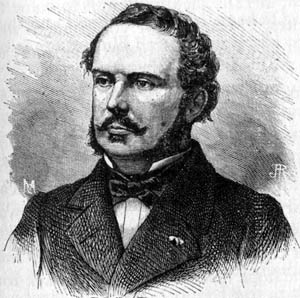
This picture is taken from L’Illustration, Journal Universel, 25e année, vol. 1, no. 1295, 21 December 1867 p. 400, which contained an obituary of Bénazet (p. 399).
The relations between Berlioz and Édouard Bénazet are covered fully in the page on Baden-Baden. In 1848 Bénazet took over from his father Jacques the management of the casino at Baden-Baden, and was able to put into action plans he had long formed to develop the status and attractiveness of Baden-Baden as an international cultural centre. Already in 1844 he invited Berlioz to come and conduct a summer music festival in the spa resort, though for health reasons Berlioz was unable at the time to follow through on the invitation. He was invited again by Bénazet in 1853 and this time he went, and then from 1856 onwards Berlioz’s direction of the summer festival became a regular event year after year until 1861. In 1858 Bénazet commissioned Berlioz to write an opera for the inauguration of a new theatre he was building; in the event Berlioz did not fulfil the original commission, but eventually he wrote the comic opera in two acts Béatrice et Bénédict, his last major work. This was accepted by Bénazet instead and premièred in Baden-Baden on 9 and 11 August 1862, and it was repeated there the following year.
From Berlioz’s point of view Bénazet was the ideal impresario: he provided Berlioz with conditions for music-making he could only have dreamed of: a free hand in the choice of programmes and artists, a lavish budget, unlimited rehearsal time, and a guaranteed audience from the élite of European society.
Anne Charton-Demeur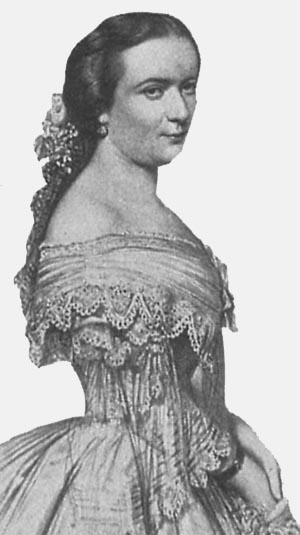
(A copy of this lithograph is in the library of the Paris Opera)
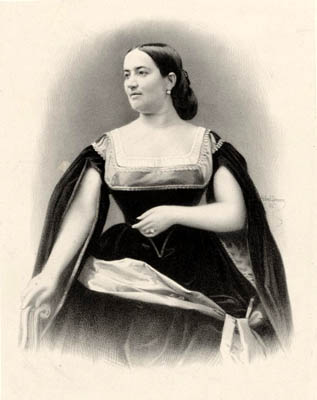
One of the finest singers of her time, Anne Charton-Demeur was closely associated with the final stages of Berlioz’s career. Berlioz first heard her in London in 1851 and was impressed by her singing; her name appears frequently thereafter in his feuilletons for the Journal des Débats, which mention for example the several visits she made to the Americas in the 1850s and early 1860s. Berlioz greatly admired her voice and talent, and she sang for him on a number of occasions: in London in March 1852, in Baden-Baden in August 1858 (see also CG nos. 2307, 2318) and again in August 1862 when as Béatrice she took part in the first performances of Béatrice et Bénédict, which were repeated a year later. She was particularly associated with the role of Dido in Les Troyens. Together with the singer Jules Lefort she gave the first public hearing of excerpts from the opera before a small audience in Paris on 6 August 1859, and went on to sing Dido in a series of performances of the second part of the work (Les Troyens à Carthage) at the Théâtre Lyrique in November and December 1863. She and her husband remained thereafter close to Berlioz: Berlioz’s last letter from his trip to Russia in 1867-68 is addressed to them (CG no. 3335), and in the last months of his life she visited him at home on several occasions. A decade later, though past her prime, she sang in a commemorative concert in honour of Berlioz (8 March 1879), and in November and December of the same year sang the part of Cassandra in Pasdeloup’s concert performances of La Prise de Troie.
Rosine Stoltz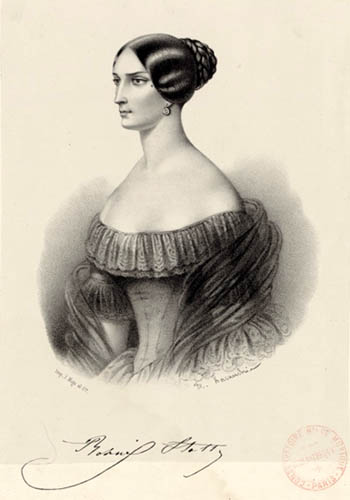
Rosine Stoltz made her début at the Opéra in August 1837, and from the start Berlioz noticed her potential. She sang Ascanio in Benvenuto Cellini at the Opéra in September 1838, then again in the early months of 1839, and acquitted herself well. In his Memoirs (chapter 48; cf. CG no. 619) Berlioz praises her singing and commends her and Mme Gras Dorus (in the part of Teresa) for the support they gave him, unlike the tenor Duprez who let Berlioz down. The hostile reception given to the work meant that henceforth Berlioz was in practice excluded from the opera; he thus did not have another chance to call on Stoltz’s talents on stage. But subsequently she did sing for Berlioz on a number of occasions: on 25 November 1838 at the Conservatoire, 15 December 1839 in the third performance of Roméo et Juliette, and years later she insisted on singing La Captive at a concert in Salle Herz (24 December 1854 and 28 January 1855).
Berlioz followed her career in Paris closely through his feuilletons in the Journal des Débats and for several years down to 1844 he was generally very complimentary on her abilities as singer and actress, though he did on occasion point out flaws in her vocal technique, particularly as regards intonation. See notably the reviews in Débats on 22 January and 22 March 1839, 7 June 1840, 18 November 1843, and 3 April 1844. Then in 1846 he fell out with her and the management of the Opéra (cf. CG no. 1049); he wrote an unusually critical review of her singing (Débats 9 June 1846), followed on 3 January 1847 by a very damaging article on the fall in standards at the Opéra and Stoltz’s limitations as both actress and singer. For the next few years Stoltz virtually disappears from Berlioz’s feuilletons, and in 1850 she departed for a series of tours abroad for the next few years. A feuilleton of 23 February 1851 has a rather ironical allusion to her performances in Lisbon in Portugal, though Berlioz reports at second hand an improvement in her style and singing.
Stoltz returned to Paris in 1854 and her reappearance at the Opéra in the autumn was once more a triumph (Débats 5 October 1854), confirmed the following year with her début in Meyerbeer’s Le Prophète (Débats 17 April 1855). She now seemed back in Berlioz’s good books, but for the fact that she soon accepted another highly lucrative engagement at the opera in Rio de Janeiro in Brazil: in Berlioz’s eyes it was an unforgivable crime for talented European singers like herself and others (Henriette Sontag, Jenny Lind) to allow themselves to be lured by money to the Americas (Débats 8 June 1855, reproduced in Les Grotesques de la musique). Berlioz continued to believe in her talent (cf. Débats 13 July 1859), but there was a final twist in their relationship in connection with Les Troyens. It is known that Berlioz donated to her the autograph manuscript of the libretto of the opera, but a letter of his in July 1863 also reveals that Stoltz, like Pauline Viardot, had hoped to be given the role of Dido in Les Troyens à Carthage at the Théâtre Lyrique in November 1863 and was incensed at Berlioz’s refusal: ‘singers cannot bring themselves to acknowledge the irreparable ravages of time’ (CG no. 2759).
Henriette Sontag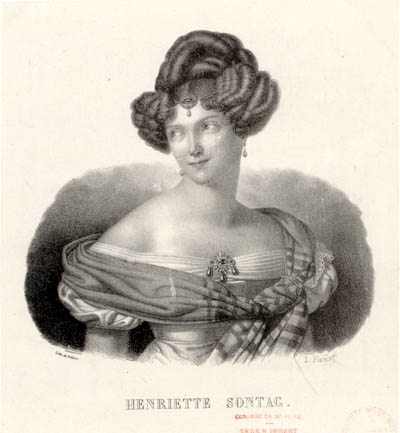
Early in his career as music critic Berlioz was already aware of the reputation of the German singer Henriette Sontag (Journal des Débats, 15 November 1835), but he only heard her for the first time many years later and had few occasions subsequently to hear before her untimely death in 1854. He nevertheless judged her to be altogether exceptional both as singer and actress, one of the most outstanding he had ever heard.
It was only in 1850 that Berlioz heard Sontag for the first time, at the Théâtre Italien (Salle Ventadour) and he was immediately impressed (Débats 2 December 1850). He heard her again in London the following year in two Mozart operas, as Zerlina in Don Juan and Susanna in The Marriage of Figaro and was completely won over (Débats 31 May and 1 July 1851; Les Soirées de l’orchestre Second epilogue). These were apparently the only occasions Berlioz heard her singing and acting, but they left an indelible impression on him: she was simply ‘incomparable’ (Débats 27 January 1852). Her unexpected death while on tour in Mexico in 1854 came as a great shock, and prompted Berlioz to reminisce on her talent; she was a complete artist and equally outstanding as singer and actress, and Berlioz remembered in particular the extreme sensitivity of her soft singing. At the same time he was distressed that such a great singer had succumbed like others to the lure of the wealth of the Americas, and above all that she should have died far away from Europe, which alone was able to appreciate her talent (Débats 5 October 1854, reproduced in les Grotesques de la musique). Years later he commented on how Mme Charton-Demeur, by her singing at a concert in Baden-Baden, had been able ‘to revive the poetic memory of Mme Sontag’ (Débats 15 September 1858).
Jenny Lind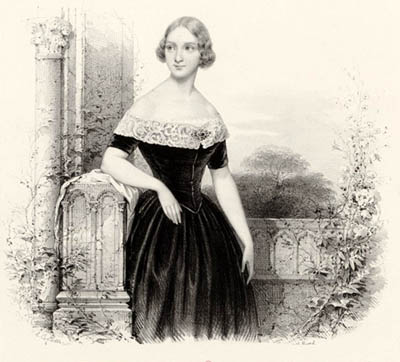
One of the most celebrated and highly-paid singers of her time, the Swedish born soprano Jenny Lind made her début in her native country in 1838 and quickly shot to fame in northern Europe in the 1840s. It was several years before Berlioz had a chance to hear her: though she visited other European countries (she sang at the Berlin opera in 1845 and made her début in Vienna in the winter of 1846) she never sang in Paris, as the French capital had failed to invite her in good time (Journal des Débats, 24 May 1846). It was only in the course of his travels outside France that Berlioz had a chance to judge for himself that her exceptional reputation was indeed thoroughly deserved.
Berlioz saw and heard her for the first time in August 1845 on the occasion of the celebrations for the inauguration of the statue of Beethoven in Bonn. Jenny Lind, who sang at the time at the Berlin opera, attended the celebrations and sang at a concert organised by the King of Prussia in his nearby castle of Brühl. In his report on the ceremonies Berlioz immediately recognised her exceptional voice and talent (Débats 3 September 1845, reproduced in Les Soirées de l’orchestre, Second Epilogue). Lind was invited to sing in London in 1848 (Débats 5 February 1847), and this coincided most fortunately with Berlioz’s first visit there: in May 1848 Berlioz was able to see as well as hear her on stage at Her Majesty’s Theatre (CG nos. 1192, 1200, 1260), which confirmed that, like Henriette Sontag, she was equally outstanding as both singer and actress. But this was seemingly the last occasion on which Berlioz heard her: the following year Lind announced that she was giving up her operatic career, and in 1850 she left for a spectacular three-year concert tour of North America amidst extraordinary publicity. In his feuilletons Berlioz describes in vivid detail the extravagant reception she received in New York (Débats 27 August, 25 September and 19 October 1850, reproduced in Les Soirées de l’orchestre, 8th evening; cf. also Débats 25 February 1852). Berlioz’s description should be compared with contemporary cartoons about the concerts she gave in New York.
There was an ironic twist to the story of Berlioz and Lind. In 1856 Berlioz was planning to make another visit to London and preparations were underway, but then had to be called off early in the year: Jenny Lind was going to give a series of concerts in London over a four-month period, and such was the ‘Lind fever’ that gripped the capital that it was pointless to organise any other musical event (CG no. 2076). Berlioz never returned to London, and never heard Lind again.
François-Joseph Fétis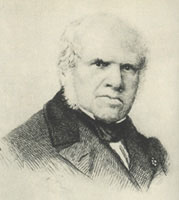
A native of Belgium, Fétis was an eminent critic and musicologist who studied and lived in Paris between 1800-1811 and 1818-1832, then became director of the newly-founded Brussels Conservatoire from 1833 to the end of his life. He is known in particular for a major encyclopedic work, his Biographie universelle des musiciens, first published in 8 volumes from 1835 to 1844 and subsequently revised. It soon established itself as a widely used and authoritative work of reference, and was cited by Berlioz among many others. The relations between Fétis and Berlioz extended over a large part of the career of both men, from the late 1820s to near the end of their lives in the late 1860s, and are treated in detail on the page on Berlioz in Belgium to which the reader is referred.
The posthumous reputation of Fétis has been influenced by the protracted feud between him and Berlioz which figures prominently in Berlioz’s Memoirs (chapters 16, 44, 51, Post-Scriptum). Ostensibly this was caused by Fétis’ corrections in 1829 to the harmony of some passages in Beethoven’s symphonies which incensed Berlioz; as is well known, Berlioz openly denounced Fétis for this in one of the passages of his Melologue at its first performance on 9 December 1832, and this was the start of a long feud between the two men. The truth is more complex: not only had Fétis been initially sympathetic to Berlioz in his early career in 1829 and 1830 (Memoirs chapters 19 and 27), but Berlioz’s change in attitude only came abruptly after he had left for Italy in 1831, and not immediately after the appearance of the offending publication. Whatever the reason, from December 1832 onwards Berlioz assumed that Fétis was hostile to him, and he felt this was illustrated during his visits to Brussels in 1842 and later in 1855. Later in life, in the 1860s, when both were now old men, they eventually became reconciled in their mutual admiration for Gluck, whose Alceste was performed in October 1866 at the Paris Opéra under Berlioz’s supervision, and prompted a moving exchange of letters between the two men.
© (unless otherwise stated) Monir Tayeb and Michel Austin for all the texts and images on Berlioz Photo Album pages.
All rights of reproduction reserved.


 Photo Album main page