


Unless otherwise stated all pictures on Berlioz Photos pages have been scanned from engravings, paintings, postcards and other publications in our collection. All rights of reproduction reserved.
This page includes portraits or photographs of the following: Honoré de Balzac, Niccolò Paganini, Richard Wagner, Ambroise Thomas and Léon Carvalho

 Honoré de Balzac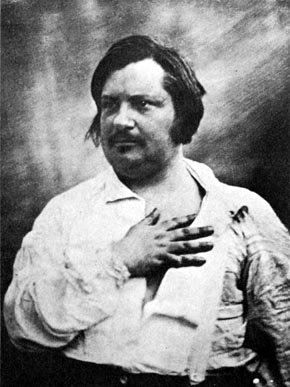
Berlioz and Balzac were close friends during the 1830s and 1840s; composer and novelist shared a strong personal liking and a mutual admiration for each other’s works. A letter of Berlioz dated 25 August 1832, not long before his return to Paris from Italy, shows him immersed in catching up with the latest productions of French literature, including Balzac’s most recent novels (CG no. 287): he was evidently already familiar with his earlier work. Balzac for his part was present at the concert on 9 December 1832 when the Symphonie fantastique was performed, together with its sequel le Retour à la vie, in the presence of Harriet Smithson. It is not clear when they first met in person; it may have been earlier than this time, but if not they probably met soon after.
Balzac was present at the first performance of Roméo et Juliette on 24 November 1839 and complimented Berlioz on the distinction of his audience (CG no. 683; cf. Débats, 7 March 1849). The following year he wrote Berlioz a very complimentary letter on a performance of the Symphonie fantastique at the Conservatoire (13 December 1840): he expresses his ‘profound admiration’ for the work and says that the performance ‘demonstrated to many fools that you are a great musician and a fine genius’ (CG no. 738). One of Balzac’s stories, Ferragus, is dedicated to Berlioz.
Berlioz on his side was equally appreciative: he evidently followed closely Balzac’s work and read everything that he published. A letter of July 1842 mentions how Balzac was working tirelessly on his novels, to the point of losing sleep (CG no. 771). In his Memoirs Berlioz describes Balzac as ‘this exceptional writer, this incomparable anatomist of the heart of contemporary French society’ (chapter 55). In a letter of 1850 he addresses him as ‘Cher et admiré maître’ (CG no. 1334). Berlioz’s writings are replete with allusions to Balzac’s novels and to characters in them, which he assumed would be familiar to his readers (see for example Débats 13 December 1839, 12 June 1842, 6 April 1853, 31 December 1855). He occasionally disagreed with Balzac on some points (for example in the last mentioned feuilleton; Memoirs chapter 47; Grotesques de la musique), but this did not in the least affect his admiration for him. In the Prologue to the Soirées de l’orchestre the musicians of the orchestra, instead of playing bad operas, spend their time reading ‘the wonderful scenes of Balzac or the charming character portraits of Dickens’.
Before Berlioz left for Russia in February 1847 he consulted Balzac, who had himself been to the country, and received from him advice about a contact in Tilsitt, together with a confident prediction that he would make a fortune in Russia (Memoirs chapter 55). He also received the loan of a fur coat for the trip (CG no. 1096). It appears that three years after his trip he had not yet been able to see Balzac again (CG no. 1334, 12 June 1850. Balzac died not long after, on 18 August 1850. His death affected Berlioz deeply (cf. CG no. 1370, 4 January 1851). In 1854, when standing for election to the Institut, he noted that Balzac had never managed to be elected to that body (CG no. 1783). Writing to Princess Sayn-Wittgenstein in January 1859 he likened Paris sadly to a cemetery full of memories of dead friends, and mentioned the place where he had seen Balzac for the last time (CG no. 2347).

Niccolò Paganini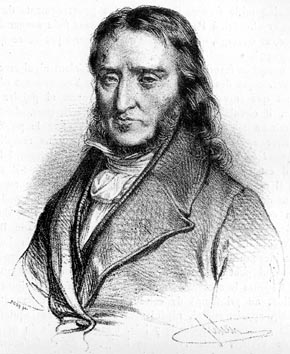
Paganini, the greatest violinist of his age, played a role in the career of Berlioz comparable to that of Liszt, the greatest pianist of his time. They belonged to two different generations, but both were quick to recognise the genius of Berlioz as soon as they heard his music. Liszt was at the first performance of the Symphonie fantastique on 5 December 1830, and Paganini attended a performance of the same work when it was followed for the first time by its sequel Le Retour à la vie on 9 December 1832. Both men became instant converts and went on to have a decisive influence on the career of the composer. Liszt’s relations with Berlioz extended for a period of over 30 years down to the 1860s and are treated in detail on a separate page. Paganini’s relations with Berlioz were restricted to a shorter period in the 1830s but were no less significant: it was thanks to him that two of Berlioz’s four symphonies, Harold en Italie and Roméo et Juliette were composed.
Berlioz gave full prominence to Paganini’s role in his Memoirs (more so than that of Liszt). In chapter 45 (with partial English translation) he relates his first encounter with Paganini and how it ultimately led to the composition of the symphony Harold en Italie. He dates the encounter to a concert on 22 December 1833 at which the Symphonie fantastique was performed, after which Paganini came to congratulate him; but here Berlioz’s memory was at fault. The composer’s own correspondence shows that the occasion was a year earlier, and the reference should be to the celebrated concert of 9 December 1832: a letter the day after the concert mentions Paganini among those who congratulated the composer (CG no. 295), and another letter a few days later gives a very detailed account of the occasion and mentions Paganini specifically: ‘Paganini came to see me and said the most flattering things, among them “You are the French Beethoven, you begin where others leave off”’, possibly the earliest instance of the accolade that Berlioz was to receive repeatedly thereafter (NL no. 299bis pp. 109-13). On the other hand Berlioz was correct in dating the origins of the Harold symphony to the intervention of Paganini in early 1834, who suggested to Berlioz the writing of a work which would give a prominent part to the viola. The composer's correspondence provides here additional detail, and shows that the projected work started off as a piece on the last moments of Mary Stuart, with chorus and solo viola, only to evolve progressively into the four-movement symphony Harold en Italie which was completed the same year (CG nos. 378, 384, 385, 408), and first performed on 23 November (Paganini was not present). Paganini’s suggestion of the viola as solo instrument, rather than the violin, is of interest: Berlioz had a special fondness for the instrument and had already used a solo viola in his 1828 setting of the King of Thule ballad in Huit Scènes de Faust.
Paganini was back in Paris in July 1837 and probably saw Berlioz again soon after (see the note below). Berlioz relates the sequel (Memoirs, chapter 49, with partial English translation). In September 1838 Paganini witnessed the fall of Benvenuto Cellini at the Opéra and was incensed. On 16 December 1838 Berlioz gave a concert at the Conservatoire with both the Symphonie fantastique and Harold en Italie, at the end of which Paganini, who was hearing Harold for the first time, publicly knelt before the composer in homage and two days later sent him a letter with a gift of 20,000 francs. Berlioz was so delighted with Paganini’s gift and the actual text of the letter that he made copies of the original in his own writing. The gift caused a sensation at home and abroad, and provoked a great deal of comment and sometimes hostile speculation as to Paganini’s motives (cf. CG nos. 602, 608, 612, 616, 617, 622). Berlioz used the money partly to pay Harriet Smithson’s debts and partly to compose the symphony Roméo et Juliette, which was appropriately dedicated to Paganini. Because of his declining health Pagainini left early in 1839 for Marseille, and then for Nice, but the two men kept up their correspondence (CG nos. 653, 666, 699; cf. Débats, 22 March 1839 [end of the article]). Paganini was unable to attend the performances of the symphony and never heard the work. He eventually died in Nice on 27 May, an event Berlioz alluded to as a rumour but did not have the heart to report as a fact (Débats, 7 June 1840). It was only many years later, on the occasion of the publication of Paganini’s works, that Berlioz was able to give a conspectus of the great virtuoso’s career and achievements, and reminisce on his relations with him (Débats, 23 December 1851, reproduced in Soirées de l’orchestre).
Note: Berlioz insisted in several places (Soirées de l’orchestre 16 and 2nd Epilogue) that he never heard Paganini playing the violin (whereas he had ample opportunity to hear Liszt at the keyboard, and frequently mentioned his playing in his writings). Berlioz was away in Italy in 1831-1832 while Paganini was giving concerts in Paris and France, and according to the Memoirs (chapter 35), all he could do when passing through the violinist’s native city of Genoa was to enquire about the great virtuoso. When he returned to Paris in 1832 Berlioz was unable to attend the concert that Paganini gave at the Opéra on 14 April 1833, apparently the last one he gave in Paris (CG II p. 96 n. 2). He heard a great deal about the virtuoso’s compelling playing, and was familiar with his violin works; his writings have numerous references to Paganini’s prodigious mastery of his instrument and the technical innovations he introduced in violin playing (for example Débats 17 January and 23 July 1836; 2 October 1839; 26 May 1844; 27 January 1852). Yet the assertion that he never heard Paganini playing seems contradicted by a statement at the end of an article in Débats (14 January 1838) that he did hear Paganini in a piano trio of Schubert a few months earlier in Paris (probably in a private setting). This must have taken place in the latter part of 1837, after Paganini’s return to Paris when he was staying with the Loveday family since July (see CM III pp. 370-1 and nn. 14, 16). This episode seems to be alluded to again in a later feuilleton (Débats, 9 January 1840 [near the end]; cf. CG no. 698), but CM IV p. 227 n. 20 does not seem make the connection with the 1838 article.
Richard Wagner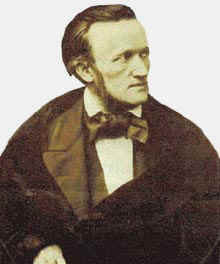
A copy of the above photo, taken by Pierre Petit around 1860, is in the Bibliothèque nationale de France, Paris. See also next picture.
Wagner first heard Berlioz’s music when he attended a performance of Roméo et Juliette at the Paris Conservatoire on 15 December 1839. Over the years they met a number of times in Paris, and also in London in 1855. Their limited correspondence continued until 1860. The relations between the two greatest composers of their time, which were made difficult from the start by differences in personality, temperament and musical style, are discussed in the page Berlioz and Wagner.
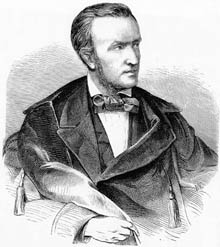
This engraving, based on the photo by Petit, was published in a March 1861 issue of L’Illustration, a copy of which is in our own collection. The engraving accompanies a review of the Paris première of Wagner’s opera Tannhäuser at the Opéra, in the presence of Berlioz, on 13 March. For Berlioz’s views on this opera see Berlioz and Wagner.
Ambroise Thomas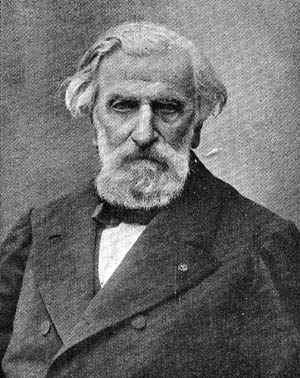
The career of Berlioz’s younger contemporary Ambroise Thomas forms an interesting and revealing contrast to that of Berlioz himself. Both were students of Lesueur, both won the Prix de Rome competition for composition, and both became members of the Institut. Thomas won the competition in 1832, two years after Berlioz, and on his return started a career as composer, chiefly of numerous comic operas which, unlike Berlioz, he had no difficulty in getting staged at the Opéra-Comique, and which for the most part were very successful. Though younger than Berlioz he was unanimously elected to the Institut in 1851 after the death of Spontini; on that occasion Berlioz, also a candidate, did not receive a single vote (CG nos. 1388, 1392), and had to wait till 1856 to be elected. Thomas did not support him when he stood in 1854 and his attitude was equivocal (CG no. 1784), though eventually he did support him in 1856 when Berlioz was at last elected (CG no. 2144). As a member of the Institut in the music section it was appropriate that Thomas should be among those representing it at the funeral of Berlioz on 11 March 1869. He succeeded Auber as director of the Conservatoire in 1871. In 1883 he was on the committee for the erection of a statue in honour of Berlioz, which was inaugurated on 17 October 1886. Georges de Massougnes, a dedicated champion of Berlioz, thought his participation on the committee was inappropiate: he writes that Thomas’ ‘artististic tendencies are diametrically opposed to those of Berlioz, and he almost belongs to an enemy school’ (letter to the Mayor of a Côte-Saint André, 21 October 1889).
There are no known letters of Berlioz to Thomas, but three of Thomas to Berlioz, two of them letters of congratulation, one in 1854 (CG no. 1837, for l’Enfance du Christ) and the other in 1863 (CG no. 2785, for Les Troyens). There is also a letter asking Berlioz to support a young pianist promoted by Thomas, but Berlioz did not oblige (CG no. 2546). There is no mention of Ambroise Thomas or of his music in any of Berlioz’s books (his Memoirs and other works).
The one domain in which Berlioz could not avoid mentioning Ambroise Thomas was that of musical criticism, given that Thomas was a prolific composer of comic operas. Between 1837 and 1860 no less than ten of Berlioz’s feuilletons deal with new operas by Thomas (see especially those of 27 August 1837, 6 April 1838, 17 October 1843, 18 July 1846, 14 December 1857 and 16 February 1860). On the surface the reviews often seem favourable, and Berlioz certainly recognised Thomas’ talent, fluency, know-how and the charm of his best music. But reading between the lines it is not difficult to divine what Berlioz thought of Thomas’ approach to music. See for example this passage from a review of 25 April 1850:
M. Thomas has the gift of composing with ease and fluency, a gift possessed in general by musicians who are thoroughly acquainted with all the resources of their art […] Yet one can see that he was brought up in Paris, that he has heard a great deal of the music of Paris, and that above all he wants to please the public of Paris.
Léon Carvalho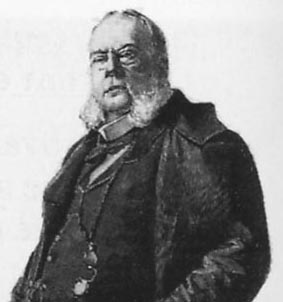
A copy of this lithograph is in the Bibliothèque nationale de France, Paris.
Léon Carvalho was director of the Théâtre Lyrique from 1856 to 1868 (with a two-year gap between 1860 and 1862). Thanks to the Postface of Berlioz’s Memoirs the reputation he has left is rather negative: he is primarily remembered as the director who staged a mutilated and inadequate production of Les Troyens in November-December 1863, but this does him less than justice. It obscures the work he did otherwise at the Théâtre-Lyrique during his tenure, in which he promoted operas by young French composers (such as Gounod’s Faust) and staged a number of works by great composers of the past (such as Gluck, Mozart, Beethoven and Weber). Berlioz himself acknowledged his achievements in his feuilletons and his correspondence, and as regards the production of Les Troyens in 1863 the presentation he gives in his Memoirs can be contrasted with a more favourable assessment in some of his private correspondence. There is a detailed discussion of Carvalho’s career and relations with Berlioz in the pages on the Théâtre Lyrique and on the Première of Les Troyens in 1863, with full citation of the relevant evidence.
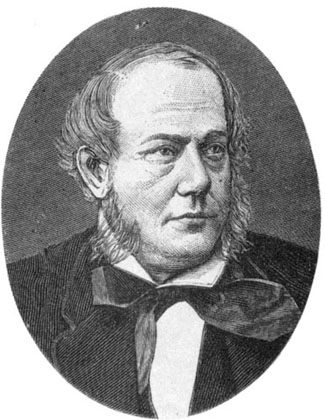
A copy of this engraving, dated circa 1890, is reproduced in Steven Huebner, The Operas of Charles Gounod, plate 6 (Oxford: Clarendon Press, 1990).
© (unless otherwise stated) Monir Tayeb and Michel Austin for all the texts and images on Berlioz Photo Album pages.
All rights of reproduction reserved.


 Photo Album main page