


Unless otherwise stated all pictures on Berlioz Photos pages have been scanned from engravings, paintings, postcards and other publications in our collection. All rights of reproduction reserved.
This page includes portraits or photographs of the following: Madame Branchu, Mademoiselle Duchesnois, Adelina Patti, Horace Vernet, Louise Vernet, Adolphe Sax

 Madame Branchu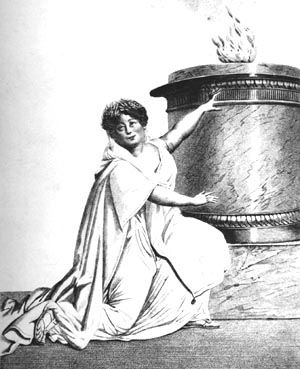
Mme Branchu was the leading soprano at the Paris Opéra in the early years of the 19th century. Although Berlioz only heard and saw her on stage for a short period between 1823 and 1826, she left an indelible impression on his mind: she was ‘the incarnation of lyric tragedy’, a singer with a voice that had exceptional power but could also be very gentle, and an actress with a commanding stage presence who identified completely with her roles. She was unique and had no successor (Débats, 14 May 1845). For Berlioz she set the standard against which other women singers were judged; in his eyes very few could come near her, such as Mme Barthe-Hasselt in Vienna or Mme Schodel in Pesth, whom he saw and heard in the course of his trip to central Europe in 1845-6 (Débats, 24 August and 19 October 1847, both reproduced in the Memoirs). When Pauline Viardot sang in Gluck’s Alceste at the Opéra in 1861, Berlioz could pay her no higher compliment than that no one had sung the role so well since Mme Branchu, who herself had raised the part to heights previously unimagined (Débats, 26 March and 24 October 1861, reproduced in À Travers chants).
Berlioz’s correspondence of the years 1824 to 1826 gives a few glimpses of the impression Mme Branchu made on him at that time. CG no. 24 (10 June 1824) refers to a meeting with another enthusiast who had attended no less than 34 performances of Salieri’s Les Danaïdes with Mme Branchu in the title role. CG no. 33 (4 September 1824) compares unfavourably with Mme Branchu a new singer (Mlle Noël) with a fine voice but no dramatic sense: ‘Where are you, Mme Branchu?’ CG no. 40 (20 January 1825), addressed to a fellow-enthusiast, refers to ‘the sublime Mme Branchu’ (cf. Memoirs, chapter 15). From indications in the letters and later evidence it can be inferred that Berlioz became friendly with Mme Branchu: he was invited to her daughter’s wedding on 11 July 1825, the day after the first performance of his Messe solennelle (CG no. 48, 30 July 1825). In his early attempts at composition Mme Branchu gave Berlioz her support (CG no. 53, 15 January 1826). The last letter referring to Mme Branchu describes her farewell appearance at the Opéra in Spontini’s Olympie on 27 February 1826, after which she retired (CG no. 61, 15 July 1826; cf. Débats, 7 April 1861).
Memories lingered on: it is very likely that when composing Les Troyens Berlioz had in mind what Mme Branchu would have made of the roles of Cassandra and Dido.

Mademoiselle Duchesnois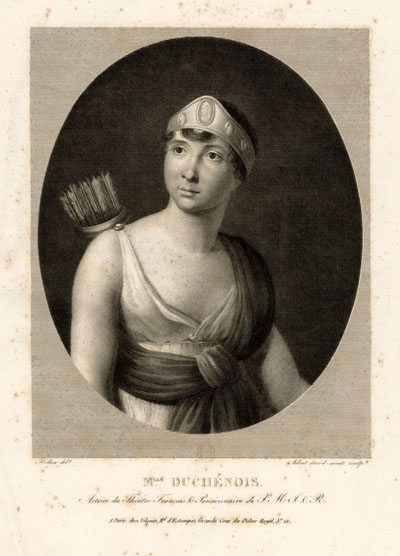
The above picture is from the Bibliothèque nationale de France.
Mademoiselle Duchesnois was famous in her day as an actress in Paris; she joined the Comédie Française in 1802 where she stayed until her retirement in 1829. She was an acquaintance of her fellow-actress Harriet Smithson, whom she may have met in the autumn of 1827 when Harriet Smithson gave a series of performances (in English) at the Comédie Française of Rowe’s Jane Shore. Extant is an autograph letter of Harriet Smithson to her dated 11 July 1828 in which she asks for tickets for a performance that evening (possibly at the Comédie Française). Later, on 2 April 1833, Mademoiselle Duchesnois was one of several actors, actresses and musicians who participated in a benefit performance for Harriet Smithson, as mentioned by Berlioz in his Mémoires (chapter 45) and in a letter to his sister Adèle written the day after (CG no. 332).
Adelina Patti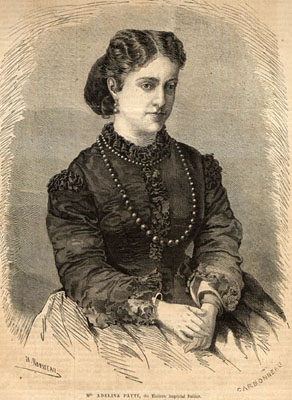
The above engraving shows Adelina Patti in 1864, as published in the French newspaper L’Univers Illustrè in November that year.
The talented young singer Adelina Patti entered Berlioz’s life late, in the early 1860s — she was 40 years her junior — but she brought to it a most welcome breath of youthful freshness and charm. She made her début at the Théâtre-Italien (Salle Ventadour) in November 1862 and Berlioz lost no time in mentioning her enthusiastically (Débats 19 November 1862). The success of Patti inspired in Berlioz one of his bons mots which became famous (Débats 13 January 1863; cf. W. Ganz, Memories of a Musician p. 210 with n. 9).
Berlioz would no doubt have had many more occasions to sing Adelina’s praises had his career as a critic not come to an end in 1863. But he soon became friendly with Patti’s family and was a welcome guest there (CG no. 2695, 5 February 1863). Coincidentally Adelina Patti was present in Lyon on the same day (23 September 1864) when Berlioz was meeting Estelle Fornier there for the first time in over 30 years, and had dinner with Patti and her family afterwards before returning to Paris overnight. The occasion is described at length in the last section of the Memoirs (Voyage en Dauphiné). On his return to Paris Berlioz had a few more opportunities to hear Patti singing in December 1864 (CG nos. 2951, 2953, 2965).
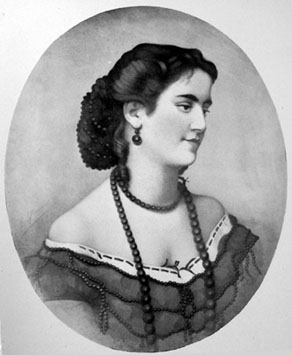
Patti autographed this portrait in 1867 for James Davison; it was subsequently published in the latter’s Memoirs posthumously compiled by his son.
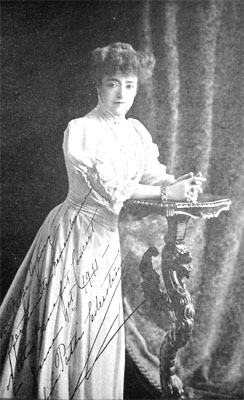
Patti autographed this portrait as a souvenir of the concert she gave for Wilhelm Ganz’s benefit on 1 June 1911; Ganz later published it in his Memoirs.
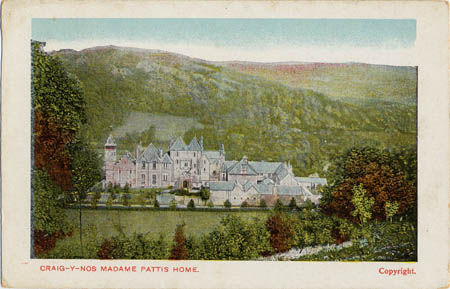
Patti owned a country house in Powys, Wales which she had it turned into a Gothic castle with a 150-seat theatre, and named it Craig-y-Nos [the Rock of Night]. The castle is now a hotel.
Horace Vernet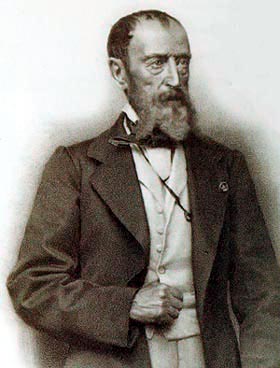
The picture is courtesy of H Berlioz, épisodes de la vie d’un artiste (Grenoble, Glénat / Musée Hector Berlioz, 2003), edited by Madame Chantal Spillemaecker, former director of the Musée Hector-Berlioz; we are most grateful to her.
The painter and artist Horace Vernet was director of the Villa Medici in Rome at the time of Berlioz’s stay in Italy in 1831-2 as winner of the Prix de Rome competion of 1830. Vernet lived at the Villa Medici with his family: his father Carle, his wife, and his daughter Louise. The family was very musical — Carle and Horace were devotees of Gluck (as was Berlioz), and Louise played the piano and sang (see below). Although Berlioz found his trip to Italy an unwelcome imposition from the musical point of view, his stay at the Villa Medici was made congenial by the friendliness of the whole Vernet family; he refers to them several times in the Italian chapters of his Memoirs; see notably chapters 34, 36, 39 (end) and 42 (end). Horace Vernet drew a picture of Berlioz during his stay in Rome. For an account of Berlioz’s relations with the Vernet family in Rome see the page on the Villa Medici.
Berlioz remained subsequently friendly with the Vernet family. Mme Vernet and her daughter Louise attended the performance of the Requiem at the Invalides on 5 December 1837 and Louise sent a letter of congratulations to Berlioz after the event. Vernet and Louise were invited to the première of Roméo et Juliette on 24 November 1839. Vernet supported Berlioz for his successful candidature to the Institut in June 1856 (CG nos. 2141, 2144), and subsequently was a congenial colleague to Berlioz.
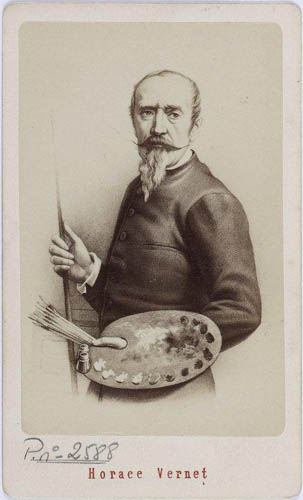
The photo on this carte-de-visite is by Etienne Neurdein (1832-1918); the image is reproduced here courtesy of the Bibliothèque nationale de France, Paris.
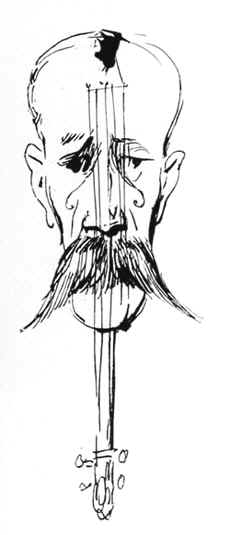
A copy of this cartoon by Vernet himself is in the Bibliothèque nationale de France.
Louise Vernet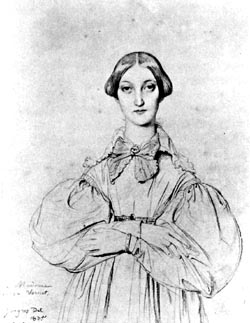
On the Vernet family see above. Louise Vernet was Horace Vernet’s daughter; Berlioz dedicated to her an early version of the song La Captive, which he composed in Subiaco in Italy.
Adolphe Sax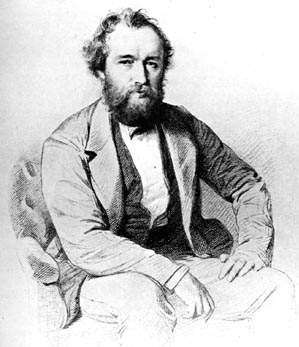
Born in Belgium, the instrument maker Adolphe Sax came to settle in Paris early in 1842, and it was not long before Berlioz discovered his talent: he devotes an extended section of an article in the Journal des Débats of 12 June 1842 to Sax and his instruments. Thereafter he was a close friend of Sax and an ardent supporter of his new wind instruments and his improvements to existing wind families. Berlioz was the first to write for the saxophone (Le Chant Sacré, 1844 arrangement), and predicted a great future for the instrument. He used the saxhorns, a family of brass instruments, in Les Troyens, and gave a prominent part to the soprano saxhorn in the last movement of the Te Deum. There is a detailed discussion of the relations between the two men in the page on Berlioz in Belgium.
© (unless otherwise stated) Monir Tayeb and Michel Austin for all the texts and images on Berlioz Photo Album pages.
All rights of reproduction reserved.


 Photo Album main page