



This page is also available in French

 Introduction
Subiaco is a small town of 4000 inhabitants, curiously built around a mountain in the shape of a sugar-loaf. The river Anio, which lower down forms the waterfalls of Tivoli, is the source of all its wealth as it supplies a few rather decrepit factories.
In some places this river flows through a narrow gorge. The emperor Nero had a dam built by means of a huge wall, of which a few traces are still visible; by blocking the water this wall caused the formation above the village of a very deep lake. Hence the name of the town, Sub-Lacu.
Thus Berlioz in his Memoirs (chapter 38). Together with Nice, Subiaco was the part of Italy that captivated Berlioz most, but unlike distant Nice, Subiaco could be reached on foot by a good walker like Berlioz — it lay some 50 km to the east of Rome beyond Tivoli. The picturesque town and its neighbouring mountains were a favourite haunt of painters and artists, and Berlioz will have heard of it from his fellow-laureates at the Villa Medici. He discovered Tivoli in June 1831 and soon formed the project of going to settle in Subiaco to escape from Rome. On 2 July he wrote to Mme Lesueur (CG no. 233, from Rome):
[…] I am going to settle without delay in the mountains of Subiaco, 18 leagues away from Rome, where I will resume my free life of Nice; unfortunately I will not find there the sea, that vast and beautiful sea which lay beneath my windows, seduced me with its shimmering green mantle, roared in unison with me on the days when I felt angry, and let me go to sleep on its white pebbles while licking my feet, on the days when I was at peace or sunk in melancholy dreams… But no matter! I need to be on my own again. […] I take a bad guitar with me, a double-barrelled gun, albums to make a notes and a few books; such modest baggage cannot tempt brigands, though in truth I would be delighted to meet them. […]
The moment he reached Subiaco after passing through Tivoli Berlioz was delighted (CG no. 236, 10 and 17 July, to his family):
At last there is rain! I can see clouds! Blessed be the sky of Subiaco, and cursed be the leaden sky of Rome which constantly scorches you and has neither thunder nor lighting! This is the most picturesque country I have seen in my whole life. It may not have the waterfalls of Tivoli, but you can see a raging torrent almost as large as the Anio; in two or three places it comes crashing down with as much noise if not majesty as the great waterfall of Tivoli. And then the mountains! and what mountains! I have just returned from them an hour ago. […]
Berlioz was so captivated with Subiaco that he kept going back there. After a fortnight in July he returned twice in September (CG nos. 240, 241), stopped there towards the end of October on his way back from Naples (CG nos. 246, 247, 250), stayed again around 20 November (CG no. 248), then again in early February 1832 (CG nos. 261, 263), and probably paid a final visit in April before departing for France (Memoirs, chapter 42). He would have stayed there even longer but for financial constraints: whereas at the Villa Medici Berlioz enjoyed free board and lodging, in Subiaco he had to pay for food and accommodation. ‘I go back to Rome when I have no money left. That is the irresistible reason that I have been detained here for the last fortnight’ he writes to his friend Albert du Boys from Rome in early March 1832 (CG no. 264). Subiaco was the ideal retreat, and it also reminded him of Meylan, as he wrote to his grand-father Nicolas Marmion (CG no. 240, 15 September 1831, from Rome):
[…] I have felt happier in the wild mountains on the borders of the kingdom of Naples, where I have already spent nearly a month and to which I will be returning shortly.
I find this solitary life delightful, wandering among the rocks, bathing in the torrent, and sharing the company of peasants who can be warm and good-natured. I am completely sheltered from the insipid worries of the city, and adapt all the more willingly to rustic manners as the constraints of the civilised world (I mean Rome) do not provide any compensation. I understand better than ever the pleasure you find in your solitude in Meylan. […]
Two days later he wrote to his friend Ferdinand Hiller (CG no. 241, 17 September):
[…] Are you still in your retreat at the Bois de Boulogne? I am going back to mine at Subiaco. There is nothing I like more than this life of wandering among woods and rocks, with all these good-natured peasants, sleeping during the day beside a torrent, and in the evening dancing the saltarello with the men and women who frequent our inn. I entertain them with my guitar; before I came they would only dance to the sound of the tambourine, so they are delighted with this tuneful instrument. I go back there to escape from the boredom which is killing me here in Rome. […]
The first letter cited above (CG no. 233) mentions brigands: this introduces a theme of particular relevance to Berlioz’s stay in Italy. For some time before his trip Berlioz had been attracted by the image, fashionable at the time, of the brigand, idealised as a free man who had emancipated himself from the constraints of civilised life. In 1829 he had set to music a poem by Victor Hugo entitled Song of pirates (CG no. 113), and not long after he composed a Song of brigands to words by his friend Humbert Ferrand (CG no. 149). Music from these earlier compositions (with different words) may have been re-used for the Song of brigands, one of the pieces of the Melologue he started in Nice in 1831 and completed in Rome a few months later. The last movement of the symphony Harold in Italy, composed in 1834 after his return to Paris, is entitled ‘Orgy of brigands’. The image of the brigand had a strong personal appeal for Berlioz at the time, and during his wanderings in the wild country around Subiaco he seems to have re-enacted in his imagination the lifestyle of a brigand, as references in his correspondence suggest. The spoken passage which introduces the Song of brigands in the Melologue is found almost word for word in letters early in 1831: ‘I would like to go to Mount Posilippo, to Calabria or the island of Capri and offer my services to the leader of a band, even if this means being just an ordinary brigand. Then at least I would witness magnificent crimes, robberies, assassinations and abductions […] Come now, that is real life!’ he declares to his sister Nancy (CG no. 213, 25 March), and similarly to Humbert Ferrand a fortnight later (CG no. 216, 12 April).
As well as a gun Berlioz regularly carried with him a guitar in his excursions to and around Subiaco, as the letter CG no. 233 specifies. Deprived of proper orchestras and orchestral concerts during his stay in Italy Berlioz fell back on the guitar as his main source of live music, whether to accompany evenings of operatic excerpts at the Villa Medici (CG no. 232; Memoirs, chapter 36), the dancing of peasants in and around Subiaco (CG nos. 236, 241), or his own improvisations (Memoirs, chapter 37). It may not be a coincidence that it is precisely in scores he composed later that had a direct Italian connection — notably the operas Benvenuto Cellini and Béatrice et Bénédict — that Berlioz made use of the guitar to accompany several choral movements. This suggests a personal reminiscence from his time in Italy.
Subiaco had other musical associations for Berlioz. He relates in the Memoirs how he first heard the pifferari in Rome around Christmas time but was even more struck by them in their original environment in the Abruzzi mountains (chapter 39). In another chapter of the Memoirs (38) Berlioz notates a tune he first heard in Subiaco sung by his friend Crispino; though he does not mention the fact in the Memoirs, he later adapted the tune in a chorus of Benvenuto Cellini. It was also in Subiaco that Berlioz completed in 1831 the overture Rob Roy which he had started in Nice, and composed in February 1832 the song La Captive on a poem by Victor Hugo, as he relates in the Memoirs (chapter 39):
[…] I remember one day watching my friend Lefebvre the architect working in the inn at Subiaco where we were staying; a movement of his elbow knocked down a book which was lying on the table where he was drawing, and I picked it up. It contained the Orientales of Victor Hugo, which happened to be open at the page with La Captive. I read this exquisite poem, and turning to Lefebvre
— If I had ruled paper, I said, I would write the music for this piece, because I can hear it.
— No problem, I will make you some.
Lefebvre then took a ruler and quickly drew a few staves, on which I jotted the melody and the bass line of this little song; I then put the manuscript in my wallet and forgot about it. A fortnight later, when back in Rome, they were singing at the director’s apartment and La Captive came back to my mind. […]
The song was first performed at the Villa Medici by Louise Vernet, to whom an early version was dedicated late in 1832; it turned out to be an instant success — almost everybody at the Villa Medici was singing it, including the servants (CG nos. 261, 263, 265-7). On his return to Paris, Berlioz developed and orchestrated the song, but it only reached its final form in 1848.
Berlioz left a physical trace of his passage in Subiaco which survived for many years. During his very first visit in July 1831 he built a small pyramid of stones on a mountain facing Subiaco (CG no. 236), which he mentions in the Memoirs (chapter 37):
[…] Facing it (sc. Subiaco), on the other bank of the river Anio, there is a large mountain shaped like the back of a whale, where nowadays it is still possible to see a small pyramid of stones which I patiently built one day when I was afflicted with spleen. French painters, dedicated admirers of these solitary haunts, have graciously called it after me. […]
A few years after returning from Italy, in a letter dated 27 September 1836 to Liszt, who was planning to go to Italy, Berlioz suggested he go and see the pyramid on his behalf (CG no. 478):
[…] If you go to Italy, you must go to Subiaco. If you go to Subiaco, enquire about the pyramid which I built on the tall rock on the left side of the Anio, and go to see it for my sake; I have heard that the shepherds have not demolished it completely. […]
Many years later, Berlioz was still curious to know what had happened to the structure. In a letter dated 23 December 1863 to Princess Sayn-Wittgenstein, who was now living in Rome, he writes (CG no. 2814):
[…] Tell me whether by any chance you have been to Subiaco, and whether you have seen a pyramid of stones I built on top of a mountain facing the village, THIRTY TWO YEARS ago. Last year French painters assured me that it was still in existence. […]

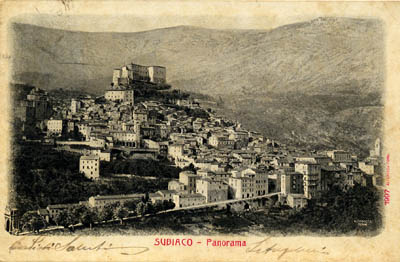
Subiaco in picturesUnless otherwise specified, the pictures reproduced on this page have been scanned from a postcard and a book in our collection. © Monir Tayeb and Michel Austin. All rights of reproduction reserved.
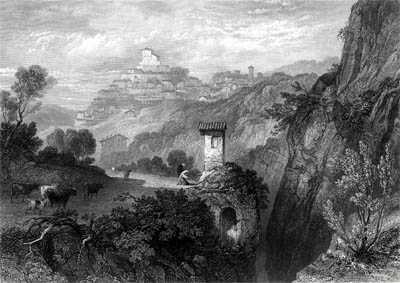
The original copy of the above engraving has been donated by us to the Hector Berlioz Museum and they hold the copyright for it.
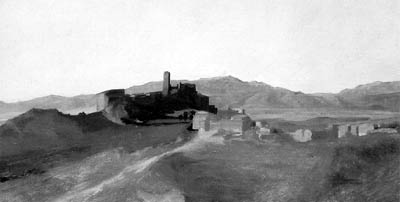
This is a painting by Corot (1827) and is entitled View of Olevano. It was one of the hill-top villages visited by Berlioz during his wanderings in the Roman Campagna and the foot-hills of the Abruzzi.
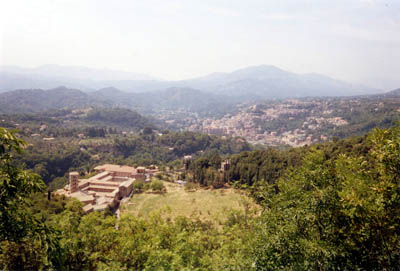
We are grateful to our friend Pepijn van Doesburg for sending us the above photograph, taken by himself.
© (unless otherwise stated) Michel Austin and Monir Tayeb for all the pictures and information on this page.
Copyright notice: The texts, photos, images and musical scores on all pages of this site are covered by UK Law and International Law. All rights of publication or reproduction of this material in any form, including Web page use, are reserved. Their use without our explicit permission is illegal.
 Back to Berlioz in Italy main page