


Contents of this page:

Introduction
The house of Nicolas Marmion, Berlioz’s grandfather
The house of Madame Gautier, Estelle Fornier’s grandmother

This page is also available in French

Copyright notice: The texts, photos, images and musical scores on all pages of this site are covered by UK Law and International Law. All rights of publication or reproduction of this material in any form, including Web page use, are reserved. Their use without our explicit permission is illegal.

Introduction

    Berlioz’s maternal grandfather Nicolas Marmion lived in Meylan near Grenoble and the young Hector and the rest of the family used to visit him every summer. It was in Meylan that he first met Estelle Dubœuf, his "youthful passion". Estelle and her sister Ninon would normally pass part of the summer with their maternal grandmother Madame Anne Gautier in Replat, above Meylan. Nancy Clappier, Madame Gautier’s niece, was a close friend of Berlioz’s mother and the two families would often meet socially in Meylan.

    Estelle Fornier (née Dubœuf), whom Berlioz refers to as his ‘Stella montis’ in the Memoirs, was born in 1797, six years before Berlioz. She was the younger daughter of a tax official from Grenoble. He first met her when he was 12 years old and fell in love with her instantly. It is not clear how many times they met. In the late 1820s Estelle married a man considerably older than herself, a rich lawyer called Casimir Fornier, who became president of the High Court in Grenoble. By this time Estelle had long disappeared from Berlioz’s life. She had six children, of whom four survived into adulthood. Her husband died in 1845, three years before Berlioz first revisited Meylan.

     In 1848, when he made a pilgrimage to Meylan, Berlioz wrote, anonymously, a letter to Madame Fornier, who at the time lived in Vif, evoking his childhood passion.

    Berlioz renewed his acquaintance with Estelle in September 1864 at her home in Lyon. He was accepted as a family friend by her and her son and his family, who by 1865 had moved to Geneva. Estelle’s son Charles and daughter-in-law Suzanne would visit Berlioz in Paris, and he would visit them and Estelle in Geneva every year, staying at the Hôtel de la Métropole, and later in Saint Symphorien back in France, until he was too ill to travel (see Memoirs and Correspondance générale, volume VII).

    In his will Berlioz left her a life annuity of 1,600 francs which helped to make her last years more comfortable. Estelle died in1876 and was buried in Saint Symphorien, where she lived towards the end of her life.

    This page tells the story of Berlioz’s romantic connection with Meylan in his own words. 

    The text on this page is our own, as is the translation of the excerpts from Berlioz’s Memoirs. We would like to express our gratitude to our friend Pepijn van Doesburg for sending us the photographs that he took in 2003 of the locations covered on this page. All rights of reproduction of these photos and of all the text and information provided here are reserved.

The house of Nicolas Marmion, Berlioz’s grandfather

    Berlioz describes his grandfather’s house thus:

My maternal grandfather, whose name (Marmion) is that of the famed warrior in Walter Scott, lived at Meylan, a village located about six miles from Grenoble, near the borders of Savoy. The village and its surrounding hamlets, the Isère valley stretching at their feet, and the mountains of Dauphiné which join there the lower Alps, all form one of the most romantic spots I have ever admired. Every year my mother, my sisters and myself would usually go there to spend three weeks towards the end of summer. My uncle (Félix Marmion), who at the time was following in the glorious steps of the great Emperor Napoleon, would sometimes come and join us.

(Memoirs, Chapter 3)

Nicolas Marmion’s house – view from the front

(full-screen view)

The Belledonne range is in the background.

Nicolas Marmion’s house – view from the side

(full-screen view)

Nicolas Marmion’s house – view from the back

(full-screen view)

The enormous Saint-Eynard is in the background.

(full-screen view)

(full-screen view)

Nicolas Marmion’s tomb in Meylan cemetery

(full-screen view)

(full-screen view)

The house of Madame Gautier, Estelle Fornier’s grandmother

Here Berlioz describes Madame Gautier’s house in Meylan and his first encounter with Estelle

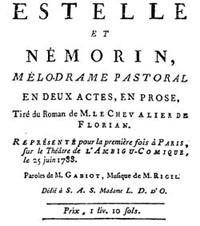
In the upper reaches of Meylan, close to the slope of the mountain, there was a small white cottage, surrounded with vineyards and gardens, from where there is a plunging view on the Isère valley. Behind are a few rocky hills, a crumbling old tower, woods, and the imposing mass of a huge rock, the Saint-Eynard: the place is evidently meant to provide the setting of a novel. That was the country house of Madame Gautier, who stayed there in summer with her two nieces, the youngest of whom was called Estelle. This name would have been enough to catch my attention; it was already dear to me because of the pastoral idyll of Florian (Estelle et Némorin) which I had found in my father’s library and read in secret over and over again. The real Estelle was eighteen, tall and elegant, with great eyes that smiled provocatively, hair that was worthy of adorning the helmet of Achilles, and feet, I will not say of an Andalusian but of a thoroughbred Parisian, and – pink boots! … I had never seen any before… You will laugh!… I must admit I have forgotten the colour of her hair (I believe they were black) and I cannot think of her without recalling the glitter of her great eyes and at the same time the little pink boots.

Her sight gave me an electric shock; in a word, I was in love with her. I lived in a trance. I hoped for nothing… I knew nothing… but I felt a deep anguish in my heart. Entire nights I would spend in despair. During the days I would hide in the maize fields, in the secret corners of my grandfather’s orchard, like a wounded bird, suffering in silence. Jealousy, that pale companion of even the purest love, would torment me at the merest word spoken by any man to my idol. I still shudder when I think of the sound of my uncle’s spurs as he danced with her! Everyone at home and in the neighbourhood would make fun of this poor twelve-year old broken by a love beyond his strength. She was the first to have guessed it all, and I am sure she must have greatly enjoyed it. [...]

No, time cannot change anything… other loves cannot obliterate the trace of the first one… I was thirteen when I ceased to see her…

(Memoirs, Chapter 3)

    The next time he briefly saw her, Berlioz was thirty years old and had just come back from his trip to Italy. On that occasion, his mother had mischievously asked him to deliver a letter to a Madame Fornier passing through the coach station en route from Vienne. He did not know that the recipient was in fact  Estelle Dubœuf:

When the coach arrived, I went forward with the letter in my hand, and asked for Mme F*******. « It is I, sir! » said a voice. It is her! said a dull thud in my chest. Estelle!… still beautiful!… Estelle!… the nymph of the Saint-Eynard, of the green hills of Meylan! It was the same demeanour, the same glorious hair, the dazzling smile!… But alas, where were the little pink boots?… She took the letter. Did she recognise me? I cannot say. The coach left. I returned home, still shaken by the event. [...]

(Memoirs, Chapter 3)

    Berlioz went back again to Meylan in 1848, on a visit to La Côte Saint-André after his father’s death « to mourn with [his] sisters in the paternal home » (Memoirs, chapter 58). Before returning to Paris he also wanted to see again Grenoble and the house of his maternal grandfather in Meylan.

What a strange thirst for pain – I wanted to salute the setting of my earliest emotional upheavals. I wanted at long last to embrace my entire past, to intoxicate myself with memories, whatever grief and sadness it might cause me. My sisters stayed back at La Côte: they understood that I wanted to be on my own for this sacred pilgrimage, which was going to stir in me so many intimate impressions which shun the company of even the most sympathetic witnesses…

On arriving at Meylan, in front of my grandfather’s house, recently sold to one of his tenants, I open the door and walk in; there was no one inside. The new owner had moved into a recently built annexe at the other end of the garden.
I then enter the sitting-room, where the family used to gather, in the days when we would come to spend a few weeks with our grandfather. It was still in the same condition, with its grotesque paintings and its extravagant multicoloured paper birds stuck on the wall.

Here is the chair where my grandfather would take a nap in the afternoons, here is his backgammon board. On the old sideboard I notice a small wicker cage which I built when I was a child. This is where I saw my uncle waltzing with the beautiful Estelle… I hurry to go outside.

Half of the orchard has been ploughed up… I look for a bench on which my father would spend hours in the evening lost in his dreams, his eyes fixed on the Saint-Eynard, this huge limestone rock, the outcome of the last prehistoric cataclysm. The bench has been broken, all that is left are two worm-eaten legs.
There was the field of barley where I would go and hide my grief, at the time of my first love sickness. It was at the foot of this tree that I started to read Cervantes.

And now to the mountain.

Thirty three years have elapsed since I last visited it. I am like a man dead since that time who is now coming back to life. In the process I am rediscovering all the emotions of my earlier life, as young and intense as ever…
I climb the rocky and deserted paths and make for the white house which I had only glimpsed from a distance, sixteen years earlier on my return from Italy – the house where Stella used to shine.

[…]

After crossing a field next to the farm I find at last the right way. Soon I can hear the murmur of the little spring… I am there… Here is the path, the row of trees resembling the one which misled me a moment ago… I feel it is there… that I am going to see… Heavens!… I am intoxicated with the air… my head is swimming… I stop for a moment and restrain my throbbing heart… I reach the avenue’s gate… A man wearing a jacket, presumably the prosaic landlord of my sanctuary, stands on the threshold, lighting a cigar… He looks at me with an air of surprise. I pass on without saying anything and continue to follow the path up… I must reach an old tower which used to stand on the top of the hill, from which I will be able to grasp the whole vista in a single glance.

I ascend without turning back, without a backward glance, I want first to reach the top… But the tower! the tower! I cannot see it… has it perhaps been demolished… No, here it is… the top has been demolished, and the neighbouring trees which have grown were hiding it from my sight.
At last I reach it. 

Nearby, close to the greenery of the young beeches, my father and I sat down, and I played for him on the flute the air of Nina’s Musette. Estelle must have come here… I may be occupying in the air the space her delightful shape once occupied… Let us see now… I turn back and my eye grasps the entire scene… the hallowed house, the garden, the trees, and below the valley, the meandering Isère, the Alps in the distance, the snow, the glaciers, everything she saw, everything she admired, I take in the blue air she breathed… Ah!… A cry, a cry that no human language can convey, re-echoes from the Saint-Eynard… Yes, I see, I see again, I adore… the past is present before me, I am young, I am twelve years old! life, beauty, the first love, the infinite poem! I fall on my knees and I shout to the valley, to the mountains and to the sky: «Estelle! Estelle! Estelle! » and I grasp the earth in a convulsive embrace, I bite the moss… I have a fit of isolation sickness… indescribable… furious…

Here is the edge of a slope where I was walking when she cried: « Take care! don’t go so near the edge!… »
This is the bush of brambles over which she leaned to pick wild berries… Ah! over there, on this platform, there was a rock on which her beautiful feet stepped, where I saw her standing in all her glory, contemplating the valley…
That day I said to myself in the sentimental and silly manner of children: « When I grow up, when I have become a famous composer, I will write an opera on Florian’s Estelle, I will dedicate it to her… I will deposit the score on this rock, and one morning she will find it, when she comes to admire the rising sun. »

(Memoirs, chapter 58)

Madame Gautier’s house

(full-screen view)

Madame Gautier’s house

(full-screen view)

The Isère valley and the Alps (Belledonne range) are in the distance.

The Isère valley and the Alps -
view from Madame Gautier’s house

(full-screen view)

Ruins of the Fort du Bourcet

(full-screen view)

On top of the hill, the "old tower" which Berlioz mentions in the Memoirs, made way for the military fort in the 1870s.

"... the imposing mass of a huge rock..."
The
Saint-Eynard

(full-screen view)


The Saint-Eynard

(full-screen view)

This old postcard is in our collection.

Related pages on this site:

Berlioz Biography

Berlioz Mémoires (in the original French)

Berlioz’s birthplace – La Côte Saint-André

Berlioz Photo Album

The Hector Berlioz Website was created by Monir Tayeb and Michel Austin on 18 July 1997;
The Berlioz in Meylan pages created on 15 April 2004.

© 2004-2009 Michel Austin and Monir Tayeb for the text and Pepijn van Doesburg for the photos on this page.

Back to Home page
