Introduction
1843
1852-1856
Benvenuto Cellini
November 1852
February 1855
February-March 1856
After 1856
Liszt and the princess
Weimar connections
The ducal family
Chronology
Selected letters of Berlioz and others
Weimar in pictures: Weimar in times past Weimar in our time Goethe and Schiller in Weimar
This page is also available in French
Copyright notice: The texts, photos, images and musical scores on all pages of this site are covered by UK Law and International Law. All rights of publication or reproduction of this material in any form, including Web page use, are reserved. Their use without our explicit permission is illegal.


 Introduction
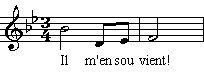
Weimar is a city of artists and the ducal family knows how to honour the arts
(Berlioz, Memoirs, Travels to Germany I Letter 10 – in 1843)
Among great French composers none has more connections with Weimar than Berlioz
(Liszt, letter to the Grand-Duke Carl Alexander – in 1883)
Weimar holds a special place in the story of Berlioz’s connections with Germany; his relations with the city stretched over a period of over two decades, from 1843 to 1863 and indeed beyond. In this period Berlioz developed many links with musicians and writers who at one time or other were active in the city, especially in the years from 1852 to 1856, when a circle of young musicians and writers congregated in Weimar around Liszt, Berlioz’s friend and supporter of long-standing, and Liszt’s companion Princess Sayn-Wittgenstein, who at the time were the driving forces in the musical life of the city. These relationships were all lasting and of significance in Berlioz’s career. The common thread running through the entire story was the sympathetic patronage exercised by successive Grand-Dukes and Grand-Duchesses of Saxe-Weimar: Carl Friedrich (1783-1853) and his wife Maria Pavlovna (1786-1859), sister of the Tsar of Russia, his son and successor Carl Alexander (1818-1901) and his wife Wilhelmine Marie Sophie Louise (1824-1897), daughter of the King of the Netherlands. All these rulers consciously perpetuated a remarkable tradition of enlightened support for the arts and intellectual activity that went back to Carl Friedrich’s father Carl August (1757-1828), the friend and patron of Goethe, under whose rule Weimar, despite its modest size, had been raised to the status of intellectual centre of the German world and became known as the ‘New Athens’. Needless to say, all the members of the ducal family were fluent in French (the correspondence of Liszt and Carl Alexander, both of them German in upbringing, was conducted entirely in French).
Berlioz’s relations with Weimar may be divided for convenience into 3 periods: the first visit in 1843; the period of closest relations between 1852 and 1856, when Liszt’s influence in Weimar was at its height; and the period after 1856 when Liszt’s influence waned and he and Princess Sayn-Wittgenstein eventually left Weimar for Rome and Italy, but where the court of Weimar continued to maintain friendly relations with Berlioz.
 1843
1843On his return from Italy in 1832 Berlioz’s travel plans for Germany focused initially on Berlin. Weimar was of course well-known to him, but not at this stage as a musical city, rather as the cultural and intellectual centre that was associated with the names of two of his literary heroes, Goethe and Schiller, as well as their patron the Grand-Duke Carl August (cf. CG no. 100). Berlioz was already familiar with the works of these poets, though only in French translation. In 1828 he had discovered Goethe’s Faust in the translation of Gérard de Nerval and was prompted to write the Huit Scènes de Faust and publish it immediately as his opus 1, though he soon withdrew the work, which was later developed into the Damnation of Faust (Memoirs, chapters 26 and 54). Berlioz even wrote to the aged poet sending him a copy of the newly-published work (Correspondance Générale no. 122, 10 April 1829; hereafter CG for short), but Goethe, relying on the negative judgement of the composer Zelter, did not bother to reply.
Initially Berlioz did not have any musical connections in Weimar. The first potential link to develop was with Jean-Baptiste Chélard (1789-1861), violinist, composer and conductor, whom Berlioz met in Paris in the 1820s when Chélard was a member of the orchestra at the Opéra (cf. CG nos. 126, 154). After several attempts to start a career abroad Chélard eventually settled in Weimar as Kapellmeister in 1836, though he never made a great impression there or elsewhere, and Berlioz clearly did not think of him as an obvious contact to be cultivated. Much more promising was the musician and writer Johann Christian Lobe (1797-1881), ‘this model of the true German musician’ as Berlioz was to call him later (Memoirs, Travels to Germany I, 3rd letter). A friend of Goethe, he played the flute in the theatre orchestra in Weimar till 1842 and founded a musical institute in the city. Lobe was among the earliest and warmest supporters of Berlioz in Germany: ‘I was your friend from the moment I heard the Francs-Juges overture, and shall remain so to the end of my life’, he wrote to Berlioz a few years later (CG no. 793). The overture had been performed in Weimar at a concert in 1837 (19 March), and it elicited an enthusiastic open letter by Lobe in Schumann’s Neue Zeitschrift für Musik the following month (9 May), in which Lobe expressed the hope that Berlioz would come to Weimar. Schumann, himself an early advocate of the composer, promptly sent Berlioz a copy of the article (CG no. 496bis [vol. VIII]).
When Berlioz eventually set out in December 1842 for his much-delayed trip to Germany, Weimar was thus an obvious stop on his itinerary: before the end of the month he contacted Lobe and received from him a warm and helpful letter (CG nos. 792, 793), though Lobe advised him that it would be prudent to conciliate Chélard to avoid friction, and Berlioz took the advice to heart (CG nos. 796, 798bis and 798ter). He arrived in Weimar around 18 January coming from Frankfurt and stayed there till the 28th, when he left for Leipzig (CG nos. 806, 807). After the disappointments of the start of the trip, the stay in Weimar marked the beginning of a more positive phase. But it was also in Weimar that Marie Recio, whom Berlioz had attempted to leave behind in Frankfurt, caught up with him and they made the rest of the trip together (CG no. 815).
Though a number of letters of January 1843 have survived they give little detail about the stay in Weimar. Somewhat fuller is the account published by Berlioz later in the year in the third of his letters about the German trip (Journal des Débats, 28 August; Critique Musicale vol. V pp. 275-84), soon reproduced together with the other letters in the first of the two-volume Voyage musical en Allemagne et en Italie of 1844, and eventually incorporated in the posthumous Memoirs.
The musical resources of Weimar at the time were modest; the theatre chorus was poor, the orchestra as usual did not have a cor anglais (cf. CG no. 970 [vol. VIII]), ophicleid, or harp, and the strings had to be strengthened with additional players (cf. CG nos. 792, 793, 799). Berlioz sought an audience with the Grand-Duke and Grand-Duchess but does not seem to have obtained it (CG no. 801); the silence of the Memoirs is indicative. The concert on January 25 in the theatre comprised the familiar Francs-Juges overture, the Fantastic Symphony, the second movement of Harold in Italy, and three songs sung by Marie Recio (Le Jeune pâtre breton and Absence with piano accompaniment, and La Belle voyageuse with orchestra). As usual, her participation is not mentioned in the Memoirs.
Berlioz professed himself pleased with the results and the reception he received (CG nos. 806, 806bis [vol. VIII], 807), and Weimar was the only city in the whole of his tour where he was allowed to keep the full takings from the concert. It was his intention to pay another visit to Weimar later in his trip before returning to Paris, though the plan fell through (CG no. 831). Mindful of Lobe’s warning, Berlioz made a point of keeping in touch with Chélard during the latter part of his trip (CG nos. 810, 826, 831). In the letter about the visit to Weimar published in the Journal des Débats he went out of his way to praise the help he had received from Chélard, referring to him as ‘my learned compatriot’ (mon savant compatriote) and as a ‘noble and worthy artist’ (artiste noble et digne; Critique Musicale V, pp. 281-2). Chélard was overjoyed at this unaccustomed public recognition, and it raised his hopes for the future (CG no. 864). But the flattering epithets were quietly dropped by Berlioz from the version he reproduced many years later in the Memoirs. Chélard was eventually supplanted by Liszt in Weimar; the rest of his musical career was undistinguished and there are few subsequent references to him in Berlioz’s correspondence; he died in 1861 (CG nos. 2071, 2207bis [vol. VIII], 2536).
The friendship with Lobe did however endure, though the preserved correspondence of Berlioz with him is not extensive (for the sequel see CG no. 1655 and in vol. VIII nos. 1598bis, 1663bis, 1751bis and 2707bis). Lobe moved from Weimar to Leipzig in 1846 where he edited his own musical journal (cf. CG no. 1444). Berlioz was to meet him there later, and as late as April 1863 made a point of inviting him to come and hear Beatrice and Benedict in Weimar (CG no. 2707bis).
1852-1856For many years Weimar disappeared from Berlioz’s horizon, despite the sympathetic reception he had received. It was thanks to Liszt that he was invited back years later, and this time Weimar came to play an exceptional part in his musical career. The open letter which he published in August 1843 about his visit to Mannheim and Weimar was actually addressed to Liszt, but it does not betray any awareness that Liszt had been developing connections with the city even before Berlioz’s visit in 1843. Liszt performed in Weimar for the first time in November 1841 and immediately made a great impression on the public and on the ducal family. He returned in October 1842, and the following month (2 November) was appointed special Kapellmeister. The contract specified that he would devote 3 months every year to his task, and early in 1844 Liszt conducted a first series of concerts. Berlioz no doubt heard of these developments; he saw Liszt on several occasions in these years, in Paris in April 1844 (CG nos. 896-8), in Bonn in August 1845 at the Beethoven celebrations, and again in Prague in April 1846. The two were in correspondence with each other, and in a letter of June 1845 Berlioz, aware that Liszt was seeking to build up the instrumental resources of the Weimar orchestra, recommended to him an oboe and cor anglais player for that purpose (CG no. 970 [vol. VIII]).
For some years Liszt’s association with Weimar was only part-time. But in February 1847 during a tour in Russia he met Princess Sayn-Wittgenstein (cf. CG no. 1108) who persuaded him to give up the career as wandering virtuoso he had been pursuing during the 1840s and settle with her in Weimar, which they did in 1848 (but they were never able to marry). As well as devoting himself to composition, Liszt as full-time Kapellmeister replacing Chélard intended to carry out, with the support of the ducal family, his project of making Weimar into a new centre for progressive music. Again, Berlioz soon learned of these developments: a letter of Liszt to him in January 1849 tells Berlioz of his work there and the forthcoming production of Wagner’s Tannhäuser (CG no. 1242bis [in vol. VIII]). Liszt’s advocacy was indeed devoted in the first instance to Wagner, to whose music Liszt had recently become a devoted convert, and whom he assisted personally in many ways: Tannhäuser in 1849 was followed by the first performance of Lohengrin in August 1850. But next to Wagner Liszt also had in mind to champion, and with equal determination, the music of Berlioz, his friend of longer standing: their first meeting dated as far back as the première of the Fantastic Symphony in 1830 (Memoirs, chapter 31; CG no. 190), and they had kept in touch ever since despite their travels and commitments. Liszt constantly tried to support his friend: for example in January 1839 he published in the Revue et Gazette Musicale an article in praise of Benvenuto Cellini shortly after the opera’s ill-fated première at the Opéra (CG no. 622). Yet it had apparently never occurred to Berlioz that Liszt might use his new position for his benefit, and it came as a complete surprise to him when in August 1851 he heard that Liszt proposed to stage Benvenuto Cellini in Weimar (CG no. 1426).
The failure of Benvenuto Cellini at the Opéra in September 1838 was one of the most important setbacks in Berlioz’s career; the work was never again performed in Paris in his lifetime, though in the next few years Berlioz did salvage some of the music for publication. The full score of the overture, which Berlioz often performed as a concert piece in Paris and abroad, was published by Schlesinger in 1839, as were 9 of the opera’s arias with piano accompaniment (cf. CG no. 1690). In 1841 Berlioz arranged the original version of Teresa’s aria in Act I as a piece for violin and orchestra, Rêverie et caprice, and in 1843-4 he adapted some of the opera’s music for the Roman Carnival overture. Both pieces figured frequently in his tours abroad, and the second version of Teresa’s aria was sung several times on its own in his 1843 tour of Germany and subsequently. But Berlioz evidently did not believe that the opera as a whole had any future in France or anywhere else, and the work was shelved for many years. It is striking in this connection that when Berlioz was appointed conductor of the Drury Lane theatre in London in 1847 and was required to contribute an opera for the forthcoming season he did not think of reviving Benvenuto Cellini but instead thought of adapting La Damnation de Faust for the purpose.
Berlioz gratefully accepted Liszt’s offer and promptly set to work to tidy up the (still unpublished) score before sending it to Liszt; this involved reinstating several passages which had been cut at the Opéra in 1838 (CG nos. 1426, 1430). In this form the opera, in a German translation by A. F. Riccius, was successfully performed three times in Weimar on 20, 24 and 27 March 1852. Berlioz, absent in London and unable to attend, was kept informed by Liszt (CG nos. 1449, 1459), to whom he was very grateful for his efforts (CG nos. 1462, 1463, 1471, 1489); nor did he fail to express his gratitude to the Grand-Duchess (CG no. 1464). But Liszt, with the assistance of his pupil Hans von Bülow who published two articles on the opera in April 1852, had soon become convinced that the second act needed drastic changes, and besides the original opera was longer than the norm in Germany (cf. CG no. 1501). These changes he suggested to Berlioz in a (lost) letter of June 1852; it is possible in fact that Liszt and von Bülow had already made cuts and changes to the work at the fourth performance on 17 April, prior to consulting Berlioz (as suggested by David Cairns), and before the publication on 30 April of the second article in which Bülow recommended that changes be made to the opera. Be that as it may, Berlioz was prepared to agree to the proposed changes and to some drastic recasting of the second act to save some good music, but significant cuts had to be made, and the shortened opera was now divided into three acts instead of the original two (CG nos. 1499, 1501). In this form the opera received a further four performances in November 1852 (CG nos. 1520, 1532, 1533, 1537, 1542), and another two in February and March 1856 (CG nos. 2076, 2092, 2093, 2100, 2104, 2128), this time in a new German translation by Peter Cornelius (CG no. 1690). These were the only performances in Germany in Berlioz’s lifetime (there was talk of staging the work in Dresden in 1854 and 1855 [cf. CG no. 1690], but nothing came of this, nor of other plans elsewhere, such as Karlsruhe — CG nos. 1542, 1548, 2351). The work was revived by Hans von Bülow in Hanover in 1879 — Bülow felt a close personal connection to the opera which dated back to his involvement with it at Weimar in 1852 — and his example was followed elsewhere in Germany where it became part of the regular operatic repertoire.
This is not the place to elaborate on the changes made in the process to the opera, which turned the original ‘Paris version’ into what was to become the ‘Weimar version’, nor to express a view on the rival merits of the different versions (see for example the pioneering articles published by Julien Tiersot in 1905 in his Berlioziana series; NBE vol. 1a, pp. XI-XXIII; David Cairns, Berlioz II [1999], pp. 492-7; the articles by Hugh Macdonald, Christian Wasselin and Pierre-René Serna on this site; and Serna Berlioz de B à Z [2006], pp. 18-32). It could be suggested that the root cause of the opera’s (and Berlioz’s) difficulties was that from the start Berlioz was never in undivided control of the work, since he did not write the libretto himself (unlike for l’Enfance du Christ, The Trojans and Beatrice and Benedict later), not to mention the problems caused later by performers and singers. Suffice it to say that Berlioz was immensely grateful to Liszt and to his princely patrons for resurrecting the work successfully, as letter after letter attests. He readily accepted the changes suggested to him by Liszt (CG nos. 1499, 1501), and went on to make, without prompting, further revisions and changes of his own down to 1856 (CG nos. 1538, 1617). He professed himself delighted with the results which he thought an improvement on the original version (CG nos. 1532, 1537, 1542, 1563, 1609, 1617, 2100), and there is nothing in his correspondence to suggest that his real wish was to return eventually to the version of 1838 in one form or another. When following the success in Weimar the opera was staged at Covent Garden in London in 1853 in an Italian translation, it used the Weimar revisions as the starting point (CG nos. 1563, 1568, 1581, 1589, 1609, 1617). Berlioz decided to sanction the Weimar version by publishing it, a decision of principle taken as early as summer 1853 and actively pursued subsequently (CG nos. 1620, 1690, 1918). In the end the vocal score was published by Litolff in Brunswick in 1856 with the French text and the German translation of Cornelius (CG nos. 1935, 2012, 2143, 2149, 2159, 2179; the piano transcription of the overture was by Bülow – CG no. 1776); writing to Liszt, Berlioz describes the publication as ‘our edition of Cellini’ (CG no. 1995). The work was dedicated, appropriately, to the Dowager Grand-Duchess of Weimar (CG nos. 1918, 2012, 2013, 2029, 2191, 2199bis [vol. VIII]). Whether given the opportunity Berlioz would have made further revisions to the work is impossible to say. The failure of the London production on 25 June 1853 deprived the composer of the chance to test his work in a series of performances under his personal direction (the London performance was the only one of the work he ever conducted himself; cf. CG no. 2104). Late in 1856 and early in 1857 there was talk of a production in Paris at the Théâtre Lyrique with some changes and the introduction of spoken dialogue, but nothing came of this (CG nos. 2178, 2183, 2195, 2209; cf. NBE vol. 1d, Appendix 4). Thereafter there are few mentions of the work in Berlioz’s correspondence until July 1863 when he signed a contract with Choudens in Paris: the contract gave Choudens full rights for the publication of the vocal and full scores of the opera, in its Weimar version but with the French libretto. The vocal score appeared in 1865 with a few cuts in the recitatives (CG nos. 2660, 2827-8, 2855, 2991); the full score was only published in 1886.
As well as inviting Berlioz to hear the revived Cellini, Liszt insisted in June that he come to conduct a concert of his own music (CG nos. 1496, 1505, 1510, 1511). The resulting visit of Berlioz and Marie Recio in November was ‘the most delightful excursion [he] had ever made to Germany’ (CG no. 1542). The reception he received exceeded in warmth anything he had experienced before, as his letters indicate (CG nos. 1532, 1533, 1537, 1542). He heard his revised opera in dedicated performances before a sympathetic audience (17, 21, 23 November), and the success of the work encouraged plans to stage it elsewhere as well, though of these, as mentioned earlier, only London was to materialise. He conducted a highly successful concert comprising the first four parts of Romeo and Juliet and the first two of the Damnation of Faust (20 November). He was repeatedly entertained, by the family of the Grand-Duke, by Liszt and Princess Sayn-Wittgenstein, and by the musicians of Weimar and other cities (21, 22, 23 November). The Grand-Duke conferred on him the insignia of the White Falcon (cf. CG no. 1725). The festivities attracted visitors from many cities (CG nos. 1533, 1542, 1563) and received favourable coverage in the German press (CG no. 1561). Berlioz was able to renew links with old acquaintances who had come to Weimar for the occasion, such as Robert Griepenkerl from Brunswick. Most important for the future were the new connections he made in November 1852 or subsequently with members of Liszt’s circle, such as Hans von Bülow, who had helped to revise the score of Cellini. The visit to Weimar led to the resumption of his musical travels to Germany and the most successful series of concerts he ever gave there, notably in Frankfurt, Hanover, Leipzig, Dresden, Baden-Baden and Weimar itself, where he was invited to return. After his stay in November he remained in regular contact with Liszt about all his musical activities, and their correspondence was at its most sustained in the period from 1852 to 1856. He planned to make a stop in Weimar in April 1854 to see Liszt and the young Grand-Duke, whose father had died the previous year (CG nos. 1717, 1725, 1726), though this had to be postponed till early May on his return from Dresden (CG nos. 1738, 1751bis [vol. VIII], 1753, 1756). A minor detail: when leaving Paris Berlioz had forgotten to take with him the decorations he had received from the previous Grand-Duke, and had to get them sent specially ahead of his arrival (CG nos. 1725, 1739, 1746). At the end of the year he was formally invited to return to Weimar early in 1855 for another festival that would be devoted to his own music (CG nos. 1811, 1812, 1847, 1869).
Berlioz’s visit to Weimar in February 1855 was if anything even more successful than that of November 1852. He gave two concerts and was pressed to give a third, which he found impossible despite having prolonged his stay longer than expected (11-27 February), which forced him embarrassingly to postpone a projected concert in Gotha. The first concert on 17 February was a more formal affair, held in a hall within the ducal palace, with on the programme excerpts from his works and the first performance of Liszt’s new piano concerto in E flat, with Liszt himself as soloist (CG nos. 1880, 1897, 1899, 1903). The second, on 21 February in the theatre, was something very special, not just because of its length but especially because of the programme. The concert started with l’Enfance du Christ, a natural choice in view of its recent success at its first performances in Paris in December 1854. This was followed by the Fantastic Symphony, but this time not on its own, as in all the numerous performances that Berlioz conducted abroad from 1842 onwards, but with its sequel The Return to Life. The two works had last been played together in May 1835, and the Return to Life was not performed again till the Weimar concert. It was now presented for the first time in a staged version and with the original monologues of 1831 extensively revised (CG nos. 1897, 1899, 1903). This was Berlioz’s own very personal idea, and calls for a word of comment.
It is likely that the revised work was intended by Berlioz as a homage to Harriet Smithson, as the actress who had introduced Berlioz to Shakespeare as far back as 1827. The death of Harriet less than a year ago, on 3 March 1854, had deeply affected Berlioz (CG nos. 1701, 1702, 1704, 1705, 1708; Memoirs, chapter 59). Liszt was particularly connected with Berlioz’s involvement with Harriet, and had been one of the witnesses at their wedding on 3 October 1833. On the occasion of her death he sent Berlioz a heartfelt letter of sympathy which Berlioz quotes prominently in the Memoirs, at the end of the account of Harriet’s death. The revisions made for the 1855 performance of The Return to Life emphasised the central Shakespearean inspiration of the work; among other changes two passages in the monologue which mentioned Beethoven were removed. The connection with Harriet was brought out by introducing the idée fixe of the Fantastic Symphony twice, during the first song (Le pêcheur) and at the end of the work after the Fantasia on the Tempest.
Another likely explanation for Berlioz’s choice of programme (which does not exclude the first one) lies precisely in the unexpected juxtaposition of l’Enfance du Christ with the two works that followed. Berlioz’s letter to Liszt at the beginning of the year (CG no. 1869), in which he proposed combining a ‘pious’ concert with an ‘impious’ one, gives a clue. Berlioz was gratified by the success of his sacred trilogy but at the same time rather irritated at the suggestion that he had changed his style (cf. CG nos. 1847-8, 1851, 1853; Memoirs, Post-Scriptum). He may have wanted to reassert his artistic identity by performing in the same concert completely different works, the gentle oratorio and the iconoclastic manifestos of his earlier years. In Weimar he felt he would find a sympathetic audience that would be receptive to both; as his letters show, it was the success of the Return to Life that pleased Berlioz most, and he dwells on it at length (CG nos. 1897, 1899, 1903). He then quickly followed up the Weimar performance by having the work published complete for the first time and in its revised form, under the title Lélio, or The Return to Life (CG nos. 1907, 1916, 1918); the vocal score appeared in December (CG no. 2070), and the full score the following year (CG no. 2169).
As in November 1852, Berlioz was entertained and fêted generously, and invited to return to Weimar the following year, when Liszt had the intention of staging Benvenuto Cellini again (CG nos. 1902, 1908, 1975). The day before his second concert he was even made an honorary member of the Neu Weimar Verein (CG nos. 1899, 1903). As he comments, ‘they form a club of young artists referred to as progressive, whose standard-bearer I am supposed to be’. The thinking in Liszt’s circles in Weimar is made clear by the reaction of Princess Sayn-Wittgenstein to Berlioz’s election to the Institut the following year: it was ‘a family celebration for all the musicians of the future’ (CG no. 2148ter, contrast no. 2143). Herein lay the roots of a problem that was to cloud Berlioz’s relations with Liszt in years to come: Berlioz was not sectarian in his way of thinking, and did not want to be enlisted as the standard-bearer of any particular movement or school (cf. CG no. 2274).
To avoid the embarrassment of the previous year Berlioz went first to Gotha where Liszt, though unwell, insisted on being present at Berlioz’s concert (CG nos. 2093, 2094); they then travelled together to Weimar where they arrived on 8 February. As in 1855, Berlioz gave two concerts (CG no. 2076). The first was at court on 17 February and comprised excerpts of Berlioz’s music with the Corsaire overture as a novelty to the Weimar audience (CG no. 2100), and a piano concerto by Litolff played by Berlioz’s protégé the young prodigy Théodore Ritter (Litolff was both a practising musician and the director of the publishing firm in Brunswick which issued the first edition of Benvenuto Cellini at the end of the year). The second concert, for the benefit of the widows and orphans of musicians, took place on 1 March in the theatre, and consisted of the first complete performance in Weimar of the Damnation of Faust (one wonders how Goethe would have judged the work). Berlioz makes no particular comment on the first concert but was pleased with the second (CG nos. 2104, 2128), though his correspondence emphasises again his delight at hearing the final version of the revised Benvenuto Cellini, this time in the new translation by Cornelius (CG nos. 2092, 2093, 2100, 2104, 2128; cf. CG nos. 2101, 2101bis). He was able to hear the first of two performances on 16 February, but not the second on 16 March. Liszt wrote to him about it two days later (CG no. 2109, cf. 2115) – it turned out to be the last performance of the work in Berlioz’s lifetime.
During his stay Berlioz also had the opportunity to hear for the first time in Weimar music by Wagner: Liszt conducted two performances of Lohengrin, the first on 18 February (or not long after) and the second on the 24th, but these were to lead to public controversy and the first rift between the two friends. But the truth of what happened is far from clear, and Berlioz’s role in the controversy is known only at second hand. He only makes one brief allusion in a letter four months later (CG no. 2128), and seems to have wanted to play down the episode; his earlier letter to his sister Adèle is conspicuously reticent on the subject though it hints at a certain reserve towards Liszt (CG no. 2104). Liszt on the other hand took the matter very much to heart, as his letters show, and rightly or wrongly he found Berlioz’s attitude spiteful and motivated by envy (CG V pp. 272 n. 2 and 304 nn. 1-2). The known facts are few. Berlioz and Marie Recio walked out of the first performance during Act II, though they stayed through the whole of the second performance. According to a report in a Dresden paper which was picked up in La France musicale on 20 April, there was at some point an open argument about Wagner’s music between Litolff and Berlioz on one side, and Liszt on the other. In the coming months, Berlioz and Liszt continued to correspond as though nothing had happened (CG nos. 2109, 2115, 2149, 2178), but the letters no longer have the same spontaneous warmth and openness as in previous years.
After 1856As on previous occasions, Berlioz was once more urged by the Grand-Duke to return to Weimar as soon as possible (CG no. 2104), but it would be many years before this would take place. In August 1858 he was unable to take up an invitation from Princess Sayn-Wittgenstein to pay a visit after his concert in Baden-Baden (CG no. 2317), and it was not till April 1863 that he was back in Weimar.
In the meantime Liszt’s position in Weimar weakened and it eventually disintegrated altogether. Despite the support of the ducal family, Liszt had always faced opposition both locally and more widely in conservative musical circles in Germany (cf. CG no. 2093). As an illustration, the violinist Joachim, appointed leader of the Weimar orchestra in 1850, left in 1852 to join the orchestra in Hanover; he subsequently sided with Brahms in the reaction against Liszt and Wagner. Liszt’s support for Wagner, a political exile from Germany throughout the 1850s, and his relationship with the Princess, were standing grievances against him (Berlioz’s correspondence is noticeably reticent on both issues). Matters came to a head late in 1858 at the theatre in Weimar when on 15 December Liszt conducted the first performance of Cornelius’ opera The Barber of Baghdad (cf. CG no. 2521); there was a hostile public demonstration, and Liszt immediately resigned his post as conductor in disgust. The Princess eventually left Weimar for Rome in 1860, and Liszt followed her there the following year.
Berlioz and Liszt never ceased to be friends; they kept in touch at least indirectly, and performed services for each other whenever possible. But over the next ten years they gradually moved apart, and this can only have been painful to both. Music had brought them together in 1830 and cemented their friendship for two and a half decades, to the mutual benefit of both, but it was now increasingly driving a wedge between them. The point of contention was ‘the music of the future’, or in other words Liszt’s boundless admiration for Wagner which Berlioz was unable to share. For Berlioz ‘the music of the future’ became synonymous with ‘the school of mayhem’ (l’école du charivari). A letter of Berlioz to Humbert Ferrand of 29 October 1864 shows how far the two men had moved apart by that time: ‘Liszt came to spend a week in Paris, we dined together twice, and since we carefully avoided any musical conversation we spent a few delightful hours together. He has returned to Rome, where he plays music of the future before the pope who wonders what it all means’ (CG no. 2920). But Liszt, for his part, never ceased to champion the music of Berlioz.
Yet the growing distance from Liszt was partly compensated by a new relationship. The most important result of the visit of 1856 was Berlioz’s decision to undertake, at long last and after much resistance, the composition of the great opera based on Virgil’s Aeneid which had haunted him since his childhood and increasingly in the early 1850s (Memoirs, chapter 59). He had already mentioned the project during his visit in 1855 (CG no. 1903, in a P.S.). On that occasion he resisted the pressure applied, no doubt by Liszt and especially Princess Sayn-Wittgenstein. But in 1856 he gave way, and it was the Princess who won the day. Berlioz’s correspondence with her had been pursued for several years already (CG no. 1463, the earliest preserved letter, dates from 1852), but from May 1856 onwards it blossomed in a remarkable way. The composition of Les Troyens was at first the guiding topic of their correspondence. Berlioz repeatedly acknowledged the role of the Princess in persuading him to write the work, and the completed score was dedicated to Virgil and to her (CG nos. 2264, 2293, 2799, 2814; Memoirs, Postface). But their correspondence expanded beyond into a wide range of subjects, as the Princess had given him license to confide in her freely, despite differences of outlook (such as over religion). As a result their correspondence continued, with intermissions such as the move to Rome, till 1867, and it helped to bridge the gap with Liszt (the correspondence with Liszt stops in 1864). Liszt, for example, was kept informed of the composition of Les Troyens and continued to show interest in the new work, as indeed in Berlioz’s last major work Beatrice and Benedict (CG nos. 2632, 2634, 2651).
During his visits to Weimar in 1850s Berlioz met with many members of Liszt’s circles, and his letters to Liszt mention them several times collectively (CG nos. 1538, 1848, 1927, 1959, 2056). But of these only a few developed deeper and more lasting relationships with Berlioz. For example the composer Joseph Joachim Raff (1822-1882) is mentioned as a friend in a number of letters from 1854 to 1856 (cf. CG no. 1899), but there is no surviving trace of any correspondence between him and Berlioz and he is not mentioned again in Berlioz’s letters thereafter. Three names however stand out.
The relations of Berlioz and Hans von Bülow (1830-1894) are traced in detail elsewhere: Bülow’s reactions to Berlioz mirror those of his mentor and father-in-law Liszt – Bülow never lost his admiration for Berlioz and never ceased to promote his music, but was hurt by Berlioz’s rejection of Wagner.
A different pattern is illustrated by Peter Cornelius (1824-1874), who translated Benvenuto Cellini for the Weimar performances of 1856 as well as l’Enfance du Christ, the Return to Life and La Captive which were all performed in Weimar (CG nos. 1690, 1869, 1880). His preserved correspondence with Berlioz starts in 1853 and continues till as late as 1866. Cornelius, an exceptionally likeable figure, achieved the feat of being simultaneously an admirer of Berlioz and of Wagner while preserving the friendship of both. It was he who in an article in praise of Berlioz published in Berlin (cf. CG no. 1690) coined the phrase ‘the three Bs’, by which he meant Bach, Beethoven, and Berlioz (later distorted by Hans von Bülow to Bach, Beethoven and Brahms). He openly acknowledged the debt of his opera The Barber of Baghdad to Benvenuto Cellini (CG no. 2521), and he and Berlioz remained very close to the end (CG nos. 2521, 2522, 2594, 2599, 2605, 2843, 3191). Berlioz was very touched when in December 1866 Cornelius made a point of coming from Munich to Vienna at very short notice to see him and stay at the same hotel. Berlioz prized his work as a translator very highly and in his will expressed the hope that Cornelius would do a German translation of The Trojans – though the hope was not fulfilled.
Less highly rated by Berlioz as a translator, but no less devoted to him, was the critic and writer Richard Pohl (1826-1896). Pohl’s wife Joanna (1824-1870) should also be mentioned in this context; from 1854 to 1864 she played the harp in the Weimar orchestra (cf. CG no. 2509). Berlioz professed a particular fondness for the instrument (e.g. CG nos. 1568, 2297; Memoirs, chapter 59), and Mme Pohl’s playing was evidently to Berlioz’s liking; he praises it several times (CG nos. 1811, 1869) and was always happy to draw on her services in concerts outside Weimar, as at Leipzig in December 1853 (CG no. 1654), Gotha in February 1856, Baden-Baden in 1858 (CG no. 2289), and Löwenberg in April 1863 (cf. CG no. 2722).
It was in Baden-Baden in 1853 that Richard Pohl first met Berlioz (he only settled in Weimar the following year). Their preserved correspondence begins in 1855 (CG no. 2089) though it had actually started earlier (CG no. 1704) and continued till 1864 (CG nos. 2355, 2571, 2670, 2678, 2691). As well as championing Berlioz as a music critic, Pohl became active in translating Berlioz’s writings. Already in 1855 Berlioz was contemplating a German edition of his future Memoirs and thought of Pohl for the task, though he did so warily (CG nos. 1965, 1975, 1995), while Pohl himself was anxious to do the work (CG nos. 2074, 2355). In the end Pohl’s German translation of the Memoirs did not materialise. But in 1859 Berlioz suggested Pohl translate the Grotesques de la musique (CG nos. 2355, 2479), and in 1862 Pohl offered to do as well À Travers Chants (CG no. 2663), then a complete German edition of all Berlioz’s writings (CG no. 2678). Eventually four volumes were published in 1864 which comprised in addition the Soirées de l’orchestre and the Treatise on Orchestration.
It is also to Richard Pohl that belongs the credit of having introduced indirectly Beatrice and Benedict to Weimar: as a journalist and writer he was a regular visitor to Baden-Baden (cf. CG nos. 2678, in 1853; 2163, in 1856; 2297 and 2317, in 1858; 2355 and 2393, in 1859), and he eventually settled there late in 1863 (CG no. 2797). He was the only German journalist to attend the first performances of Beatrice and Benedict in August 1862 (CG VI p. 325 n. 1 and nos. 2632, 2663), and back in Weimar suggested that the work be performed at the theatre in a German translation which he himself would provide. Opinions in Weimar were apparently divided; Dingelstedt the theatre manager was unenthusiastic, and the terms Berlioz was initially offered infuriated him (CG no. 2670). But Pohl and the Grand-Duchess intervened, Dingelstedt fell in line and matters were quickly settled (CG nos. 2678, 2692). Berlioz thus returned to Weimar for the first time since 1856, though now in changed circumstances: Liszt and the Princess were no longer there, and the Neo-Weimarians had dispersed. The two performances of the opera, now enlarged with two additional movements, took place on 8 and 10 April 1863; they were highly successful, and Berlioz’s letters give a very full account of the occasion (CG nos. 2708, 2709, 2710, 2711, 2712, 2713, 2715). Two further performances took place, without Berlioz, on 29 May (CG no. 2725) and 13 November (CG nos. 2771, 2797).
Though Berlioz had his doubts about the merits of Pohl as a translator (CG no. 2712), the months that followed were the time of his closest relations with Pohl and his harpist wife. The Pohls accompanied Berlioz on his excursion to Löwenberg, Berlioz made a point of having Richard Pohl invited to Strasburg in June for the performance of l’Enfance du Christ (CG nos. 2738-9), and Pohl attended again the performances of Beatrice and Benedict in Baden-Baden in August (CG no. 2757). Yet surprisingly their correspondence came to an abrupt end the following year when a series of letters of Berlioz to Pohl remained without answer (CG no. 2913). In the event Pohl had not actually turned against Berlioz, and twenty years later, in 1884, he published a sympathetic volume of studies and reminiscences on Berlioz (cf. Liszt’s letter of 1883; some excerpts from Pohl’s book [Hector Berlioz: Studien und Erinnerungen] are reproduced in Michael Rose, Berlioz Remembered [2001], pp. 131-2, 148, 245, 248-9, 251).
‘The welcome I always receive from this charming ducal family is so gracious and cordial in spite of the etiquette’ wrote Berlioz early in 1856 (CG no. 2076). During his first visit in 1843 the Grand-Duke and Grand-Duchess, though well-disposed (cf. CG no. 793), do not seem to have met Berlioz directly and conveyed their compliments through their chamberlains; but Berlioz left with the feeling that ‘the ducal family knows how to honour the arts’ (cf. CG no. 826). From his visit of November 1852 onwards he was unfailingly made to feel welcome at court by two successive generations of rulers, who took a lively interest in his music and constantly supported him, as his correspondence abundantly attests (CG nos. 1533, 1537, 1542 in 1852; 1811 and 1869 in 1854; 1869, 1899, 1903 in 1855; 2076, 2104 in 1856). The Dowager Grand-Duchess gave particularly strong support for the revival of Cellini, and the work was appropriately dedicated to her (CG nos. 1464, 2013, 2029, 2191, 2195). In his Memoirs Berlioz singles out the (young) Grand-Duke of Weimar as one of 3 German rulers who had a serious interest in music and mentions the open invitation he issued to return to Weimar in 1856, while he ascribes to the influence of the (young) Grand-Duchess the decision to stage Beatrice and Benedict in April 1863.
On the occasion of Berlioz’s visit in 1863 the Grand-Duke and Grand-Duchess were as gracious in their support as ever, as Berlioz’s writings shows: in this respect the traditions of Weimar were unbroken, despite the departure of Liszt and the princess. The Grand-Duke went even further: he enquired about Les Troyens, asked Berlioz to read the poem of the opera before a select audience at court, and intervened with his cousin the Duchess of Hamilton to try to induce Napoleon III to stage the work complete at the Opéra (CG nos. 2713, 2715, 2722, 2724, 2728). When The Trojans at Carthage were eventually staged in November 1863 at the Théâtre-Lyrique he sent his congratulations (CG nos. 2798, 2805). The following year Berlioz wrote a long letter, valedictory in tone, to thank the Grand-Duke for his support and inform him of the fate of his opera and of his present position (CG no. 2857).
After 1863 the Grand-Duke continued to show interest in Berlioz and remained in touch (CG no. 3217), and Berlioz’s music was occasionally played in Weimar. Though a projected performance of the duet between Coroebus and Cassandra in early 1864 did not come off (CG nos. 2810, 2811, 2820), Harold in Italy was performed on 2 February, Sur les lagunes on the 16th (CG VII p. 19 n. 1; cf. no. 2840), and the Fantastic Symphony in January 1867 (CG no. 3217). Years later, in 1883, when a subscription was launched in Paris to set up a monument in honour of Berlioz, Liszt drew it to the attention of the Grand-Duke in a letter in which he summarised Berlioz’s connections with Weimar and his own role in promoting his friend’s music. Liszt, the Grand-Duke and the Grand-Duchess added their own contributions to the subscription, though when the monument was eventually inaugurated in Paris in 1886 the Paris press apparently made no mention of the fact.
Chronology1837
19 March: performance of the Francs-Juges overture in Weimar
9 May: open letter in praise of Berlioz by J. C. Lobe in the Neue Zeitschrift für Musik in Leipzig
1842
December: Berlioz contacts J. C. Lobe early in his first trip to Germany
1843
ca. 18 January: Berlioz arrives in Weimar
25 January: concert by Berlioz in the theatre
28 January: Berlioz and Marie Recio leave Weimar for Leipzig
28 August: publication in the Journal des Débats of the third letter of the Voyage musical en Allemagne, addressed to Liszt
1851
August: Liszt offers to Berlioz to stage Benvenuto Cellini in Weimar
1852
20, 24 & 27 March: first three performances of Benvenuto Cellini in Weimar conducted by Liszt; Berlioz is away in London
17 April: fourth performance of Benvenuto Cellini
Late June: Liszt suggests to Berlioz changes to Benvenuto Cellini
2-4 July: Berlioz responds to Liszt’s suggestions
12 November: Berlioz and Marie Recio leave Paris for Weimar by evening train (CG no. 1529)
14 November: arrival in Weimar in the morning (CG no. 1529)
17 November: performance of Benvenuto Cellini conducted by Liszt
20 November: concert at the theatre conducted by Berlioz
21 November: Berlioz dines at court at the invitation of Grand-Duchess Maria Pavlovna; in the evening, performance of Cellini
22 November: banquet and ball in honour of Berlioz, who is decorated by the Grand-Duke; gala evening at the town hall
23 November: performance of Cellini; reception at the Altenburg
24 November: Berlioz and Marie Recio leave Weimar
25 November: arrival in Paris; performance of Cellini
30 November: performance of Cellini
1853
25 June: sole performance of Benvenuto Cellini at Covent Garden
8 July: death of the Grand-Duke Carl Friedrich
1854
4 March: death of Harriet Smithson
April: a projected stop in Weimar does not materialise
3 May: Berlioz and Marie Recio leave Dresden for Weimar
3-6 May: stop at Weimar
7 May: arrival in Paris
November: Berlioz is invited by the Grand-Duke Carl Alexander to return to Weimar
1855
8 February: Berlioz and Marie Recio depart for Weimar
9 February: stop in Brussels
11 February: arrival in Weimar
2nd half of February: portrait of Berlioz in Weimar by Richard Lauchert
17 February: first concert by Berlioz, at the court of Weimar; reception at court by the Grand-Duchesses
18 February: reception at the Altenburg for the birthday of Princess Marie von Sayn-Wittgenstein; Berlioz improvises the Valse chantée par le vent on the princess’s album
20 February: Berlioz made an honorary member of the Neu Weimar Verein
21 February: second concert by Berlioz, at the theatre
26 February: reception in honour of Berlioz in the Goethe Museum (as he calls it)
27 February: departure for Gotha
2 March: return to Paris
27 May & 3 June: publication of an article by Cornelius on ‘Hector Berlioz à Weimar’ in Revue et Gazette Musicale
1856
6 February: concert in Gotha, attended by Liszt
7 February: Liszt accompanies Berlioz and Marie Recio on their journey to Weimar
8 February: arrival in Weimar
11 February: Berlioz is invited to visit the Grand-Duchess (CG no. 2097)
16 February: Liszt conducts a revised version of Cellini
17 February: first concert conducted by Berlioz, in the ducal palace
ca. 18 February: Liszt conducts a performance of Lohengrin; Berlioz and Marie Recio walk out during the 2nd act
24 February: second performance of Lohengrin under Liszt, attended by Berlioz and Marie Recio
1 March: second concert conducted by Berlioz, in the theatre
2 March: departure from Weimar
3 March: arrival in Paris
16 March: second (and last) performance of Benvenuto Cellini
Early December: publication of the vocal score of Benvenuto Cellini by Litolff in Brunswick
1858
August-September: Berlioz is unable to visit Weimar after his concert in Baden-Baden
1859
23 June: death of the Grand-Duchess Maria Pavlovna, the dedicatee of Benvenuto Cellini
1862
8 August: Richard Pohl hears the first performance of Beatrice and Benedict in Baden-Baden
1863
January: Berlioz agrees to the staging of Beatrice and Benedict in Weimar
30 March: departure for Weimar
6 April: Berlioz hears a performance of Wagner’s Tannhäuser
8 April: first performance of Beatrice and Benedict at the theatre, conducted by Berlioz; banquet after the performance
10 April: second performance of Beatrice and Benedict conducted by Berlioz, who dines afterwards with the Grand-Duke
12 April: Berlioz reads the libretto of Les Troyens to the Grand-Duke
14 April: Berlioz departs for Löwenberg
29 May: third performance of Beatrice and Benedict
13 November: fourth performance of Beatrice and Benedict
November: the Grand-Duke congratulates Berlioz on the staging of The Trojans at Carthage in Paris
1864
January: a projected performance of the duet between Cassandra and Coroebus in Weimar does not materialise
2 February: performance of Harold in Italy in the Weimar theatre
16 February: Mme Milde sings the orchestral version of Sur les lagunes in Weimar
12 May: last known letter of Berlioz to the Grand-Duke
1867
January: performance of the Symphonie fantastique in the Weimar theatre
1883
March: the Grand-Duke, the Grand-Duchess of Weimar and Liszt make subscriptions for the monument to Berlioz in Paris
 Chronology
Top of page
Selected letters of Berlioz and others 1842To J. C. Lobe in Weimar (CG no. 792 [vol. VIII]; 24 December, from Stuttgart):
[…] Is it possible to get in Weimar a respectable band of string players? I need violins and basses and violas as though they were raining down in buckets; I cannot manage without them, they are my strength and life, and when deprived of them I am like Samson after his woman Delilah had cut off his hair. How much hard currency can a successful concert in Weimar bring in? How many rehearsals is it possible to get? Tell me all this in German and your letter will be translated to me in a human tongue. What a shame that I do not know a word of German!
But rest quiet we will understand each other very well. My old friend Chélard will, I hope, offer me his hand to help overcome the obstacles which I am bound to find there, don’t you think?
I am particularly keen to let you hear my symphonies which you do not know; I mean the symphonies without chorus, because as far as Romeo and Juliet and the Funeral Symphony are concerned, they need a vast paraphernalia, singers… men and women… this is worse than five hundred devils… […]
It will be such a joy for me to shake your hand and get to know some of your works which as yet are completely unknown to me!… You cannot imagine how delighted and rejuvenated I will feel at meeting the soul of an artist, that is not blasé, but strong, ardent and bold as yours is said to be. […]
I have convinced myself that there is in you nothing of the sort and I am greatly looking forward to meeting you. […]
Consider me one of your oldest and most reliable friends. […]
J. C. Lobe to Berlioz (CG no. 793; 29 December, from Weimar):
[…] You can appreciate how delighted I am with your letter, which brings me the hope of accomplishing one of my most ardent wishes: to see you and shake your hand as a friend and brother artist! Yes, M. Berlioz, whoever said to you that I had the soul of an artist was not lying, as you will find if we are able to meet in this life. I was your friend from the moment I heard the Francs-Juges overture, and shall remain so to the end of my life. […]
Apart from this, have you written a few words to Monsieur Chélard? Between us he does not have much influence on musical matters here, but while so few people can be of use to their fellow-men, everyone can cause harm. […]
Madam the Grand-Duchess loves music and has heard your Francs-Juges overture; she has read my letter to you in the Gazette Musicale, and she even has her own copy of your Overture, … thanks to Goetz, our Head of Music. It would be good if you could get a letter from the Court of Stuttgart to our own. […]
I could have found many people in Weimar to translate a letter in German into French, or to correct this one. But I have my reasons that no one should know a word of this before your concert: suppose, for example, that Monsieur Chélard knew that you had written to me first, and not to him, he might be offended, and his friendship for you might go to the devil, and that is a ghost you probably have some belief in.
Yes, Monsieur, there is a devil, and particularly in the world of music! His name is envy! You know him well, don’t you? You will find him in Germany as well. Beware! […]
I was, am, and will always be one of your most reliable friends. […]
Chronology
Top of page
1843To Karol Lipinski in Dresden (CG no. 807; 27 January, from Weimar):
[…] The concert I have given here was very brilliant and successful, the people of Weimar have welcomed my music, as they did its author, with rare goodwill. […]
To J.-B. Chélard (CG no. 826; 3 April, from Berlin):
M. Parish Alvars, who will give you this letter, will certainly give a concert in Weimar; I give you my word of honour that he is the most prodigious harp-player there has ever been; he is a phenomenon. Without doubt the Grand-Duke and the Grand-Duchess will have the greatest pleasure in hearing him. No need therefore for me to ask you to do for him what you did so graciously for me; everything will fall into place naturally. […]
J.-B. Chélard to Berlioz (CG no. 864; 15 November, from Weimar):
During your brief stay here you reproached me with neglecting my old friends from Paris, among whom you most cordially included yourself, and you raised the pleasant prospect of corresponding with you. The accusation of neglect I hereby reject, and impute all false appearances to the complications imposed on me by the course of action I had opted for. And as regards correspondence, you yourself have taken the initiative in your letters on Weimar and Leipzig in the feuilleton in the Journal des Débats with such genuine goodwill towards me, such restraint and tact, that it would be a serious failing on my part not to pay you at least the tribute of my gratitude. So here I am… and I almost reproach myself for not having come earlier. To tell you the good it did to me to see my poor name in a French newspaper, a name that has been almost forgotten or mocked in the Paris press, to see it rehabilitated in one of its main organs with such simplicity and dignity… to tell you, in short, the emotion I felt would be as childish as it is unnecessary […] Thank you, thank you, dear Berlioz: such noble impulses of a kind heart are as valuable as good music and good critical writing, without doing them any harm. Your articles are causing a sensation […] I await Liszt with great impatience to talk about all this, and unfortunately he is in no hurry… Let all this stay between us […]
See also CG nos. 796, 798bis and ter [vol. VIII], 799, 801, 803-4, 806, 806bis [vol. VIII], 810, 815-17, 831, 848
Chronology
Top of page
1851To Liszt (CG no. 1426; 6 August, from Paris):
I am back from London. Belloni [Liszt’s agent] tells me that you plan to stage Benvenuto in Weimar. I thank you a thousand times for thinking of this. It would be a great pleasure for me to see this poor work revive or rather be born under your direction. I have just given the score to my copyist who is patching it up and making a few changes that I believe are necessary. Everything will be ready in a few days and Belloni will send you the parcel. Do not forget to inform me of its arrival, as I do not have another copy of this work. Then when the Weimar copyist no longer needs it take it out of circulation in the theatre; I know what happens to manuscripts in these brawls.
At the same time I will send you a printed libretto which matches the score, and which will be indispensable for the translator. […]
To Liszt (CG no. 1430; 29 August, from Paris):
[…] I fear that you will be short of several wind instruments in Weimar. So please be good enough to arrange some passages.
I have thus used 4 bassoons; when they played exposed chords, substitute two clarinets for the first and the second if they do not have anything important to play at the same time.
I also introduced a bass clarinet in the Septet and in the overture. If it is not possible to get one it is almost better to have the part played almost everywhere by an ordinary B flat clarinet.
Do you have two harps? – Two cornets? The latter can be replaced by two valve trumpets, one in low A and the other in low B flat. As for the three timpani one should be omitted and it should be easy to find on the spot a second timpanist for passages where there are simultaneous rolls on two instruments.
I say nothing about the singers, I do not know the Weimar company nor the present composition of the chorus. But it is more than likely that you will need to exert your will to obtain a truthful rendering of many pieces whose rhythmic difficulties must be thrown off with panache and not approached with hesitation and tentatively. It is almost like having to educate the players. […]
However childish my joy may appear I will not conceal it from you. Yes, I am very happy to see this work presented to an unprejudiced public, and presented by you. After thirteen years of oblivion I have had a serious look at it, and I swear that never again will I find this verve and Cellini-like impetuosity, nor such a variety of ideas. But this makes its performance all the more difficult, and theatre companies, and especially singers, are so devoid of humour! But I rely on you and your fire to make Pygmalions of all these statues. […]
See also CG no. 1428bis
Chronology
Top of page
1852To Auguste Morel (CG no. 1449; 10 February, from Paris):
[…] To tell you the truth I am rather annoyed not to go to hear Benvenuto. Liszt tells me that it is going wonderfully, and they have been working on it for four months. Before sending the score I had cleaned it up thoroughly, and tied and patched it together. I had not looked at it for 13 years; it is devilishly lively, never again will I find such a flood of youthful ideas. What ravages these pigs at the opera caused me to make there!… I have put everything back in order. […]
Liszt to Berlioz (CG no. 1459; 21 March, from Weimar):
Glory to the goldsmiths! Glory to things of beauty, and make way for them! Benvenuto Cellini, performed yesterday, will stand tall in its full stature. London and Paris can be informed of its success without puff. I thank Berlioz most sincerely for the noble pleasure given to me by the careful study of his Cellini, one of the most powerful works I know. It is at once a work of superb chiselling and statuary of great vitality and originality.
To Liszt (CG no. 1462; 29 March, from London):
My good, dear, admirable friend,
I am far less excited, believe me, by what you announce and the happy outcome of your efforts, than by your very efforts and the new proof they give me of your friendship for me. I embrace you with all my heart and say to you: Thank you! without elaboration. […]
P. S. Please do not fail to convey on my behalf to the musicians of the Weimar theatre words of gratitude for the devotion and talent they have shown in supporting you, and add apologies for the difficulties presented by my score which must have tried their patience so often. Tell them that in performing this capricious and temperamental music they have given the greatest proof of musical worth that can be demanded of any musician today, and that I believe them to be capable of anything. […]
To Princess Sayn-Wittgenstein (CG no. 1463; 29 March, from London):
[…] The behaviour of Liszt, on this occasion, behaviour so original and noble, fills with admiration all elevated minds and all the hearts of artists, whether friends or enemies. Ill-disposed idiots try to grasp the motive but will never be able to understand it… […]
To the Grand-Duchess of Saxe-Weimar (CG no. 1464; 29 March, from London):
Allow me to place at the feet of your Highness the expression of my gratitude for the kindness with which you deigned to welcome the project of staging my opera in Weimar. The constant support and high protection that you have subsequently granted to the eminent artist who was directing its preparation have alone been able to bring a difficult enterprise to a favourable outcome, an enterprise which was also likely to bring to you a certain kind of reproach. This proof of esteem given by your Highness for a work that was defeated at its first battle and which had been left among the dead, and this belief in its vital energy, could not fail to revive it, provided it still had a spark of life. […]
To Liszt (CG no. 1471; 12 April, from London):
[…] I was greatly interested, I would even say surprised, by the details you gave me. How did you manage to get hold of all the instrumental paraphernalia that my score contains?… You must have the power of Moses, and your baton is seemingly capable of bringing forth a flood of instrumental players by striking the walls of the theatre, just as his stick would draw water from the rocks. […]
To Dieudonné Denne-Baron (CG no. 1489; 26 May, from London):
[…] Please also mention [in a projected biographical article on Berlioz] the fine conduct of Liszt who has just staged with great success in Weimar my opera Benvenuto which suffered a resounding failure in Paris in 1838. Liszt suggested this production of my work and conducted it in spite of all the opposition which the memory of its fall must naturally have instigated. […]
To Liszt (CG no. 1499; 2 July, from Paris):
[…] Concerning your observations on Benvenuto I will tell you that they are entirely justified, and that the part you propose to cut has always seemed to me frigid and intolerable. But no one had yet shown the way to the perfectly simple method that makes it possible to remove it; it is you who found it. All it involves in practice is not to make the Cardinal leave the stage after the scene of the statue and to go straight to the ending. But I have found a way of preserving the chorus of workmen (Bienheureux les matelots) which would begin the second act, by giving the solo parts to Francesco and Bernardino, Ascanio’s aria (though with a change in the words), and the aria of Cellini « sur les monts ». Despite the lack of elevation in style of the second, all three should, I think, be preserved. […]
The outcome of your idea and mine is that the opera will now be in 3 acts, and since the sets for the 3rd act are those of the final tableau those for the 3rd tableau will be discarded. […]
To Liszt (CG no. 1501; 3 or 4 July, from Paris):
[…] Thus reduced, especially if the 6/8 Stretta of the sextet is not retained, the opera should not exceed the duration of an ordinary operatic production in Germany. All the more so as there will now only be two changes of scenery to make. […]
To Liszt (CG no. 1520; 10 October, from Paris):
[…] The Gazette musicale announced the other day that I was going to Germany to conduct in person a performance of Benvenuto; as you imagine, I have nothing to do with this incorrect report which Brandus must have found in some ill-informed German paper.
Benvenuto is in good hands, and I am even extremely curious to see how far we agree in our two ways of feeling the tempi in a work of this kind. […]
To Auguste Barbier (CG no. 1532; 19 November, from Weimar):
I am taking advantage of fifteen minutes of freedom between rehearsals to tell you that the first performance of Benvenuto took place the day before yesterday with colossal success, under the direction of Liszt. I was forced to appear after the last act and was applauded in a very gratifying way.
I give you my word of honour that in its present condition Benvenuto is a nice boy. The great finale of the Carnival, the Oath of the Goldsmiths, the arias of Ascanio and Teresa, and the prayer for two voices with the litanies, and above all the scene of the Cardinal, have made an unusual impact. We have two talented women, a very good Fieramosca and a Cellini who is adequate in the more vigorous scenes. Nevertheless he does sing the Romance fairly well, though for the aria: Sur les monts, he has never dared to sing it… The staging is excellent, and the Pantomime of Harlequin and Pierrot very well executed. In sum it is a delight.
It would be difficult for me to convey to you all the sad joy I have experienced when comparing this sympathetic performance with the sordid cabal which we endured at the Opéra. I felt a tightening of the heart. I am leaving you to go to the last rehearsal of the concert I am giving tomorrow, which includes the complete Romeo and Juliet and the first two acts of Faust. I have a hundred choristers and a good orchestra. All the hotels in Weimar are full of music-lovers who have come from Hanover, Brunswick, Iena, Eisenach and Leipzig to attend this concert and the 2nd performance of Cellini which will take place the day after tomorrow, on Sunday. […]
To J.-E. Duchesne (CG no. 1533; 21 November, from Weimar):
Stupendous success! After Benvenuto I was called back by the entire audience and asked by the manager to appear, otherwise the public would not have left. After the concert yesterday where I was conducting the frenzy was even greater. The Grand-Duchess summoned me to her box, and immediately after the manager handed over to me on her behalf the insignia of the White Falcon. I dined at court the day before yesterday and the princesses lavished marks of kindness on me. The old Duke is in a peculiar state of jubilation. This evening, second performance of Benvenuto under Liszt’s direction, who has displayed on this occasion a wonderful warmth of spirit. Tomorrow a grand dinner, offered to me by all the artists of the theatre, chorus, orchestra, singers, actors, together with a crowd of professional and amateur musicians from Weimar, Iena, Brunswick, Hanover, Leipzig and Eisenach, who had flocked here for these three musical celebrations.
Last night at the concert we gave under my direction the whole of Romeo and Juliet and the first two acts of Faust. I had a large chorus, as all the amateur singers of the town, men and women, had for the first time joined the professional musicians on this occasion. The final oath was splendid, there were shouts of ‘bis’, curtain calls, crowns, and quite a commotion… […]
Could you get some of the papers of your acquaintance to say something? If you can, do so without fail. […]
To his sister Adèle (CG no. 1537; 27 or 29 November, from Paris):
I am back from Weimar; I have only time to embrace you and ask you to read the paragraph in this morning’s Journal des Débats. M. Bertin got one of our colleagues to do this following a letter I had written to him; you will see the cause of my joy. […]
I would need many long pages to give you all the details about these festivities in Weimar, and to repeat to you the kind words that the Grand-Duke, the Grand-Duchess, and especially the princesses of Prussia addressed to me. Yet on the first day I felt a violent tug of the heart when noticing the contrast between this enthusiasm on the part of the public and the musicians, and the sordid and odious cabal which this opera endured 13 years ago in Paris. I had almost forgotten it; I heard it from the back of a box with all the cool detachment of an ordinary listener, and apart from a few small changes of detail that I have made in it I found the score young and fresh. It is certainly the case that never again will I do anything of this kind that would be more vital and colourful. […]
To Liszt (CG no. 1538; 30 November, from Paris):
[…] On my return from Germany I found a fairly good alteration to make to the ending of Cellini, and will implement it out as soon as I get the score back. I have also taken advantage of your observation on the flimsy little E major allegro in fugal style, which interrupts the Sextet; it is comic-opera style at its most trivial, and I am discarding it. It is because of the words that I was led to write it; they can be removed perfectly easily and do not in any way depend on the action.
I will polish this scene, several details of which do not satisfy me. […]
[…] Greetings to Joachim, to Cosman, to M. Bulow, to M. Mar, and to all our excellent friends. […]
To Auguste Morel (CG no. 1542; 19 December, from Paris):
[…] I could scribble many long pages to give you all the details of what happened in Weimar, London and Paris. I will only tell you that this little excursion to Germany has been the most delightful I have ever made to that country. They spoiled, embraced and intoxicated me (in the moral sense). This whole orchestra, all these singers, actors, comedians, playwrights, directors, the manager, all gathered at the dinner in the town hall the night of my departure, represented a way of thinking and feeling which is unsuspected in France. In the end I wept like two dozen calves, thinking of how much grief this same Benvenuto has caused me in Paris. That excellent Liszt was adorable in his kindness, selflessness, zeal and dedication. The ducal family spoiled me in every way. The young princesses of Prussia were exquisitely gracious, and lavished their praises… especially on Romeo and Juliet which we performed complete with a superb chorus of 120 voices. Then the fiery Griepenkerl, who had come from Brunswick and has forgotten the little French he knew, told me after the first performance of Benvenuto, while embracing me furiously: E pur si muove, mon cher! E pur si muove!!!
I have touched up a few things in the score and arranged the libretto so that it now runs smoothly. Arrangements are being made to get it translated into Italian for London […]
A thousand greetings to Lecourt. How he would have laughed, drunk and joked in Weimar if he had come there!… We had people from the whole region, from Leipzig, Iena, Brunswick, Hanover, Erfurt, Eisenach, and even Dresden, and there was even Chorley who had come from London. He likes Benvenuto but cannot make any sense of Romeo!! What can you do? […]
See also CG nos. 1444-5, 1448, 1451, 1453-4, 1456, 1465, 1471, 1496, 1505, 1510-11, 1514, 1524, 1525, 1528-9, 1535, 1543, 1546, 1548-9
Chronology
Top of page
1853To Carl Friedrich, Grand-Duke of Saxe-Weimar (CG no. 1552bis [see vol. VIII]; 2 January, from Paris):
Allow me to present you with a volume I have just published [Les Soirées de l’orchestre], in which questions that are important for music are discussed in various ways. The keen interest displayed by your Highness in everything relating to the arts makes me hope that you will be willing to peruse this book.
It is but a weak proof of my gratitude for all the acts of kindness which Your Excellence and Madam the Grand-Duchess, have lavished on me. […]
To Karl Franz Brendel (CG no. 1561; 5 February, from Paris):
[…] You have written […] pages full of goodwill on the subject of my latest trip to Weimar and the works that I performed there […] The opinion of an enlightened and conscientious critic such as yourself can only exercise a powerful influence in correcting the rather strange ideas that some people have of me and my works.
I lack opportunities such as those offered by Weimar, and great artists such as Liszt, to combat myself these ideas in those parts of Germany where they are prevalent. […]
To Charles Gruneisen (CG no. 1563; 8 February, from Paris):
[…] My great ambition and ardent wish would now be to be able to have Benvenuto Cellini staged this season on one of the Italian theatres in London. I believe it will succeed. There is devilish fire in this score, and in the state I have just placed it I believe it is worthy of being presented to an attentive and impartial audience. […]
The trip to Weimar was for me a celebration which I cannot describe, so moved and delighted I was by the warmth of all the musicians and of Liszt and the kindness of the Ducal family. People had flocked in large numbers from neighbouring towns and I have often regretted that you were not able to come as well. […]
To Liszt (CG no. 1568; 23 February, from Paris):
The trip to Weimar has had an outcome all the more fortunate for me as it has revived and made more frequent our relations by letter. It is a real joy when on returning from my muddy or expensive excursions in Paris I find on my table an envelope criss-crossed with the lightning strokes of your pen; your zigzags console me for the square and all-too legible letters which, for my misfortune, I have to answer so often. […]
I can see, dear friend, that you still entertain fond illusions about me. Even should Benvenuto be staged with the most unhoped-for success in London, the same would not necessarily happen in Paris. And should it be staged in Paris and even be a success, there is no publisher who would venture to publish the full score. Your request for the manuscript touches me greatly and I can understand why you attach so much value to it. This work is dear to you as convalescents become to doctors who have rescued them from a fatal illness. I will therefore be happy to keep it for you. In any case, should Faust be published first […] that manuscript also belongs to you as of right. […]
To Frederick Gye (CG no. 1581; 6 April, from Paris):
[…] For this score to make its full impact it must be put across with verve, without fear or hesitation, and thus achieve a performance resplendent with the same qualities, a performance so to speak of insolent swagger.
Then I believe the public will follow us. […]
To Princess Sayn-Wittgenstein (CG no. 1589; 23 April, from Paris):
[…] The director of Covent Garden is in these circumstances no more than a plagiarist; it is Liszt who, as always, has been a conspicuous innovator. The idea of reviving Benvenuto could assuredly have only occurred to him. […]
To Gemmy Brandus (CG no. 1609; 27 June, from London):
[…] P. S. BETWEEN US I am certain that a serious future is reserved to this score (in Germany, and later in France). I am almost sorry to have written it, because of the impossibility this leaves me in of analysing it. I would write a curious article on the subject. Whatever its present fortune and the bad risks that it runs because of the libretto, it is in my opinion music of a novel kind and of indomitable vitality. […]
To Liszt (CG no. 1617; 10 July, from Paris):
[…] The work has benefited greatly from this ordeal [the failure at Covent Garden]: many details of the score have been improved, a few small cuts made with happy results, and some stage effects have been added. I will be obliged to send back to you the last 2 acts so that your slow copyist can put all these changes in good order. […]
So on the title page of the score the following should be added: Fallen for the second time on 25 [June] etc. One of the English papers, writing about the last performances of Benvenuto in Weimar, says that they took place under the direction of the intrepid Liszt. Well, let this new defeat of your protégé not deprive you of any of your intrepidity; I can assure you that Cellini is more worthy than ever of your protection, and I hope that sooner or later it will do credit to its patron. […]
See also CG nos. 1552-4, 1556, 1562, 1567, 1572, 1574, 1603, 1619, 1620, 1637, 1657, 1662, 1664, 1669
Chronology
Top of page
1854To Liszt (CG no. 1690; 15 January, from Paris):
[…] I cannot tell you how touched I am by the care and devotion you display for my unfortunate opera and how this fills me with admiration. You are someone quite special. I have long known that, but extraordinary happenings like that are so rare that one may even be allowed to be surprised. Yes of course, feel free to decide on the fate of Cellini and I am entirely with you in giving the preference to Dresden. I also share your view that one must start by publishing it in Germany… if this is possible.
And there should not be any obstacles on the part of Brandus. The separate pieces from this score which belong to him have not been published in Germany since he put them on sale in France, and have consequently fallen into the public domain abroad and I have never signed any contract whatsoever with him or his predecessor Schlesinger for the whole of the full score or the vocal score. As a result there was no problem in publishing Teresa’s Cavatina in Vienna [in 1846]. These pieces belong to everybody, while I am the sole owner of the rest. […]
Thank M. Cornelius a thousand and a thousand times for undertaking with you the revision of the German text, and for his translation of The Flight to Egypt and his charming and witty article in the Berlin Musical Gazette. He is spoiling me; you pass on your bad qualities to everyone around you. […]
To Liszt (CG no. 1725; 4 April, from Brunswick):
[…] Would you be so kind as to warn the manager of the Erbprinz Hotel that a little box is to be sent to me at his address and that he should accept it. They contain my crosses which I had forgotten in Paris. It would not be at all proper for me to present myself to the Grand-Duke without wearing the decorations which his father gave me. […]
To his sister Adèle (CG no. 1756; 10 May, from Paris):
[…] I wrote to you around the 29th or the 30th giving you details of my happy experiences in Dresden and telling you that I was going to Weimar to visit Liszt and the young Grand-Duke. […] The Dresden musicians came as a body to escort me to the railway station, and those from Weimar who knew that I was arriving came to await me and then to escort me back at one in the morning. […]
To Liszt (CG no. 1811; 14 November, from Paris):
[…] I would be delighted to go to Weimar before the end of the winter on my way back from Gotha, where the Duke, through the agency of Griepenkerl, has invited me to come. […]
I congratulate you in securing the appointment of Madame Pohl; now at least the Weimar orchestra has a full complement of players. Please give my regards to the kind harpist and her husband; I will be very glad to see both of them again. […]
See also CG nos. 1696, 1704, 1706, 1711, 1717, 1726, 1738, 1739, 1746, 1748, 1751bis [vol. VIII], 1753, 1756bis [vol. VIII], 1762, 1764, 1773, 1776-7, 1785-7, 1796, 1799, 1812, 1847, 1848
Chronology
Top of page
1855To Liszt (CG no. 1869; 1 January, from Paris):
I accept with great pleasure the invitation you conveyed to me from the Grand-Duke; please thank his highness for me. […]
I have an offer for 3 concerts in Brussels in February, but I am not very keen on the Belgians, and as the song goes I would much prefer less money and spend some good time with you and our friends in Weimar. […]
Now as for the programme of the concert at court my advice is give the Childhood of Christ. It does not contain any violent effects, trumpets and cornets are not used and there are only two horns. Besides the subject will please the religious souls of the Grand-Duke and the Grand-Duchesses. We should be able to find at the theatre a ready-made Virgin Mary. […] Since Mme Pohl is in Weimar (for which I often thank God) our trio of Ishmaelites should go perfectly, after a little rehearsal of the two flutes with the harp.
Would you like to do something rash? after a pious concert are you willing to put on an impious concert (*)? In which case we would give at the theatre the Fantastic Symphony followed by the Melologue, the Return to Life (considerably modified). Génast would speak the part of the artist; the choruses are easy to learn and I think that in eight days or less M. Cornelius could translate the spoken and sung texts. It would be rather intriguing, and without risk in Weimar where sarcastic comments are not the norm. The Melologue should be staged and performed with costumes, but that presents no problems! […]
(*) This is a figure of speech; there is nothing impious in the Melologue, it is simply a work of violent passions. Let’s do it! […]
To Liszt (CG no. 1880; 10 January, from Paris):
Agreed. The programme of the court concert will comprise:
1o Festivities at the Capulets, from Romeo.
2o The Scene of the Sylphs from Faust, with solos of Faust and Mephistopheles
3o The Trio with chorus of the goldsmiths from Benvenuto
4o La Captive sung by Mme Knopp, with orchestral accompaniment
then whatever you wish to complete the programme, if this is not enough.
I will tell Richaut to send you la Captive so that Cornelius has time to translate it.
You say you will be hearing this piece for the second time but you have never heard it: it has only been performed three times – in London by Mme Viardot, at the Versailles Festival by Mme Widemann and recently here in Paris by Mme Stoltz who will be repeating it at the concert on the 28th.
I think it is one of the most colourful pieces I have written and I will be delighted to introduce it to you. It is fairly difficult for the singer who needs to have a perfect rapport with the conductor, otherwise – nothing. […]
Farewell, a thousand greetings, I am keenly looking forward to the ten or twelve days I will be spending with you. […]
To Adolphe Samuel (CG no. 1897; 20 February, from Weimar):
[…] I am exhausted and dead with fatigue. I conducted the court concert last Saturday; the programme comprised:Excerpt from Romeo and Julietexcept for the splendid concerto by Liszt you can see that the rest of the programme was mine. The performance was outstanding.
La Captive
A concerto by Liszt
The Scene of the Sylphs from Faust
And the great trio with chorus from Benvenuto Cellini
Tomorrow I am giving at the theatre a huge concert:
The Childhood of Christ then
The Fantastic Symphony followed by its sequel The Return to Life, a lyrical monodrama with chorus, song and monologues. This work will be performed for the first time dramatically (at the front of the stage, before the lowered curtain), with the orchestra and singers on the stage and consequently invisible. I am told that for the role of the Artist I have a good actor, M. Granz. As for the singers I am very pleased with them. They are Messrs. Caspari and Milde. In a moment I will be conducting the dress rehearsal. A few additional musicians have arrived yesterday from Gotha and Erfuhrt. […]
To his uncle Félix Marmion (CG no. 1899; 25 February, from Weimar):
[…] I was invited to come here by the Dowager Grand-Duchess, sister of the Emperor of Russia, to organise a concert composed almost exclusively of my music and direct it at the court on the 17th of this month, the birthday of H.R.H. In my honour, Liszt also played exceptionally a piano concerto he has composed. Four days later I gave another grand musical evening at the theatre, which comprised The Childhood of Christ, my Fantastic Symphony and a Lyrical Monodrama for which I wrote the words and music, entitled The Return to Life. This work had never been performed dramatically. It proved necessary to rearrange the theatre a little to make it possible to perform the work: the front of the stage had to be enlarged, as the orchestra, chorus and singers were to be positioned behind the lowered curtain and consequently be invisible, while the character of the Monodrama speaks and acts at the front of the stage. It would be difficult for me to give you an idea of the success of this evening. I was acclaimed, called back and applauded like a fashionable tenor. The Duchesses invited me to their box, sweating and panting as I was, to compliment me like thorough-bred dilettanti. Then the young men of Weimar offered me a dinner where there was an orgy of toasts. One of these, who does not speak French well enough, and mindful of my deep ignorance of German, made a fine speech for me in Latin, and the poet Hoffmann improvised a song also in Latin. It was immediately set to music by a young composer [Raff] and sung at sight by the guests.
Here are the words:Nostrum desideriumThe New-Weimarians mentioned here form a club of young artists referred to as progressive, whose standard-bearer I am supposed to be.
Tandem implevisti;
Nobis venit gaudium
Quia tu venisti.
Sicut coloribus
Pingit nobis pictor,
Pictor es eximius
Harmoniae victor.
Vivas, crescas, floreas
Hospes germanorum,
Et amicus maneas
Neo-Wimarorum.
[(our translation) You have fulfilled our desire at last; joy came to us because you came. / Just as the painter paints with colours for us, you are an outstanding painter, the lord of harmony. / May you live, grow and flourish, guest of the Germans, and may you remain the friend of the New-Weimarians.]
The court is spoiling me; I have just come from dinner with the Reigning Duchess, and this is for the fifth time. They wanted me to give a third concert, but the day when this would have been possible was too far away; I must return to Paris for more important engagements and then go back to Brussels where I am booked for three concerts at the Théâtre du Cirque. The young Duchess invited me to stay till at least Monday. This evening a party will be given in my honour in the part of the museum that is called the Goethe Salons, and which exceptionally will be floodlit for the occasion. You can see that everything is being done to give me a swollen head, though I hope to avoid this. The only regret I feel in the midst of all these celebrations is that I am unable to have you witness them and convince you that your pupil does indeed do you some credit. Joking apart, I have often in these circumstances, and recently in Paris at the three performances of my Oratorio felt a deep sadness at being the only member of my family face to face with an exceptional success, which presumably you would have been pleased to see bursting out in France. […]
To Fiorentino (CG no. 1903; 28 February, from Gotha):
[…] The playing was excellent, the singers were Melles Wolf and Génast, Messrs. Milde, Knopp and Caspari. The latter has a tenor voice for which they would pay vast sums in Paris if he knew French and if he knew… how to sing. Milde on the other hand has talent and also a very fine deep baritone voice. The music makes a very special effect in this splendid hall of the ducal palace, which recalls in its architecture and decoration that of the Assembly of nobles in St Petersburg. In this luminous atmosphere all harmonies seem to become luminous, and the imposing but not excessive reverberation of these high ceilings gives a wonderful character to some pieces like the Festivities from Romeo and Juliet and the Chorus of Goldsmiths from Cellini.
Liszt was astounding in his verve and power, as always.
Three days later [in fact four, on 21 February], with two rehearsals a day and the participation of the Academy of song in Weimar (with a body of 80 male and female singers) added to the professional choristers, I was able to give at the theatre a concert in three parts:1o The Childhood of Christ (welcomed as in Paris)This last work, for which I wrote the words and the music, was being performed for the first time on stage. A platform had been constructed above the space normally occupied by the orchestra and on this forward stage, before the lowered curtain, the actor (Granz) played the Monodrama. Behind the curtain, the chorus, singers, pianists, the orchestra and myself on a rather large amphitheatre, performed invisible the pieces of music introduced by the actor’s monologues; the sound was rather muffled by the intervening curtain and so took on the character of mysterious poetry required by the subject. This is supposed to be imaginary music heard in his mind by the Artist, the sole character of the Drama. The pieces are 1o The Fisherman, a ballad of Goethe, for Tenor and Piano, in which Liszt played the piano, interspersed with appearances of the Idée fixe from the Fantastic Symphony of which this monodrama is only the conclusion. 2o A Chorus of Shades with orchestra (Liszt played the tamtam) – 3o Song and Chorus of Brigands – 4o Hymn of Bliss for Tenor and orchestra. – 5o An orchestral piece called: The Aeolian Harp. Memories. – 6o Finally, Grand Fantasia with chorus, orchestra and piano with four hands, on The Tempest by Shakespeare, with the curtain raised, at the conclusion of the monodrama. The latter piece is supposed to be the work sketched by the Artist, who leaves the front of the stage to go into the study room of his numerous pupils to entrust to them its performance. The curtain is then raised, and all the performers can be seen on the stage; this is real music, which the Artist rehearses with critical comments, as Hamlet does in the scene of the comedians. After this vast finale he thanks them, compliments then dismisses them. The curtain is lowered again; he is left alone and hears once more (in his mind) the theme of the Fantastic Symphony, the Idée fixe, his musical reflexion of the woman he loves, and he exclaims when going out: « Once more, once more! (and on the last sigh of the invisible orchestra) Again… and for ever. »
2o The Fantastic Symphony.
3o The Return to Life, a Lyrical Monodrama.
That, my dear Fiorentino, is what this monodrama is, and I would not dare to have it ever performed before our bragging Parisian public.
The success was colossal, I was called back again and again, complimented by the Grand Duchesses in their boxes, etc. etc... but I was almost dead with fatigue and (should I say) with emotion. The piece Memories where the Aeolian harp is imitated with great fidelity by the orchestra had broken my heart. It is one of those sad impressions which, as you can imagine if you heard this piece, has a devastating impact on me. I wrote this in 1831 in Italy, during a journey I made on foot from Genoa to Rome, and I subsequently revised it in Paris.
The next day the young men of letters and musicians of Weimar offered me a dinner in which one of them addressed a speech in Latin to me, with as conclusion a song in Latin which was immediately set to music by one of the guests, copied on some thirty pieces of paper, and sung in a chorus at first sight (here are real musicians!), with the following refrain:« Vivas, crescas, floreasI left yesterday; the New-Weimarians were waiting for me at the railway platform, and as the train was moving off they threw a shower of bouquets into my carriage with shouts of Elien! Elien! (a Hungarian cry that is a substitute for « Vivat »). And now you can complain of my silence! […]
Hospes Germanorum
Et amicus maneas
Neo Wimarorum! »
To Grand-Duchess Maria Pavlovna of Saxe-Weimar (CG no. 2013; 10 September, from Paris):
[…] My Benvenuto Cellini, assassinated in France several years ago, has regained some spark of life thanks to an illustrious doctor, your Kapellmeister in Weimar. A German publisher has been found who is willing to give it the fresh air of publicity, and I dare to ask Her Imperial Highness to continue her patronage for the convalescent by accepting the dedication of this work. […]
To his sister Adèle (CG no. 2029; 30 September, from Paris):
[…] I wrote an almost informal letter to the Dowager Grand-Duchess of Saxe-Weimar, the aunt of the present Emperor of Prussia, to ask her to accept the dedication of my opera Benvenuto Cellini which is being published in Germany. It appears that my letter caused a great deal of pleasure to the dear old Duchess; she has asked for my letter to be given an appropriate reply, and Liszt believes that some friendly gesture is being planned for me this winter at the Weimar court. […]
See also CG nos. 1871, 1882-3, 1891-5, 1896 [with vol. VIII], 1898, 1900-2, 1905, 1907-8, 1911, 1918, 1927, 1931, 1935, 1965, 1974, 1975, 1995, 2012, 2044, 2056, 2065, 2070, 2071-2, 2074
Chronology
Top of page
1856To his sister Adèle (CG no. 2076; 8 January, from Paris):
[…] I am expected in Gotha on February 2nd and in Weimar on the 8th. On the 16th, the birthday of the Grand-Duchess, there will be a grand gala performance in the theatre of my opera Benvenuto Cellini, and two days later a complete performance of my Faust, of which only the first 2 acts have been heard in Weimar. […]
Yet the trip to Weimar should cheer me up; the welcome I always receive from this charming ducal family is so gracious and cordial in spite of the etiquette!… and then Liszt and all the friendly musicians of the orchestra, and the other friends from Brunswick and Berlin who will be coming!… and the performance of my two great works! […]
Ferdinand Friedland to Berlioz (CG no. 2092; 3 February, from Prague):
It was a few days ago that I read in the papers that you were travelling to Weimar where your illustrious friend Liszt is due to perform your opera Benvenuto Cellini. Last Sunday your friend confirmed this news to me while passing through our city, where I had the pleasure of talking to him. You know me, and know how interested I am in everything that concerns you; the news caused me great joy, because I could see from it that your genius is breaking through ever more in our country, which is always so reticent towards innovators, and that at last Germany will repay to you the just honours which you deserve. […]
Princess Sayn-Wittgenstein to Berlioz in Gotha (CG no. 2093; early February, from Weimar):
[…] And yet at the moment Liszt’s task is made very difficult and the onslaught against him amounts to genuine fury. He is spared neither insults nor lies. The ground gained every day by modern ways of feeling is a sign that he has set his heart on championing in his sphere of activity, but it raises to the pitch of delirium tremens the rage of the classical musicians, that is to say those who are unproductive but call themselves by this name… At the moment he is the target of a volley of arrows. […]
Your Cellini will run like a dream; local vanity is involved, and people are anxious to show themselves in their best light in front of you; so be assured that whatever is possible or impossible will be done.
Will you not invite the Duke [of Gotha] to attend this performance, by explaining to him how happy you would be (!?!) to present Cellini to him? This could provide him with the incentive. He might do as an artist to another what for many years he has not done as a prince to other princes, that is to say to come here on the 16th. […]
To Hans von Bülow in Berlin (CG no. 2100; 12 February, from Weimar):
[…] Here we are anticipating a good performance of Cellini, now that the rust has been removed from the score and it has been furbished afresh like a sword. The singers are full of the best intentions; Caspari, who was told his part could not be sung and would ruin his voice, sings it on the contrary with love and without effort. He at least will sing the aria « Sur les monts » which I had regretted not to be able to let you hear. Yesterday we rehearsed at length the overture Le Corsaire for the next concert at court. Thank you for agreeing to arrange this overture, and if you do not have it I will send it to you; but I believe it can be reduced for piano with two hands, and that would be much better. When two players perform together a piece with four hands, whether on one or two pianos, they never play together (at least in my view) and the end result of the performance is always more or less chaotic (again, in my view). Besides, arrangements for four hands on a single instrument have the disadvantage of accumulating in the lower part of the keyboard a mass of notes disproportionate in sonority to the right hand of the first player. The result is a harmonic congestion that is noisy rather than harmonious and dreadfully indigestible. So it is better to entrust to the two hands of a single intelligent pianist the transcription of a symphonic work, when this is possible. In this case the composer is sure at least of not being pulled apart in two opposite directions… Forgive these blasphemies against pianists… But they do not really concern you: you are a musician. […]
To his sister Adèle (CG no. 2104; 3 March, from Paris):
[…] I was welcomed as usual in Germany. My opera Cellini is going wonderfully […] The Weimar court is perfectly disposed, as always. I conducted the annual concert which takes place in the palace every year for the birthday of the Dowager Grand-Duchess. I also conducted at the theatre, THE DAY BEFORE YESTERDAY, Saturday (such is the speed of travel that I can write this to you from Paris today Monday) a grand performance of my dramatic Legend The Damnation of Faust. The amateur singers from the Academy of song in Weimar, women and young men, had joined forces with the choristers from the theatre; I had a chorus of 150 voices, a charming Marguerite and an excellent Mephistopheles; only the Faust proved weak and cold. Several pieces were encored, I was called back three times, and the Grand-Duke invited me to his box to compliment me and ask me to come back as soon as possible.
Two hours later I was at the platform at the railway station where professional and amateur musicians were waiting for me; my departure was greeted with cheers and acclamations on their part, after they had welcomed me with a chorus from Benvenuto Cellini and prolonged applause.
At one in the morning (Sunday) the train departed, and at 5 in the morning (Monday) I arrived in Paris.
Liszt remains an excellent friend, and his friends are mine. I only wish he would allow me to conduct my opera once, but his dedication does not go as far as that. […]
To Auguste Morel (CG no. 2128; 23 May, from Paris):
[…] I have not yet received from Brunswick the score of Cellini, otherwise I would have sent you a copy.
This work has just been given a very good performance in Weimar, with thrilling success, shouts of ‘bis’, curtain-calls for the actors, etc., as I have been told. I only heard the first performance of this revival, which took place for the gala evening in honour of the Dowager Grand-Duchess, and that evening applause was banned. They made up for it three days later when I conducted in the same theatre the Damnation of Faust.
I had the 160 choristers from the Academy of song added to those from the theatre; they knew their parts perfectly, and the impact was truly prodigious. In Weimar they only knew the first two acts of this score; the last two seem to have grabbed by the throat this impressionable and intelligent public. The ride to the abyss astounded the audience, but the apotheosis of Marguerite was, I am told, found more touching than everything else. […]
There have been incredible scenes in Weimar concerning Wagner’s Lohengrin… It would be too long to tell you about it. This resulted in arguments which are still raging in the German press. […]
To Princess Sayn-Wittgenstein (CG no. 2145; 24 June (Paris):
[…] I would never have believed that public opinion would attach such importance to this election [to the Institut]. I even heard that at the Altenburg you drank a toast to my candidacy; I thank Liszt, and you and our friends.
At the next academic dinner (we are going to have a few) I will drink a toast to the Altenburg and the spirits that haunt it.
I forgot to tell you that this gives me an income of 1500 francs. (Fifteen feuilletons fewer to write!!!)
Princess Sayn-Wittgenstein to Berlioz in Paris (CG no. 2148ter [in vol. VIII]; 28 June, from Weimar):
[…] The news of your election has delighted the whole of Weimar, and the NW (New Weimar) is greeting it with acclamation. For the last ten days it is the only thing people mentioned when meeting each other – It is a family celebration for all the musicians of the future, in the capital city first, but also among the numerous members scattered all around Germany. […]
To Grand-Duchess Maria Pavlovna of Saxe-Weimar (CG no. 2191; 14 December, from Paris):
[…] You have allowed me to place under your high patronage the German edition of one of my works, which would no longer exist but for the kind protection you have given it. The score of the revived Cellini has just been published. I am taking the liberty of offering a copy to your Highness, and of requesting you to accept the expression of my keen gratitude and the assurance of my complete devotion. […]
To Princess Sayn-Wittgenstein (CG no. 2195; 25/26 December, from Paris):
[…] I thought you had both returned to Weimar a long time ago. […] I hasten to reply, first to follow your instructions, and then to tell Liszt not to send as yet the orchestral parts of Cellini. They would stay here without being used. I still do not know anything positive about the precise time when I will need them, nor for how many weeks I will ask to keep them. In this respect Liszt must do exactly as though I had not said anything to him. Between us, the idea is to stage Cellini at the Théâtre-Lyrique, with part of the libretto turned into prose for the dialogue and a few useful changes made by the authors. But rehearsals for this will only start after Oberon which the theatre is rehearsing at the moment. […]
Litolff must have sent to Liszt my letter to the Grand-Duchess and a copy of the score of Cellini. Would he please present both of them to H.R.H.
I implore you must urgently not to let anything out of the Altenburg about this projected performance in Paris. Nobody here knows anything about it, and prudence demands that it should only be mentioned at the last minute. […]
See also CG nos. 2077, 2079, 2083, 2089, 2090-1, 2094, 2094bis [vol. VIII], 2097, 2098, 2099, 2101 and 2101bis [both in vol. VIII], 2102, 2105-6, 2109, 2115, 2120, 2126, 2149, 2160, 2163-5, 2178, 2183
Chronology
Top of page
1857See CG nos. 2199bis [vol. VIII], 2200-1, 2207bis [vol. VIII], 2209, 2211, 2216, 2219, 2232, 2264, 2269
Chronology
Top of page
1858To Princess Sayn-Wittgenstein (CG no. 2279; 20 February, from Paris):
[…] Von Bülow has told me before you of his musical undertaking in Berlin, and he wrote about the first concert he conducted. But he informed me that, far from praising it, the Prussian papers had tried to obstruct the success of this overture [Benvenuto Cellini]. I replied to him immediately and at length. Wagner came to see me on exactly the same day. His presence in Paris, shortly after the attempted assassination [of Napoleon III, on 14 January], could hardly fail to be interpreted in a peculiar way… Nevertheless we spent a few hours together; he was supposed to introduce me to Liszt’s son-in-law M. Ollivier, but we were unable to meet. […]
What you tell me about the revival of Alceste in Weimar does not surprise me. I am only astonished that the bourgeois are admitted to the theatre when such works are being staged. If I were the Grand-Duke I would send these good folk a ham and two bottles of beer that evening, with instructions to stay at home. […]
I would like Liszt to be kind enough to congratulate Mme Milde on my behalf for the way she played Alceste; I take your word for it. She must have been a charming Queen of Thessaly. […]
To Liszt (CG no. 2317; 28 September, from Paris):
[…] Please convey to the Princess my most humble apologies; I ought to have answered her over three months ago and I did not do it. To my great regret I was unable to respond to the invitation made in her latest letter of going to spend a few days in Weimar after leaving Baden-Baden. I had too many commitments here. […]
That is my story. But what are you doing in Weimar? What is happening to the ducal theatre? I see some papers are announcing an opera by one of your pupils. Who is this young man whose name was unknown to me?
They say Wagner is going to settle in Florence; I can understand that. I do not know Switzerland but I prefer Italy. […]
Wallace, the New-Zealander, whose story is to be found at the end of my Soirées de l’orchestre, is back again from the antipodes. He will be visiting Weimar in a few months, and wants me to give him a letter for you. Welcome him without fear, he will not eat you; exceptionally, and despite being a New-Zealander, he has no taste for human flesh. He has a very pretty wife, and they both play the piano quite well. […]
Farewell, dear friend, please give my greetings to our friends in Weimar, Singer, Steur [Stör], Kaussmann [Cossman]. […]
See also CG nos. 2273, 2274, 2289, 2293, 2297
Chronology
Top of page
1859To Princess Sayn-Wittgenstein (CG no. 2343; 7 January, from Paris):
[…] Your letter (compassionate as ever), that from Liszt which preceded it, and Mme Viardot whom I saw a few days ago, have more or less kept me up to date with your life in Weimar. I can see you at the Altenburg, I hear your absorbing evening discussions, illuminated by the gentle smile of princess Marie… and I think (in spite of my doctor’s prescription) and admire how much warmth and intelligence there is in the small corner of the world which you inhabit, and what noble ideas you keep alive, Vestals of art that you are.
How I would listen to you, how I would drink in your words and those of Liszt, who is magnificently eloquent when he talks about subjects that move and stir him! I am supposed to be sent to Cannes, to the southern sun… If I were free, it is to Weimar that I would go; the south is really where life only blows over us with a warm breath, where the heart can thaw, and imagination deploy its mighty wings… You would let me curl up in a large armchair and listen while appearing to be asleep, and maintain an obstinate silence… But so many voices shout to me: Stay! Stay! that I obey them, as the wandering Jew used to obey. […]
To Princess Sayn-Wittgenstein (CG no. 2390; 10 August, from Paris):
[…] Your adorable letter… how could I possibly convey to you how much good it did me? Counting the weeks of your long silence, I was worried that something terrible had happened to you. A German who was last month in Weimar assured me that you were no longer there, that Liszt was also away. You must have fallen back on your philosophy. Yes, Rome is right: « Perish philosophy! If it does not have the power of… etc, etc, etc. » I can imagine being there in your sitting-room in Weimar, listening to Liszt talking, hearing your thoughts, and bathing in the warmth of your benevolent gaze.
Dear Princess, you can see the disadvantage of allowing the wounded such as myself to lay their souls bare! I am bleeding, bleeding, bleeding… I would do better to go to hospital than to weary you with my eternal complaints. There are days when I would give with great pleasure two years of the life that remains to me to crouch at your feet, like a respectful dog, and hear you reciting these poems of consolation which fill your heart. However impossible it might be to heal unsuspected wounds… […]
See also CG nos. 2347, 2351, 2355, 2380, 2393, 2406, 2427, 2428, 2447, 2449, 2451
Chronology
Top of page
1860Peter Cornelius to Berlioz in Paris (CG no. 2521; ca. 22 November, from Vienna):
[…] If only I could show you my score of the Barber of Baghdad you would see there that you have started a school in Germany, and that Cellini causes creative minds to have children! […]
M. Heckenast is publishing in Pesth my translation, or rather adaptation of Liszt’s Bohemians, since it is simplified and abbreviated, and at the same time a collection of my poems under the title: Songs of Peter Cornelius. Have one of these translated and set it to music, my venerated Berlioz, and I will keep it as a holy memory of you to the grave! Heavens! Warm tears flow from my eyes at this moment, as I think of you and so many moments of enthusiasm and happiness we have spent together!
« What a life! what a life! » sings Cellini.
I embrace you with tears, dear master! Every 12th of December I congratulate you and this time I want to celebrate your birthday with my friends here, young men from Prague where you are in everyone’s memory. […]
My dear Berlioz! May God preserve you and be with you! I have for you the most tender and affectionate memories. Do not forget me! […]
To Peter Cornelius (CG no. 2522; 27 November, from Paris):
Your letter caused me much pleasure; it was a long time that I wanted to have your news, and as neither Liszt nor the princess have written to me for over ten months, I did not know what had happened to you. […]
Yes, I would love to hear your Barber and your Cid; I am convinced that there must be in them flavour, life and colour. […]
What you can guess without my saying it, is my sincere and keen affection for you, and the intense sympathy which binds me to a host of ideas, endeavours and passions which are yours. […]
See also CG no. 2509
Chronology
Top of page
1861See CG nos. 2536, 2538, 2551-2, 2555, 2557, 2571
Chronology
Top of page
1862Peter Cornelius to Berlioz in Paris (CG no. 2594; 16 February, from Vienna):
[…] For my part it is a day of real celebration when I hear your passionate melodies and all this aristocratic music, which for the crowd will ever remain a four-horse coach passing by at a gallop. They stand there bemused and with gaping mouth and ask: Who can possibly have been inside!
Dear, dear Berlioz, I kiss your hand! It is that of a great master! […]
To Richard Pohl in Weimar (CG no. 2670; 28 November, from Paris):
I hear strange news from you. I see that a new opera, regardless of its author, has nowhere near the same value for theatres in Germany than a cheap song album has for a Parisian music-publisher. I replied that I left it to M. Dingelstedt to determine what allowance I should be granted to make the trip to Weimar. With 15 louis it is impossible. As for allowing a performance of Beatrice without my presence at the dress rehearsals and without conducting the first performances, that is something I cannot agree to. […]
To conclude, I will tell you simply that at present the idea of staging Beatrice in Weimar is out of the question, since neither the work, nor the music, nor the author’s guidance are of any value to the theatre! I therefore request that you return to me the libretto and spare yourself the trouble of translating it. It is sad to realise that in the country of intelligence so little value is attached to intelligence. We are not slaves, and we should not even be seen to be putting up with exploitation.
So let us forget about it. […]
Richard Pohl to Berlioz in Paris (CG no. 2678; 9 December, from Weimar):
I hope that this letter will reach you on December 11th – the day of your birth! I have never forgotten this day which I have only celebrated once with you, 9 years ago in Leipzig [in 1853]. Nine years is a fairly long time, enough to forget and lose a great deal, but also to gain even more! And in this period I have gained your friendship, which means so much to me and makes me so happy. It was in 1853 that I met you in Baden-Baden, so there are the nine years of Horace’s « nonum prematur in annum » – nine years have elapsed and my veneration for you has not changed. […]
The theatre in Weimar is too small to honour masterpieces as they should be – in Vienna, Berlin and Dresden they can pay whatever is asked, but here the state is so small that only the Court is in a position to meet exceptional expenses, and it was one of Liszt’s greatest merits that he would always insist that the Dowager Grand-Duchess would provide the funds to honour you and other great artists. – I hope that the Grand-Duke will opt for your opera, in which case you will receive what is needed. I therefore urge you: be patient, a few more weeks, and do not ask for your libretto to be returned just now. […]
I hope I am able little by little to do a German edition of your complete works. Are you not thinking already of a complete edition? Including your libretti (poems), the newspaper articles which have not yet been reprinted, and also selections from your Memoirs, in other words the chapters that are in « Le Monde Illustré » and possibly also your « voyage musical »?
See also CG nos. 2632, 2651, 2656, 2663
Chronology
Top of page
1863Franz Dingelstedt to Berlioz in Paris (CG no. 2692; 22 January, from Weimar):
[…] It is possible that Their Royal Highnesses the reigning rulers will do something on their side to contribute to my renewed efforts to satisfy you; I would like to believe it, though cannot promise it in advance. What is certain and has long been known to you, Monsieur, is that your visit will be a source of pleasure to the Court, the theatre, the musicians in Weimar, and above all to myself. […]
To J. C. Lobe in Leipzig (CG no. 2707bis [vol. VIII]; 5 April, from Weimar):
I have been here for three days, and we shall be performing my opera Beatrice on the 8th; I would be very happy to see you. Could you come and spend 24 hours in Weimar? Do what you can.
A thousand loyal greetings. […]
To Hippolyte Lecourt (CG no. 2708; 7 April, from Weimar):
[…] You must be joking! But I believe that deep down you are pleased with Beatrice. It is nice and neatly orchestrated, I can assure you. Our rehearsals here are going very well and in a moment I am off to conduct the last one. The trio for the women, which I added after the performances in Baden-Baden and which I had never heard, came as a pleasant surpirse the other day, and these ladies sing it to perfection. The only problem is that Mme Milde, the Beatrice, does not know how to assume an Italian character, she remains a sentimental German Beatrice.
The hall was hired long ago; the queen of Prussia arrived last night. The Duke and Duchess received me, as always, in the most gracious and affectionate way, as did the orchestra, all the actors and the manager. So I hope that tomorrow we will have a beautiful evening. I will conduct another performance after that, then depart for Löwenberg where the prince of Hohenzollern has invited me to conduct a concert for which he sent me the programme. […]
Yesterday I saw a performance of [Wagner’s] Tannhaüser; Mme Milde is the ideal personification of Elisabeth, and I find her admirable and adorable with her dove-like beauty. There are many fine things, especially in the last act; it has a deep sadness but great character; why is it necessary? etc. etc. There is too much to be said. […]
To Fiorentino (CG no. 2709; 9 April, from Weimar):
This is the story. Outstanding success. Despite the etiquette imposed by gala performances, the hall simmering at times from top to bottom with suppressed applause. Excellent performance on the whole, Mme Milde a ravishing Beatrice and Knop a very witty Benedict. The new trio for the three women almost as effective as the duo. After the piece their highnesses summoned me to their box where they congratulated me warmly. The queen of Prussia was even more enthusiastic, accomplished musician that she is. For tomorrow I am promised a breaking of the ice and a thaw in the applause, as the ban is lifted. After the performance I had to attend a long banquet offered by the musicians of Weimar who were joined by those who came from Dresden, Berlin, Leipzig and the small towns in the neighbourhood. […]
If you can manage the transition, be kind enough to say something nice about the Grand-Duchess and the Grand-Duke of Weimar. It is impossible to be more gracious than they always are to me. This time they showered me with marks of affection. […]
To the Massarts (CG no. 2710; 9 April, from Weimar):
[…] I am writing to you after getting up at one o’clock. I had to spend part of the night at a banquet offered to me after the first performance by the musicians of Weimar together with those who had come from the neighbouring towns and even from Dresden and Leipzig. The success of Beatrice was incandescent, and the performance excellent on the whole. The Grand-Duke and the Grand-Duchess and the Queen of Prussia showered me with compliments. The Queen in particular said all sorts of things to me which I dare not repeat to you. The piece she loves most is the women’s trio, although she admits that the duo is a delightful invention, and that Beatrice’s aria and the comical fugue please her enormously.
I am told that tomorrow there will be a salvo of applause such as to bring the house down.
The orchestra is going wonderfully and the entire vocal ensemble is behaving musically. The Beatrice is delightfully pretty and a true artist; she does, however, remain too German and makes this Sicilian lioness almost sentimental. […]
To Pauline Viardot (CG no. 2711; 9 April, from Weimar):
You have allowed me to send you news of the performance of Beatrice. In two words here it is. Very great success, flawless performance for the most part, congratulations, compliments, thanks from their Highnesses and the Queen of Prussia, who showered me with kind words.
The first evening reduced to favourable murmurs through the etiquette of gala evenings, after a very warm dress rehearsal. Tomorrow I am promised a thaw in the applause. Many musicians had come from Dresden, Leipzig and neighbouring towns around Weimar. Mme Milde is charming but turns this Sicilian lioness into a German Beatrice, and her dove-like eyes cannot manage to shoot flames.
It is another kind of truth. Our new trio caused a real sensation, it is even the favourite piece of the Queen of Prussia and several other dilettanti. The staging is well managed. The duet moved the entire audience. In short it is much better than in Baden-Baden. […]
These Germans really are musicians. Last night I was on the look-out for mistakes, but not a single one was made. Knop (Benedict) does not flinch in the final Scherzo. […]
To Humbert Ferrand (CG no. 2712; 11 April, from Weimar):
Beatrice has just scored a great success here. After the first performance I was complimented by the Grand-Duke and the Grand-Duchess and especially by the Queen of Prussia who could not find the words to express her delight.
Yesterday I was called back twice on the stage by the public after the first and after the second act. After the performance I went to have dinner with the Grand-Duke who lavished on me every mark of kindness. He really is an incomparable patron. He has organised for tomorrow evening a small party where I will read out the libretto of The Trojans. The musicians of Weimar and those from neighbouring towns and even from Dresden and Berlin offered me a huge banquet. […]
Last night in my joy I took the liberty of kissing my Beatrice who is ravishing. At first she seemed a little surprised; then looking straight at me: « Oh! she said, I must kiss you too! »
If you knew how well she sings her passage
I have heard many compliments about the work of my translator [Richard Pohl]. For my part, and despite my ignorance of German, I caught him out in flagrant mistranslation of several passages. He apologises awkwardly, and this irritates me. He is the same who is translating my book A Travers Chants. Now imagine that in this passage: « This adagio seems to have been breathed by the archangel Michael when, seized with a fit of melancholy, he contemplated the universe, standing on the threshold of the empyrean », he has taken the Archangel Michael to be Michelangelo, the great Florentine artiste. You can see the absurd nonsense that this confusion of persons must produce in the German sentence. For a translator is this not a hanging matter?… But then he is so devoted to me, he is such a good fellow! […]
To Auguste Morel (CG no. 2713; 15 April, from Weimar):
Yes, Beatrice has scored a magnificent success here. I was complimented by the Grand-Duke, the Grand-Duchess and the Queen of Prussia at the first performance at which applause was banned because of the etiquette of gala evenings; at the second performance the applause would not stop. I was called back after the first act and after the second. A dinner offered by the musicians of Weimar together with those who had come from outside, from Dresden, Leipzig, and the towns in the neighbourhood of Weimar etc. etc.
The Duke is full of attentions for me, and recently at the great dinner at court, while the military band placed in a gallery was playing my Hungarian March from Faust, he beckoned to me from afar with his champagne glass. Every day he sends for me to talk with him. The day before yesterday he gathered a small number of people before whom I read out the libretto of The Trojans, and I can say that this was very successful. […]
To his uncle Félix Marmion (CG no. 2715; 26 April, from Paris):
[…] I have just spent a month of real musical intoxication. I conducted the first two performances of Beatrice at the Weimar theatre (in German) with colossal success, with compliments from the Grand-Duke and the Grand-Duchess, who had chosen my opera for her birthday, and even warmer congratulations from the Queen of Prussia. I was called back on stage after the 1st and 2nd acts, then there was a dinner offered by the musicians of Weimar and by those who had come from Leipzig, Dresden, Iena etc. Delightful congratulations from the Duke who drank to my health from afar at the grand dinner on the day of the gala (300 guests) at the moment when a military band placed in a gallery was playing my Hungarian March. […]
To Johanna Pohl (CG no. 2722; 6 May, from Paris):
[…] I wrote five days ago to the Grand-Duchess of Weimar, and sent her the score of The Trojans, a copy of which I understood one evening that she would be very pleased to possess.
I have also written to the prince of Hohenzollern to ask for his news. I dare not write about him in my next feuilleton, for fear of leaving a negative impression in the minds of the court in Weimar… You understand. Later this will come more easily. […]
To Humbert Ferrand (CG no. 2724; 9 May, from Paris):
[…] The Grand-Duke of Weimar insisted on writing to his cousin the Duchess of Hamilton a letter concerning me destined to be shown to the Emperor. The letter was read, I was summoned to the ministry, I said everything that was on my chest, without mincing words, and they were forced to admit that I was right, and… matters will rest there. Poor Grand-Duke, he finds it impossible that a ruler should have no interest in the arts… He scolded me for not wanting to do anything more. « God, he said, has not bestowed on you such great talents from them to remain idle. »
One evening, at court, he asked me to read out The Trojans in front of some twenty people who understand French well. This made quite an impression. […]
Baron Beaulieu Marconnay to Berlioz in Paris (CG no. 2728; 23 May, from Weimar):
Her Royal Highness the Grand-Duchess has asked me to send you the enclosed ring, which She asks you to accept in memory of your recent stay in Weimar. The Grand-Duchess expressly told me to convey to you all the pleasure you have given by the invaluable dispatch of the score of The Trojans which interests Her to the highest degree: Her Royal Highness is infinitely touched by your thoughtfulness in letting Her enjoy this fine composition. […]
Count von Wedel to Berlioz in Paris (CG no. 2798; 18 November, from Weimar):
His Royal Highness the Grand-Duke, my revered master, on being informed that the performance of your Trojans has taken place recently at the Imperial Opera and that this work scored all the success it deserved, as H.R.H. had sincerely hoped, now wishes me to convey to you His warm congratulations and to say how much he shares in this happy event. […]
To Humbert Ferrand (CG no. 2805; 26 November, from Paris):
[…] The Grand-Duke of Weimar has just written to me through his personal secretary to congratulate me on the success of The Trojans. His letter has been published everywhere. How delightfully thoughtful on his part!
He could not be a more gracious, more princely, more intelligent patron.
You would be the same, if you were a prince. […]
To Eduard Lassen (CG no. 2811; 14 December, from Paris):
My publisher, M. Choudens, has just told me that he has received a letter from Richard Pohl requesting the immediate dispatch to Weimar of the full score of the duet between Chorebus and Cassandra in Act I of The Capture of Troy. He says that the Grand-Duchess would like to hear this piece in a concert at court on the first day of the new year. The score no longer belongs to me, and consequently the publisher will send you tomorrow a copy, which he already has, but I do not know what he will ask for this from the manager. I only told him to be very reasonable in his demands.
[…] Write to me about this when you receive my letter. I am very anxious that the matter should work out as the Grand-Duchess wishes. […]
See also CG nos. 2691, 2693, 2694-5, 2697-8, 2701, 2705-7, 2714, 2716, 2719 [vol. VIII], 2725-6, 2734-5, 2738-9, 2745, 2769, 2771, 2797, 2801, 2804, 2806, 2810, 2814
Chronology
Top of page
1864To Toussaint Bennet (CG no. 2843; 15 March, from Paris):
[…] If by chance you meet in Vienna M. Peter Cornelius please give him my warmest greetings and tell him that I would be delighted to hear from him. […]
To Grand-Duke Carl Alexander of Saxe-Weimar (CG no. 2857; 12 May, from Paris):
Your Excellence,
Your kindness is indefatigable. I heard recently that you had deigned to enquire about me in terms which touched me greatly. I cannot resist the urge to thank you for this.
I should have informed you long ago of the result of the letter which you had kindly written to Madam the Duchess of Hamilton about me, but the fear of burdening you with my concerns and of seeming importunate held me back. I think that today my noble protector will forgive me for this sad confession.
Last year, shortly after my return from Weimar, I found myself invited to a meeting by M. Camille Doucet, head of department of the Beaux Arts at the ministry of state. The Emperor had instructed the minister to see me and he left it to his subordinate to carry out this task. As soon as M. Doucet spoke I realised the reason for his questions. It was your letter, Your Excellence, which in accordance with your wishes had been placed under the eyes of the Emperor. M. Doucet was already fully informed. The question was simple: it was three years since I had completed an immense opera, it was not being performed, I was kept out of the hall of the Conservatoire, despite having given there in the past some thirty-six concerts, every door in France was closed to me, etc. etc. As M. Doucet was struggling to explain to me this anomaly and justify the administration’s contemptuous hostility, I cut the conversation short with these words: « May I speak to M. Doucet the artist, the man of letters, the acclaimed author of the French theatre, and not to the head of department in the ministry of state? I would then say to him, My dear sir, about the reasons you are giving me, it is out of order for an artist to speak to another artist this kind of NONSENSE. » At which M. Doucet, lowering his eyes, replied: « Alas, since you force me into this position, I have to admit that you are right. » The meeting ended there and since then I heard no more about the Opéra, the Conservatoire, or the intervention of your Highness.
Three months later I finally gave in to the renewed entreaties of M. Carvalho, the director of the Théâtre Lyrique, who had long been asking me for my opera The Trojans. I agreed to entrust to the limited resources of his theatre, which amount to less than a quarter of those of the Imperial Academy of Music, the score of The Trojans at Carthage, by detaching from the work The Capture of Troy and composing a prologue to justify this cut. Mme Charton-Demeur, the only singer capable of singing and playing the role of Dido, had then to be recruited. As she was very tempted by this role she agreed to make a sacrifice by accepting six thousand francs a month, instead of the eight thousand offered to her by the Théâtre Italien.
My work was performed in these circumstances, and the efforts and daring of M. Carvalho succeeded in bringing about what your Highness would have liked to obtain for me in full from the administration of the imperial academy. But after twenty one performances and a brilliant success, the singer returned to the Théâtre Italien which she had only left temporarily, and The Trojans disappeared from the programme. M. Carvalho thus demonstrated once more that he was an artist; he has staged in his theatre the masterpieces of Gluck, Mozart, Weber, and Beethoven which were nowhere to be heard in Paris, and without him my great score would to this day remain completely unknown. I cannot refrain from bringing this to your attention, and should your Highness think it appropriate to bestow an honorific distinction on a theatre director, there is, I believe, no one in Europe who is more worthy of it and who would be more delighted than M. Carvalho. The opera The Trojans created a sensation. To this day I am often accosted in the streets by unknown enthusiasts who thank or congratulate me for having written it. Others on the contrary look at me askance like Shylock, as though I had insulted them personally: such is the rage excited in Paris by manifestations of great art among the champions of the lower forms of musical industry.
My task is now complete. Othello’s occupation’s gone. I have even resigned my position as critic at the Journal des Débats. Since art is dead among us musical criticism is no more than a contemptible farce. I no longer feel myself the courage to write nonentities about nonentities.
I no longer write any prose, or verse, or music. Some of my works are performed far away, in several cities in Germany, in America and elsewhere. I have written four operas that are not being performed anywhere [Berlioz is counting Les Troyens as two separate operas]. Night and day I suffer agony from an inexorable nervous disease; but I have organised myself so as to be ready at any time and able to say to death: « When you will. »
Such, Your Excellence, is my confession. I hope that your Highness will forgive me for making it and will not doubt the deep and affectionate gratitude with which I constantly think of your kind deeds. […]
To Eduard Bock in Berlin (CG no. 2913; 13 October, from Paris):
I have not received the copy which you mention of your edition of Beatrice and Benedict. I have just written to M. Kœnnemann [CG no. 2912] to send you the first sheets of the first scene of the full score. I have also written to M. Pohl, but I am sure that he will not pay any attention to my letter; it is the fifth I have written to him without receiving any reply. Consequently if you do not hear from him within the next ten days, please let me know. I will then send you the dialogue in French which you can get translated into German under your eyes in Berlin. With the help of Shakespeare’s play (Much ado about nothing) in the translation by Schlegel, all that will be needed is to copy out many passages, and this should hardly take three days. […]
See also CG nos. 2820, 2827, 2840, 2851, 2855, 2858, 2871, 2887, 2888, 2905-7, 2908, 2911, 2915, 2918, 2920, 2923, 2924
Chronology
Top of page
1865To Estelle Fornier (CG no. 2984; 22 March, from Paris):
[…] I would like in future to be immensely admired and famous, in order to make you dear to my admirers. Yes, you would be particularly dear to the Germans; in their country the soul is still alive and active. […]
See also CG nos. 3008, 3021, 3025, 3046
Chronology
Top of page
1866To Peter Cornelius (CG no. 3191; 12 December, from Vienna):
Dear, good, excellent friend Cornelius!
A thousand thanks for your delightful greetings which I received yesterday on returning from an exhausting rehearsal. They revived me. You are still the same. I had written to you from Paris before my departure, and I was very sorry to hear on arrival that you were no longer in Vienna. […]
See also CG nos. 3110, 3115, 3116, 3117, 3187
Chronology
Top of page
1867Count von Wedel to Berlioz in Paris (CG no. 3217; 1 February, from Weimar):
[…] On this occasion the Grand-Duke would like you to know, Monsieur, that you have been in this thoughts, especially recently when there was a very fine revival of your Fantastic Symphony; it was well performed in the grand-ducal theatre and received with all the applause from the public that it so greatly deserves. […]<
See also CG nos. 3290, 3296
Chronology
Top of page
1882Liszt to Grand-Duke Carl Alexander of Saxe-Weimar (28 February, from Budapest; Letter 172 p. 187 in Correspondance entre Franz Liszt et Charles Alexandre, Grand Duc de Saxe [Leipzig, 1909]):
In the little volume of the Lettres intimes of Berlioz to his friend Ferrand, recently published, I read the following [CG no. 2805]: « It is impossible to be more princely or to be a more charming patron than is the Grand-Duke of Saxe-Weimar. » Such praise gives me so much pleasure that it makes me forget the saying of the same Berlioz [CG no. 3116] in relation to my Gran Mass: « What a negation of art! » That he should be right concerning Your Excellence, and wrong towards my work, remains my wish. […]
Chronology
Top of page
1883Liszt to Grand-Duke Carl Alexander of Saxe-Weimar (8 February, from Budapest; Letter 182 p. 196 in Correspondance entre Franz Liszt et Charles Alexandre):
[…] Your Excellence, I have two requests to submit to you today.
10 A friend of thirty years standing, Richard Pohl, is now publishing his writings in book form. The first volume, as is fitting, is devoted to Wagner and dedicated to King Ludwig of Bavaria, who graciously bestowed the cross of Saint-Louis on Pohl. The second volume, which concerns the period in Weimar from 1850 to 1860, will be dedicated, with Your permission, to Your Royal Highness, and I beg of Your Highness to grant the cross of Knight of the Falcon to the writer. Pohl stayed some twelve years in Weimar, where his wife played the harp in the theatre orchestra. He is one of the best critics and collaborators in music; he has translated the literary works of Berlioz, the libretto of Beatrice and Benedict, as he has also done for the opera by Saint-Saëns, Samson, and, if I am not mistaken, for several pieces by Madame Viardot. He therefore has many connections with Weimar, and only the red ribbon is missing. May it please Your Royal Highness to fill this gap. […]
Liszt to Grand-Duke Carl Alexander of Saxe-Weimar (4 March, from Budapest; Letter 186 p. 200-1 in Correspondance entre Franz Liszt et Charles Alexandre):
[…] For the modest part that concerns music, may I request the attention of Your Royal Highness in honour of the memory of Berlioz.
Among great French composers, none has more connections with Weimar than Berlioz. His Benvenuto Cellini, a marvel of verve and originality, was performed several times at your theatre, despite the fall that it suffered in Paris as a result of unjust prejudices and a violent cabal, and again some fifteen years later in London.
In accepting the dedication of Cellini, Your august mother agreed to set right the wrongs committed by other theatres.
The second opera of Berlioz, Beatrice and Benedict, a lighter and more understated work, has remained in the repertory of the Weimar theatre, and I know one of Europe’s most discerning connoisseurs who appreciates it: Her Highness the reigning Grand-Duchess.
Admittedly my activity in Weimar was somewhat too forceful in relation to the subdued temperature of the city, but had it continued I would certainly have introduced there the opera The Trojans in its complete form, a most magnificent and remarkable work, which only achieved a succès d’estime in Paris in the composer’s lifetime. You know some fragments of this work, Your Excellence, and you will also recall that Berlioz had the honour of conducting his wonderful Symphonies in concerts at your court.
I am passing on to Baron von Loën the letter addressed to me by the committee for the Berlioz monument. President: Viscount Delaborde, perpetual secretary of the Académie des Beaux-Arts. Members: A. Thomas, Saint-Saëns, Massenet, etc., of the Institut de France.
In my view it is not appropriate to follow literally the invitation of the Paris committee by setting up sub-committees in Weimar and Budapest. In Germany and Hungary we have to provide for so many national monuments, and alas for so many victims of the floods, that our wallets are most of the time empty.
Here I have asked a few well-disposed friends – Cardinal Haynald, Géza Zichy, Albert Apponyi and others – to hand to me their contribution for the Berlioz monument.
From Weimar, if Your Royal Highnesses agree to make a donation, Baron von Loën would be a well-qualified go-between. […]
Grand-Duke Carl Alexander of Saxe-Weimar to Liszt in Budapest (8 March, from Weimar; Letter 187 p. 202 in Correspondance entre Franz Liszt et Charles Alexandre):
Your letter dated March 4 from Budapest found me virtually on the point of carrying out the desires it conveys, since M. von Loën had already passed on to me the request concerning the monument for Berlioz. The sum of six hundred marks, which represents the donation of the Grand-Duchess added to my own, will be handed over to M. von Loën to answer the call made by the artistic conscience of France with the aim of demonstrating that neither the Republic nor the Monarchy were or are able to appreciate true merit in good time. My dear friend and most venerated maestro, you were right to count straight away on the understanding of Weimar. […]
Chronology
Top of page
Weimar in pictures: Weimar in times pastThis section is devoted to Weimar as it existed in the past, with particular reference to the time of Berlioz. A separate page shows Weimar in our own time (2008), and a third page is devoted to Goethe and Schiller in Weimar. All the pictures on this page have been scanned from engravings, postcards and other publications in our collection. © Monir Tayeb and Michel Austin. All rights of reproduction reserved.
From the moment of his arrival in Weimar in 1843 Berlioz was charmed by the city (Memoirs, Travels to Germany I, 3rd letter):
[…] Something in the air tells me this is a literary city, a city of artists! Its appearance corresponds exactly to the image I had formed: it is quiet, full of light, air, peace and dreaminess. The surroundings are delightful: beautiful waters, shaded hills, inviting valleys. How my heart throbs as I walk around! Is this really the pavilion of Goethe? Here is the one where the late Grand-Duke liked to take part in the learned discussions of Schiller, Herder and Wieland! This inscription in Latin was carved on the rock by the author of Faust! Is this possible? These two little windows provide air to the miserable attic in which Schiller lived! It is in this modest dwelling that the great poet of noble impulses wrote Don Carlos, Mary Stuart, The Brigands, Wallenstein! That is where he lived as a poor student! […]
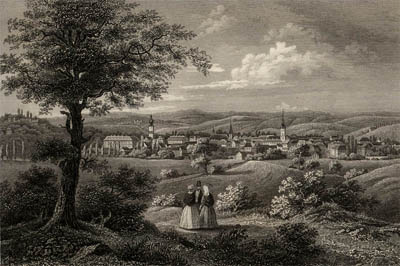
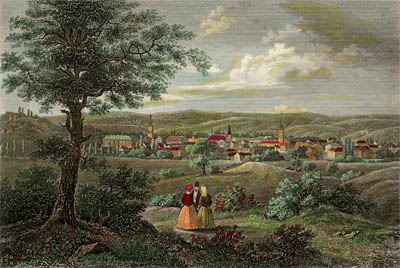
In his visits to Weimar from 1843 to 1863 Berlioz stayed almost invariably at a hotel, and it seems that it was always the Hotel zum Erbprinzen, which he refers to as the ‘Hôtel du Prince éréditaire’. This is specifically attested for January 1843 (CG nos. 801, 803-4, 810), 1852 (CG no. 1529), 1854 (CG nos. 1725, 1739), 1856 (CG nos. 2075, 2091, 2100, 2149) and 1863 (CG no. 2707bis [vol. VIII]), and presumably was also the case in 1855, though it does not seem to be specifically attested. Built in 1749, the hotel was in the central square (Marktplatz or Market Square), but is no longer extant.
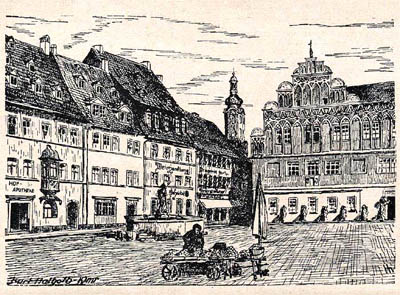
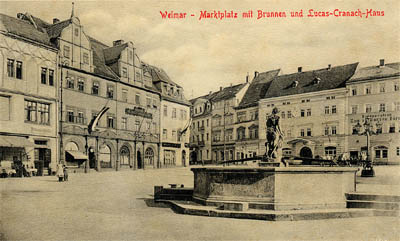
Part of the Erbprinz Hotel is seen at the centre of the picture at the back, to the right of the white building with a flag. See also the large view.

The above picture is a vignette from a postcard, which includes images of a few other sites in Weimar; see the large view of this card.
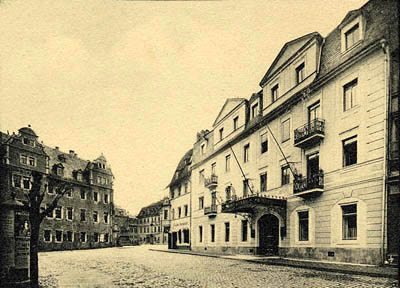
The room is named after Berlioz, but there is no evidence that he stayed in it.
Similarly this room is named after Napoleon, but there is no evidence that he stayed in it.
Located in Market Square, the original Rathaus was destroyed by fire twice and twice rebuilt. The neo-gothic structure of the Town Hall dates from 1841. On 22 November 1852 Berlioz attended here a banquet given in his honour.
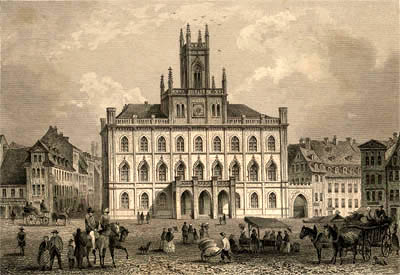
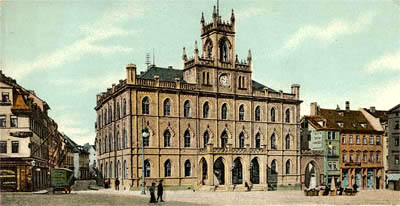
The ducal theatre that Berlioz knew was built in 1825 by Baurat Steiner, which replaced an earlier building, built in 1779, and destroyed by fire. The new theatre, also destroyed by fire in 1906, was rebuilt in a classical style by the architect Max Littmann and opened in 1908. Bombardments by the US Air Force on 9 February 1945 left only the main façade standing; the theatre reopened in 1948. Over the years, the theatre has been called by different names: Hoftheater (1779), Hoftheater Weimar (1825-1907), Nationaltheater (1907), and Deutsche Nationaltheater and Staatskapelle Weimar (1999).
All the performances of Benvenuto Cellini in 1852 and 1856, and the performances of Beatrice and Benedict in 1863, were given in this theatre, as were all the concerts conducted by Berlioz in 1843, 1852, 1855 and 1856, except for two in 1855 and 1856 which took place in the palace. For the performance of the Return to Life on 21 February 1855 the stage had to be adapted for the occasion (CG nos. 1899, 1903). All the performances of Benvenuto Cellini were conducted by Liszt, who was musical director of the theatre from 1848 to 1848; Berlioz regretted that Liszt did not allow him to conduct even a single performance of his opera (CG no. 2104).
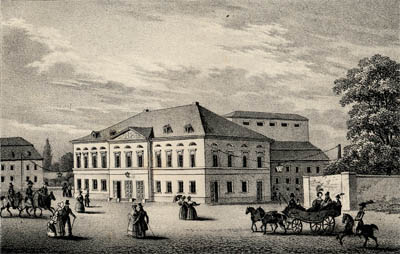
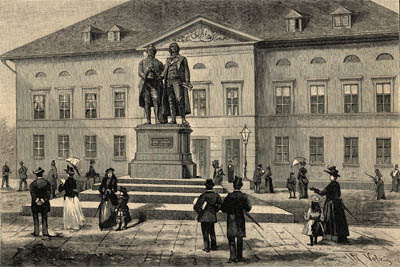
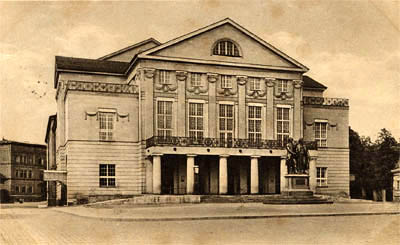
This card was posted on 13 January 1918.
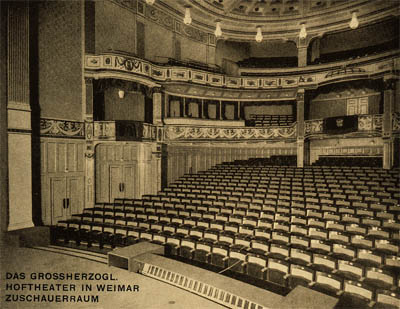
The above photograph by Louis Held, Weimar is reproduced on an
early 20th century postcard.
Berlioz was invited to a number of receptions at the palace of the Grand-Dukes (21 and 22 November 1852; 17 February 1855; 10 April 1863) and will have been a regular visitor to the palace during his stays from 1852 onwards. Two of his concerts were given in the palace itself (17 February 1855; 17 February 1856); he describes the splendid setting and the generous acoustic of the hall in one of his letters (CG no. 1903).
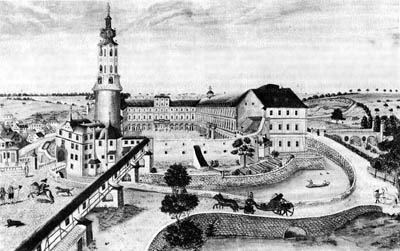
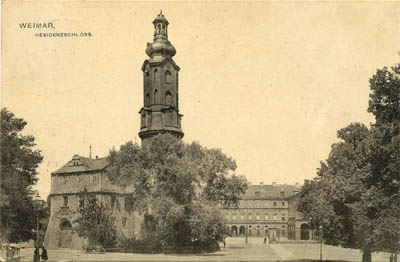
This card was posted on 28 December 1915.
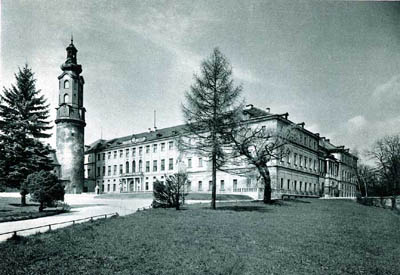
This postcard was issued in 1920.
The Altenburg was built in 1811 by Oberstallmeister Friedrich von Seebach; it was a large house on the slope of a hill just outside Weimar and originally overlooking the town. Liszt and Princess Sayn-Wittgenstein set up house there in 1848, and stayed till 1861.
In Weimar Berlioz normally stayed at a hotel, and stayed only rarely at the Altenburg (cf. CG no. 1445 on his reluctance because of Marie Recio), but he was a very frequent visitor and probably attended a number of receptions there (one of these was on 23 November 1852, another on 18 February 1855). In two letters of 1859 Berlioz looks back with nostalgia to the evenings he spent there (CG nos. 2343, 2390).
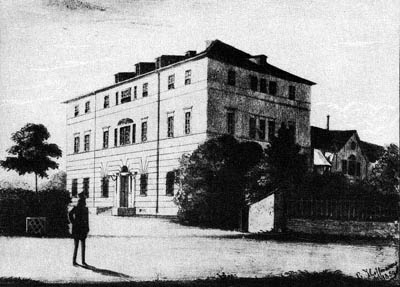
The signature on the original painting reproduced on this picture is dated 1859.
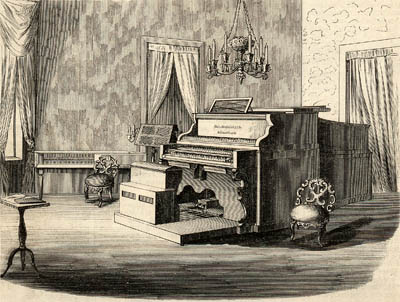
This engraving comes from the Illustrirte Zeitung of 2 June 1855 (no. 622, p. 364), in our collection; it shows the music room on the second floor of the Altenburg. The small keyboard instrument at the back once belonged to Mozart. The large piano was made by Berlioz’s friend the instrument-maker Edouard Alexandre on a specific commission from Liszt. Berlioz acted as an intermediary between the two men and exchanged messages and letters between them. For example, in a letter dated 23 April 1853 (CG no. 1589) Berlioz gives a progress report to Princess Carolyn Sayn-Wittgenstein regarding the design of the instrument:
[…] I saw Alexandre some time ago and he refused to let me see his preparations for Liszt’s instrument; he assured me that I would not be able to make sense of it and could not as yet form any idea of his plan. He is more convinced than ever that he will be successful. The shape of the piano will be that of a normal concert grand, the bottom part of which will be filled up down to the level of the pedals. […]
(See also CG nos. 1556, 1558, 1559, 1568, 1620 and 1624.) In his feuilletons Berlioz refers several times to the triple-keyboard instrument invented by Alexandre, which he refers to as a ‘piano-organ’ and describes in one place as a ‘Liszt-piano’ (see for example Journal des Débats 3 May 1856, 24 September and 14 December 1857).
The Grand-Duke Carl Friedrich of Saxe-Weimar had conferred on Berlioz the order of the White Falcon.

The above card was issued around 1889 by the tobacco company Allen and Ginter, then based at Richmond, Virginia, in the United States. The card is from the N44-The World’s Decorations series of 50 cards; the number of our card is 48.
See also on this site:
Goethe and Schiller in Weimar
Berlioz’s Weimar in our time
Berlioz and Liszt
Berlioz and Wagner
The Hector Berlioz Website was created by Monir Tayeb and Michel Austin on 18 July 1997; the Berlioz in Weimar page was created on 1 February 2008, substantially enlarged on 1 March and 15 July 2012. Revised on 1 April 2024.
© (unless otherwise stated) Monir Tayeb and Michel Austin
 Back to Berlioz in Germany
Back to Home Page