


Unless otherwise stated all pictures on Berlioz Photos pages have been scanned from engravings, paintings, postcards and other publications in our collection. All rights of reproduction reserved.
This page includes portraits or photographs of the following: Heinrich Heine, Émile Deschamps, Hans von Bülow, and Robert Griepenkerl

 Heinrich Heine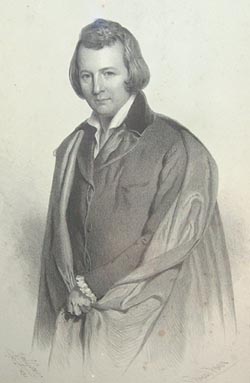
The German poet Heinrich Heine was a friend of Berlioz and memorably called him “a colossal nightingale, a lark the size of an eagle, such as is said to have existed in the primeval world. … There is for me in Berlioz’s music something primitive, if not antediluvian; it sets me thinking of gigantic species of extinct animals, of mammoths, of fabled empires with legendary sins, of many impossibilities piled on top of each other; these magic strains remind us of Babylon, of the hanging gardens of Semiramis, of the wonders of Nineveh, of the daring monuments of Mizraïm, such as we see on the paintings of the Englishman Martin.” (See Berlioz’s Memoirs, Postscript,
and Berlioz on his musical style.)
In his Mmoirs Berlioz addresses to Heine his 6th Letter from his first visit to Germany (1842-1843; in connection with his visits to Brunswick and Hamburg).
Many years later, on one of his visits to Heine, Berlioz writes: ‘Poor Heine! Nailed on his bed for six years by an incurable paralysis, almost blind, he preserves nevertheless his terrible sense of humour. He will not yet consent to die, he says; dear God has to wait. He would like to see first how all this is going to end. He jokes about his enemies, his friends, and even himself. The day before yesterday, when he heard me being introduced, he exclaimed from his bed, in that weak voice of his that seems to emerge from a tomb: « Well, my dear! what, you here! come in. So you have not abandoned me?… You always have to be original! »’
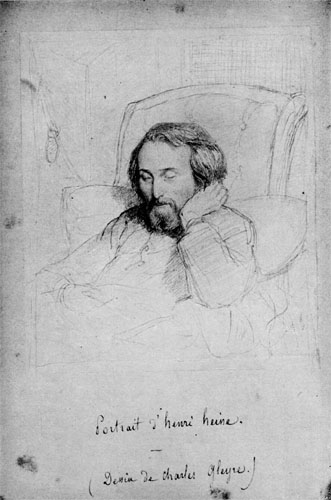
This original pencil drawing is reproduced here courtesy of the Bibliothèque nationale de France.
Heine was born in Düsseldorf and died in Paris. He is buried at Montmartre Cemetery, where Berlioz is also buried.
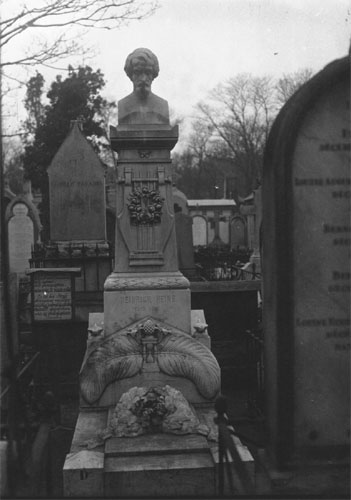
This picture is reproduced here courtesy of the Bibliothèque nationale de France.

Émile Deschamps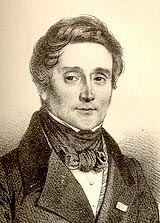
A copy of this picture is in the Bibliothèque nationale de France.
A friend and collaborator, the French poet Émile Deschamps turned Berlioz’s prose into verse for his Dramatic Symphony Roméo et Juliette. In this connection Berlioz writes: “ After a fairly long period of indecision, I settled on the idea of a choral symphony, with vocal solos and choral recitatives, for which Shakespeare’s Romeo and Juliet would provide the sublime but perennially fresh subject. I wrote a prose draft of all the text that was intended for the vocal interludes between the instrumental pieces. Émile Deschamps, obliging as ever, turned this text into verse with the exceptional fluency that is his, and I started work. ” (Memoirs, Chapter 49; see also Romeo and Juliet.). Strophes 2 and 3 of Berlioz’s Le Trébuchet are also by Deschamps.
Hans von Bülow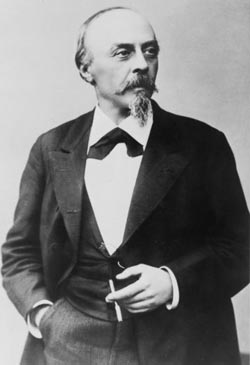
The German conductor, virtuoso pianist, and composer was as a young man a protégé of Liszt whom Berlioz met in Weimar in 1852. He married Liszt’s daughter Cosima, who later left him to marry Wagner in 1870.
Bülow became one of the most active supporters of Berlioz in Germany and continued to champion his music after the composer’s death, though rather selectively; the work of Berlioz that he was most attached to was the opera Benvenuto Cellini, which he had played a major part in revising together with Liszt for the performances in Weimar in 1852 and 1856. In 1879 he revived the opera in Hanover, after which the work became popular in Germany in subsequent decades. See further the page devoted to Hans von Bülow on this site.
Robert Griepenkerl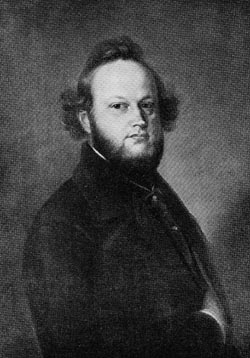
The above portrait has been scanned from our own copy of Ritter Berlioz in Braunschweig (on which see below).
A German critic and writer on music, Griepenkerl became one of Berlioz’s most ardent supporters in Germany from the time of the composer’s first trip there in 1842-3. The two men first met on 9 March 1843 in Brunswick where Berlioz had just given a concert. Brunswick was itself one of the cities in Germany were Berlioz was most warmly received, and he made repeated visits to the city between 1843 and 1856. In 1843 Griepenkerl published a pamphlet entitled Ritter Berlioz in Braunschweig (Sir Berlioz in Brunswick), in which he vigorously defended Berlioz against negative criticism of his music. Berlioz’s relations with Griepenkerl are traced in detail in the page devoted to Berlioz in Brunswick, with citation of a number of letters of Berlioz to Griepenkerl.
© (unless otherwise stated) Monir Tayeb and Michel Austin for all the texts and images on Berlioz Photo Album pages.
All rights of reproduction reserved.


 Photo Album main page