


Unless otherwise stated all pictures on Berlioz Photos page have been scanned from engravings, paintings, postcards and other publications in our collection. All rights of reproduction reserved.
This page contains images of the following writers and poets: Virgil, Shakespeare, Byron, and Thomas Moore.

 Virgil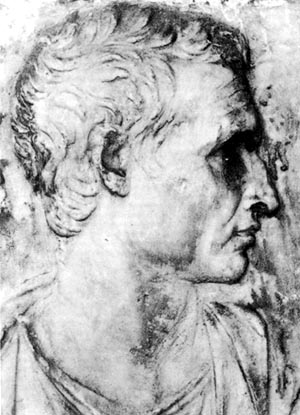
The above picture shows a Roman relief from the Villa Medici in Rome, and was probably known to Berlioz when he was a resident there in 1831-1832 as a Prix de Rome laureate.
Berlioz read Virgil in the original Latin as a boy as part of his education by his father. His epic opera Les Troyens was the culmination of his life-long admiration for the Roman poet, whose works he knew intimately as evidenced by frequent citations or allusions in his writings. The opera is dedicated to Virgil and Princess Carolyne von Sayn-Wittgenstein. See also on this site Berlioz and the Classics in paintings: The Trojans (1) The Trojans (2)
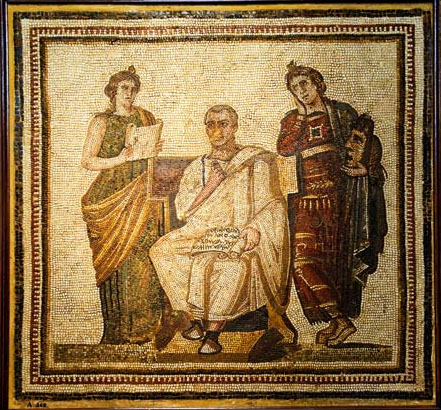
Virgil (centre) holding a scroll with a quotation from the Aeneid and flanked by the muses Clio and Melpomene, mosaic, early 3rd century AD; in the Bardo National Museum, Tunis, Tunisia. The above picture and its description are reproduced here courtesy of Encyclopaedia Britannica.

Shakespeare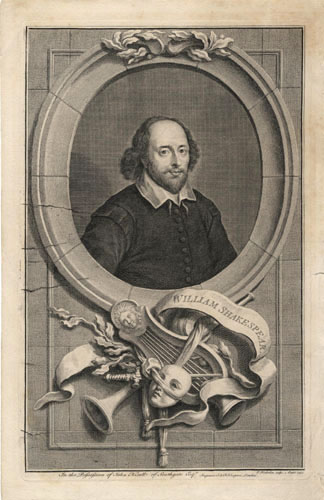
No other great composer has been so influenced by Shakespeare as Berlioz, and none has known his works so closely as he did, as countless references in all his writings show. He discovered Shakespeare when he saw Hamlet and Romeo and Juliet at the Odéon Theatre in Paris in 1827. His future wife Harriet Smithson played the title role in both plays. His discovery of Shakespeare prompted him to start learning English to be able to read Shakespeare in the original. Many of Berlioz’s compositions were inspired by Shakespeare’s plays: the Overture La Tempête, which was later incorporated in le Retour à la vie, the overture Le Roi Lear, the dramatic symphony Roméo et Juliette, the Marche Funèbre pour la dernière scène d’Hamlet, the ballade La Mort d’Ophélie, the comic opera Béatrice et Bénédict. Berlioz himself described the opera Les Troyens as ‘Virgil shakespeareanised’. — The above original 1747 engraving has been donated by us to the Musée Hector Berlioz.
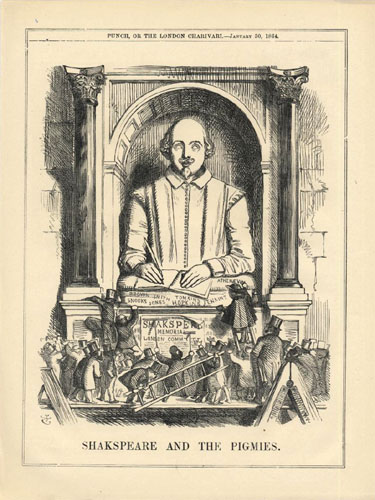
This cartoon, a copy of which is in our own collection, was published in 1864 in the weekly satirical magazine Punch, known as the London Charivari. The cartoon is by the British illustrator and political cartoonist John Tenniel (1820-1914). It reflects on continuing anxieties and disagreements regarding the arrangements for the national Shakespeare Tercentenary celebrations, and the erection of a fitting memorial to Shakespeare in London.
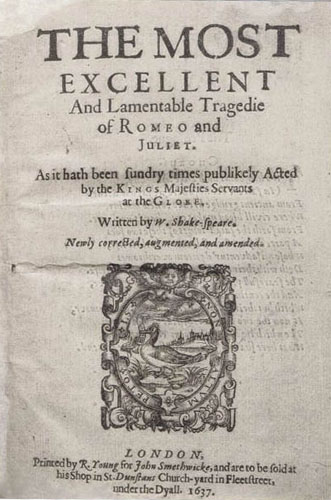
The above facsimile is in our collection.
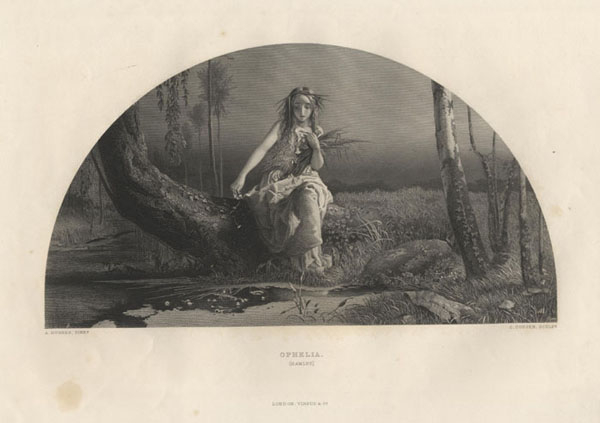
This 1876 engraving, by Charles Cousen (1819 – 1889) after a painting by Arthur Hughes (1832 – 1915), was published in London by Virture & Co. It is in our collection. — See also a Portrait of Shakespeare by Haydn Greenway; and elsewhere on the site other works of art inspired by Shakespeare’s plays: Hamlet, Romeo and Juliet, King Lear and The Tempest.
Byron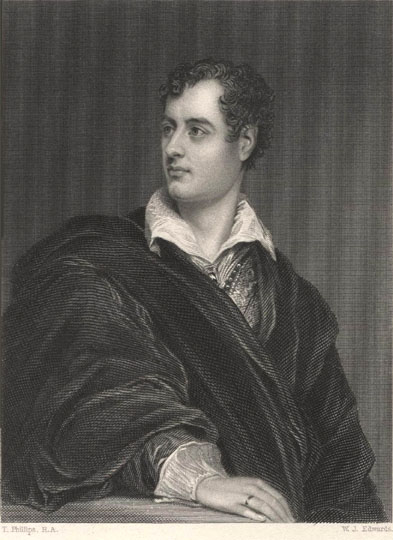
The above 1835 engraving is by W. J. Edwards, after T[homas] Phillips; we have donated it from our collection to the Musée Hector-Berlioz.
As early as 1828 Berlioz was an avid reader of Byron and identified with him; he was delighted to be told by a musician that the was ‘the Byron of music’ and that his Francs-Juges overture was ‘a Childe-Harold’ (CG no. 94, 28 June 1828). During his trip to Italy as Prix de Rome laureate he was very conscious of following in Byron’s footsteps. On the ship sailing from Marseille to Livorno in 1831 he was intrigued to meet a Venetian who claimed to have commanded Byron’s ship (Memoirs chapter 32); during the heat of summer he would read Byron’s The Corsair in a corner of St Peter’s in Rome (Memoirs chapter 36). But, he assured his family, his own passion for travel did not mean that he wanted merely to emulate Byron (CG no. 238, 7 August 1831). The earliest musical result of his Italian trip was the symphony Harold en Italie, in which the solo viola is ‘a kind of melancholy dreamer in the manner of Byron’s Childe-Harold’ (Memoirs chapter 45). Another connection with Byron and Italy was the overture Le Corsaire (first composed in Nice in 1844 but extensively revised later), the title of which looks back to Byron’s The Corsair which he had read in Rome in 1831. — See also Berlioz: Byron and Gautier on this site.
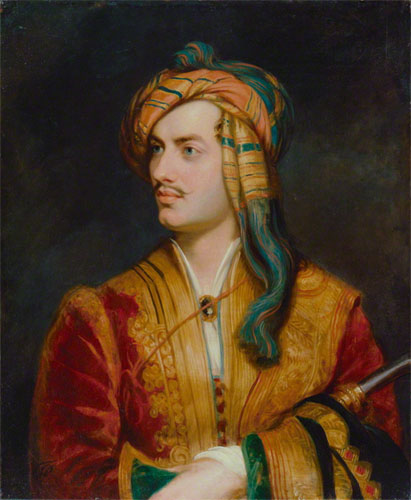
The above replica of a painting by Thomas Phillips circa 1835 (1813) shows Byron in Albanian dress; the original copy is in the National Portrait Gallery, London.
Thomas Moore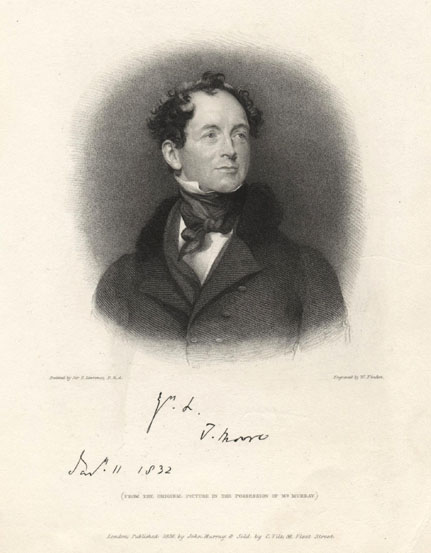
The above portrait was painted by Sir T. Lawrence, P.R.A., engraved by W. Finden, and was signed and dated in 1832; it was published in 1836 in London by John Murray and sold by C. Tilt at 86 Fleet Street. We have donated this copy from our collection to the Musée Hector-Berlioz.
Berlioz discovered early the poems of Thomas Moore, around 1825-1826 when he was staying at rue de Harlay; he conceived a deep affection for Moore’s poetry which endured throughout his life. It is noticeable how frequently Moore’s name, and citations from his poems, recur in the Memoirs; see especially chapters 11, 12, 18, 29, 39 (end), 59 and the concluding Voyage en Dauphiné, in which he cites in translation a poem by Moore which best rendered the feelings he experienced after meeting again Estelle Fornier in September 1864 in Lyon, for the first time in over 30 years. He himself set to music in 1829 a series of poems of Moore under the title Neuf Mélodies, later called Irlande, and during his stay in Italy in 1831-1832 Méditation religieuse, which later became the first of the three pieces collected as Tristia. He also composed in Italy Le Retour à la vie, in which he says the style of the monologues was influenced by Thomas Moore (CG no. 231).
© (unless otherwise stated) Monir Tayeb and Michel Austin for all the texts and images on Berlioz Photo Album pages.
All rights of reproduction reserved.


 Photo Album main page