


This page is also available in French

 Introduction
In his first report on the musical institutions of London, which he first published in the Journal des Débats on 31 May 1851 (pp. 1-2) and reproduced the following year in the Soirées de l’orchestre (21st evening), Berlioz writes as follows:
In London there are also several quartet and chamber music societies, the most active of which bears today the name of The Musical Union. It was founded by M. Ella*, a distinguished English musician, who directs it with a care, intelligence and dedication that are beyond all praise. The aim of the Musical Union is not exclusively the promotion of quartets, but of all fine instrumental compositions for salons, to which are added sometimes a few vocal pieces, almost always belonging to the productions of the German school. Though a talented violinist himself, M. Ella modestly restricts his role to that of organiser and director of these concerts without participating in them as performer. He prefers to associate to the best players in London the most celebrated foreign players who happen to be passing there. This year to MM. Oury and Piatti he has thus added Léonard, Vieuxtemps, Mlle Clauss, Mme Pleyel, Sivori and Bottesini. The public is very satisfied with a system which provides it simultaneously with excellence in performance and a variety of styles which could not be obtained by staying always with the same players. M. Ella does not merely devote his care to the performance of the masterpieces that are on the programme of these concerts, he also wants the public to appreciate and understand them. The programme of each matinée is therefore sent in advance to the subscribers, and it contains a synoptic analysis of the trios, quartets and quintets which are to be heard. The analysis is in general very well done, and speaks at once to the eyes and to the mind: the critical text is supplemented with musical examples on one or more staves which show either the theme of each piece, or the figure that plays an important part in it, or the most remarkable modulations it contains. It would not be possible to show more care or devotion. As a motto for his programmes M. Ella has adopted the following epigram in French, which he took from the lips of the erudite professor Baillot, the good sense and truth of which is unfortunately not appreciated in this country: « Il ne suffit pas que l’artiste soit bien préparé pour le public, il faut aussi que le public le soit à ce qu’on va lui faire entendre. » [It is not enough for the artist to be well prepared for the public, the public must also be well prepared for what it is about to hear]
* Note: The letter M. used by Berlioz before John Ella’s name is an abbreviation for Monsieur [Mr.].
The Musical Union, which used to hold their matinées in Willis’s Rooms, was founded in 1845 by John Ella (1802-1888), an early supporter of Berlioz and one of his closest friends in London. It continued until 1880 and enjoyed the patronage of the Prince Consort. It consisted of a series of eight afternoon concerts every year and for a long time offered almost the only opportunity of hearing chamber music in London’s West End. The Musical Union’s concerts were first held at the Willis’s Rooms in King Street, St James’s, and when St James’s Hall was built in 1858 they moved there and carried on until 1880 (Ganz [1913] pp. 110-13). Charles Hallé was one of the many musicians who performed there (cf. Correspondance Générale no. 2142, a letter from Ella to Berlioz, 24 June 1856), and he mentions the Musical Union in his reminiscences (Hallé [1896] pp. 103-4, 112-13). See also the recollections of James Davison, reproduced in Davison (1912), pp. 80-2, 231-4, 277-8.

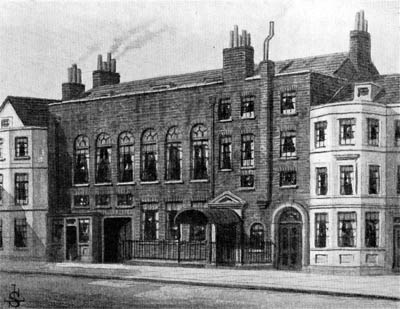
Willis’s RoomsOn 7 April 1848 Berlioz conducted in Willis’s Rooms his Hungarian March from La Damnation de Faust, in response to an invitation by the then new Amateur Musical Society, and the performance of this piece which had become very popular in London was a great success (Ganz [1950] p. 58).
The origin of Willis’s Rooms can be traced to William Almack’s Assembly Rooms which opened in 1765 in King Street, St James’s. According to Edward Walford (Old and New London, 1897, cited in Elkin, 1955, p. 75), the Assembly Rooms consisted of a large ballroom decorated with columns and pilasters, classic medallions and mirrors, and two spacious apartments on either side of a vestibule on the top of a great staircase. These apartments were occasionally used for large suppers or dinners.
On Almack’s death in 1781 the rooms became the property of his niece Mrs Willis, and were thereafter called Willis’s Rooms. The rooms were let for other purposes besides music. For instance Charles Kemble, who along with Harriet Smithson and other members of the English theatre company performed Shakespeare plays at the Théâtre de l’Odéon in Paris in 1827, had Readings from Shakespeare sessions in Willis’s Rooms in 1844.
The rooms ceased to exist as such in 1890. Part of the premises became a restaurant and part of them was occupied by a firm of auctioneers. The building suffered damages in 1940 and was completely destroyed in the 1944 bombardments.
(For further details on Willis’s Rooms and their history see our source: Elkin, 1955.)
Willis’s Rooms and the Musical Union in picturesUnless otherwise stated, the pictures on this page have been scanned from the book by Elkin cited above, in our collection. © Monir Tayeb and Michel Austin. All rights of reproduction reserved.
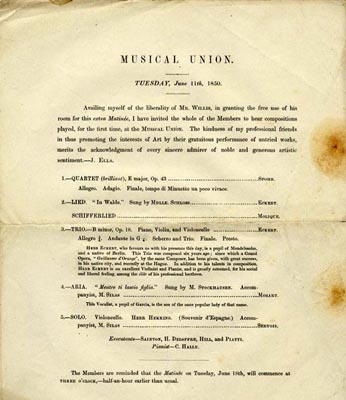
We are most grateful to Mr. Raymond E. O. Ella, for sending us electronic copies of the concert programme of 16 June 1846, the “Musical Union in 1846”, the concert programme of 11 June 1850 and the “Anniversary Dinner” in 1879, and the related information. See also on this site an article by Mr. Ella, entitled John Ella, musician, born Leicester 1802, died London 1888: His Family History.
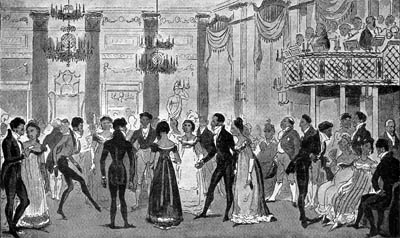
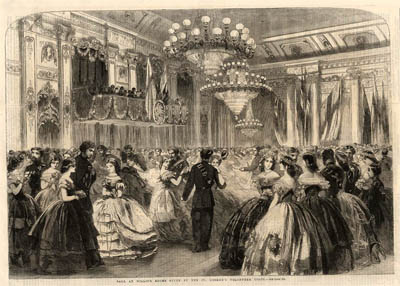
The above picture was published in The Illustrated London News of 30 March 1861, a copy of which is in our collection.
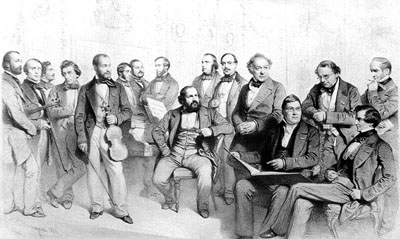
The picture below is a lithograph made in 1853 after a drawing by Charles Baugniet (1814-1886). The lithograph was sold in those days under the title of ‘L’Analyse. Souvenir of the Musical Union (Ninth Season)’ and shows from right to left: Ella, Berlioz, Molique, Spohr, Lindpaintner, Baumann, Barret, Hiller, Jarrett, Pratten, Lazarus, Vieuxtemps, Blumenthal, Goffrié, Blagrove and Bazzini. At the time that this picture was drawn Berlioz was in London to stage his Benvenuto Cellini at the Opera in Covent Garden. Ferdinand Hiller, a friend of Berlioz since his student days at the Paris Conservatoire, was present at the only performance of the opera on 25 June 1853. See Theatre Royal Covent Garden for details of that eventful evening.
We are most grateful to Mike Joyce for sending us this photograph taken by him from an original engraving he found in London in the early 1970s, and to Gunther Braam for identifying its date, those present in it and other details on its provenance.
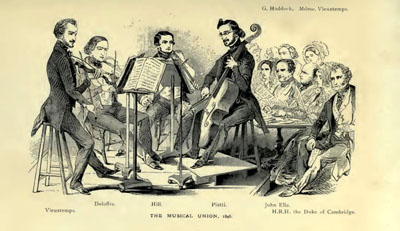
The above engraving was published in G. Haddock, Some Musical Recollections of G. Haddock (Schott & Co., London, 1906), page 75.
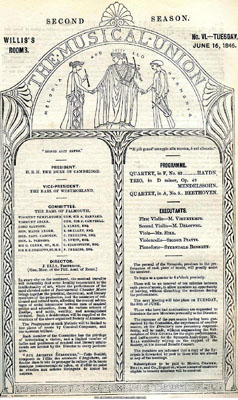
At the “Meeting”, which took place in Willis’s Rooms, Haydn’s Quartet in F, No. 82, Mendelssohn’s Trio in D minor, op. 49, and Beethoven’s Quartet in A, op. 18 No. 5 were performed. The performers were: ‘M. Vieuxtemps (first violin), M. Deloffre (second violin), Mr. Hill (viola), Signor Piatti (violoncello) and Sterndale Bennett (pianoforte)’.
Here is the transcription of the text in the lower half of the concert programme [in mixed languages, English and French] :
|
|
|
|
In every city on the continent, the musical traveller will invariably find some locality consecrated to the intellectuality of art, where the performance of the most elevated order of Instrumental Chamber Music brings together the practical, theoretical, and literary members of the profession, and the amateurs of cultivated and refined taste, affording the mutual advantages of social intercourse between men of musical genius and education, from the various schools of Europe, and noble, wealthy, and accomplished virtuosi. Such a desideratum will be supplied at the réunion of the above organized Society of Amateurs. The Programme at each Matinée will be limited to two pieces of music by Classical Composers, and one morceau brilliant. Each member of the Committee has the privilege of introducing a visitor, and a limited number of ladies and gentlemen of musical and literary attainments are invited by the Director to every performance. “AUX ARTISTES ÉTRANGERS.” — Cette Société, composée de l’élite des amateurs d’Angleterre, est fondée dans le bût (sic) de propager la culture de la haute musique instrumentale de salon, et d’offrir un point de réunion aux artistes distingués de toutes les nations. |
The perusal of the Synopsis, previous to the performance of each piece of music, will greatly assist the amateur. To begin at a quarter to 4 o’clock precisely. There will be an interval of ten minutes between each piece of music, to allow members an opportunity of leaving, without disturbing the audience during the performances. The next Meeting will take place on TUESDAY, the 30th of JUNE. Those who have had nominations are requested to introduce the new Members personally to the Director. The expenses of the past season having been guaranteed by the Committee, the experiment of another season, on the Director’s own pecuniary responsibility, will be made, without augmenting the Subscription of ONE GUINEA for the eight performances, and half-a-crown for the Synopsis Analytique; Mr. Ella confidently relying on the support of the Society, at his Annual Benefit Concert. The members are informed that a copy of the Synopsis is forwarded by post to those who are absent at any of the meetings. Subscriptions to be paid to Messrs. CRAMER, BEALE, and Co., Regent-st., where names of amateurs eligible to become members will be received. |
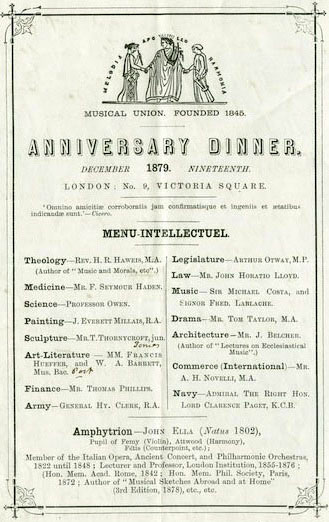
The anniversary dinner in 1879 was also John Ella’s 77th birthday and the 35th anniversary of his musical union – it was to last just another year (1880) and he retired in poor health and vision.
© (unless otherwise stated) Monir Tayeb and Michel Austin for the picture and information on this page. All rights of reproduction reserved.
Copyright notice: The texts, photos, images and musical scores on all pages of this site are covered by UK Law and International Law. All rights of publication or reproduction of this material in any form, including Web page use, are reserved. Their use without our explicit permission is illegal.
 Back to Berlioz in London main page